

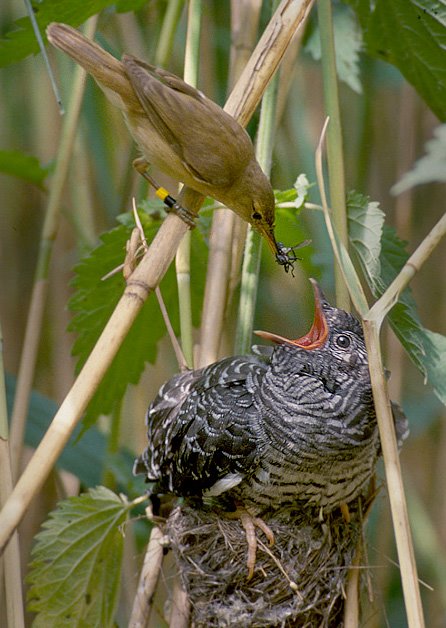
Play a certain grating, drawn-out call near a nesting bird and something specific happens. Neighbors drop what they are doing and converge on the sound. They are not coming to help with a hawk or a snake. They are coming because a cuckoo, or some other egg-dumping impostor, has been spotted near a nest. And here is the strange part: a warbler in China and a wren in Australia and a bird in Argentina all make roughly the same call for the job, despite last sharing an ancestor around 53 million years ago.
That is the finding from a large international team led by William Feeney, published in Nature Ecology & Evolution. The researchers were chasing an old idea from Darwin, who wondered whether learned communication (like human language) might have grown out of older, innate signals rather than appearing from nowhere. Brood parasites turned out to be a good place to test it.
One sound, many hosts
Brood parasites are birds that lay their eggs in other species' nests and let the unwitting foster parents do the work. Common cuckoos are the famous example. For the host, getting parasitized is a disaster: the intruder's chick often hatches first and shoves out the real eggs. So hosts have every reason to sound an alarm when they see one lurking.
The team documented what they call a "whining" vocalization in 21 bird species. These species are scattered across the avian family tree, separated by tens of millions of years, yet their whines are structurally similar. The researchers also noticed a pattern in where the call shows up. Species that produce it tend to live in places with dense parasite-host networks, the tangled webs of who parasitizes whom. That hints the call is not just a private warning but something that helps different host species coordinate against a shared threat.
Testing what the call means
Documenting a shared sound is one thing. Showing it carries meaning is harder. The group ran playback experiments across three continents to check whether the whine is referential, meaning it points to a specific thing in the world the way a word does, rather than just signaling generic alarm.
It passed. In multiple host species, hearing the whine triggered a fast recruiting response, birds gathering to the source. And the response held even across enormous evolutionary distances. Host species from different continents reacted the same way to each other's whines, birds that had never encountered one another and whose lineages split long ago. Hearing the sound produced an innate reaction, no learning required on the listener's end.
That combination is the interesting bit. Producing the call in the right situation, when a parasite actually appears, seems to be learned. But the response it triggers in listeners is built in. The authors describe it as an intermediate between a purely innate signal and a fully learned one, a kind of halfway house between the two categories that communication is usually sorted into.
Why it matters, and what it doesn't settle
The result lends real evidence to Darwin's hunch. If an innate response can anchor a signal whose use is learned, you have a plausible bridge between reflexive animal calls and the flexible, learned systems that culminate in language. The finding also reframes anti-parasite defense as something that can span species. A cooperative alarm shared across a whole community of hosts is a more powerful deterrent than any single species going it alone.
Some caution is in order. This is one call type in one ecological context, birds defending against brood parasites, and stretching it toward the origins of human language is a long reach that the study itself does not claim to complete. Convergence across 21 species is striking, but "structurally similar" leaves room for real variation that field recordings can smooth over. The link between the call and dense host-parasite networks is a correlation, and correlations can hide other explanations. And playback experiments capture a snapshot of behavior, not the developmental path by which a young bird learns when to whine.
Still, the core observation is hard to shrug off. Distantly related birds on separate continents converged on nearly the same sound to name the same enemy, and that sound reliably summons a crowd. For a group of animals defending against a parasite that has been fooling them for millions of years, that shared vocabulary looks like one of evolution's more elegant answers.
Feeney, W. E. et al. "Learned use of an innate sound-meaning association in birds." Nature Ecology & Evolution, 2025. doi.org/10.1038/s41559-025-02855-9
PubMed PMID: 41044184.
Photograph: Per Harald Olsen, CC BY-SA 3.0, via Wikimedia Commons.
Comments