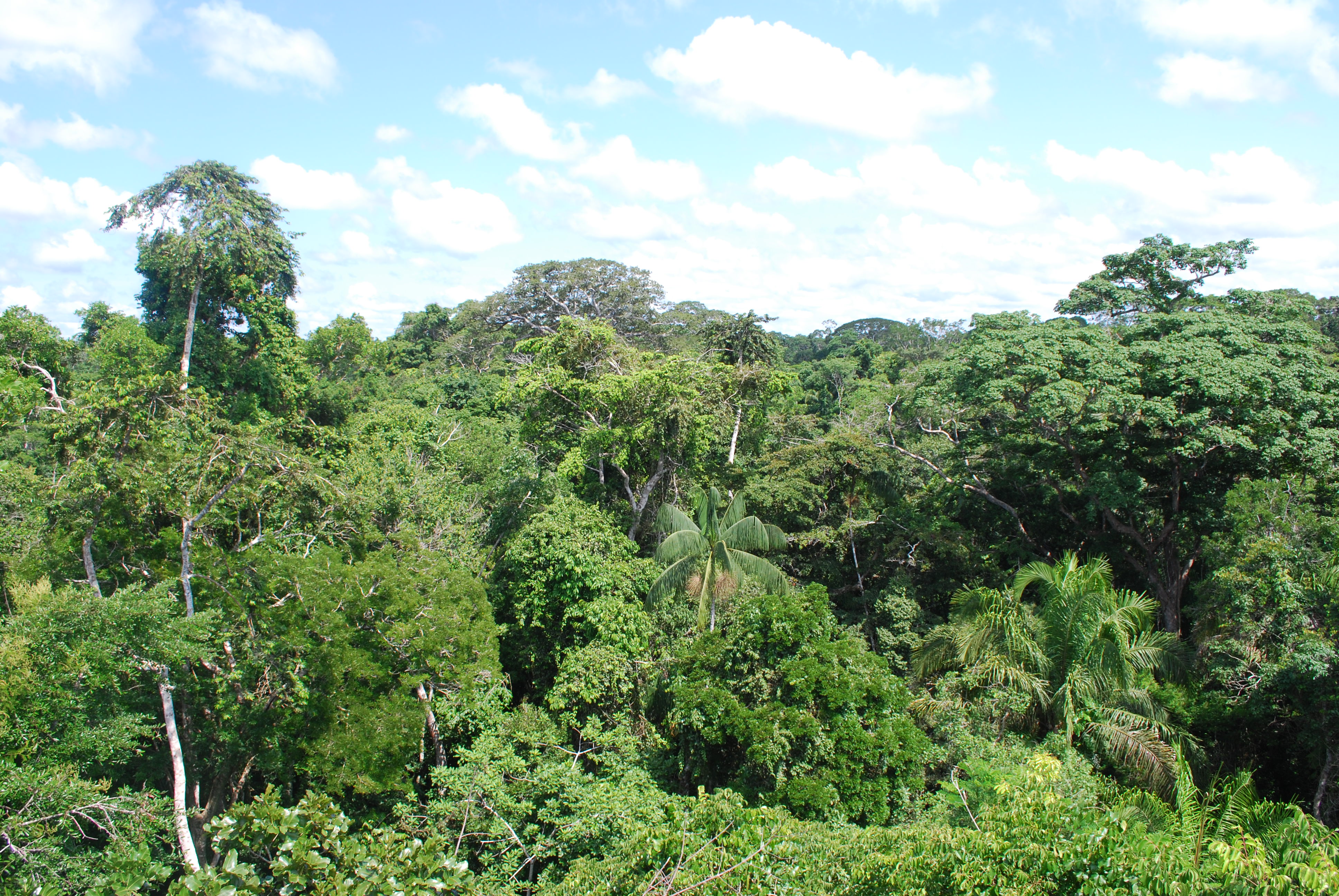
Walk into the same patch of Amazon rainforest today that a botanist measured in the early 1990s, wrap a tape around the trunks, and the numbers come out bigger. Not because someone planted new giants. The trees that were already standing have been quietly bulking up, decade after decade, across nearly the entire basin.
That is the finding from a new study in Nature Plants led by Adriane Esquivel-Muelbert and a large network of forest researchers. They pulled together 30 years of records from 188 mature forest plots scattered across Amazonia, tracking how the physical structure of the forest has shifted. The headline measure is basal area, which is essentially the total cross-sectional area of wood you would see if you sliced every trunk at chest height. At the stand level, it rose by 3.3% per decade, with a 95% confidence interval running from 2.4% to 4.1%.
That may sound modest. Over three decades it adds up to a meaningful thickening of the world's largest tropical forest, and it held up plot after plot, region after region.
Big trees won, but the small ones did not lose
The obvious guess is that the biggest trees simply ran away with the gains. They sit at the top of the canopy, soak up the most light, and if there is extra carbon dioxide floating around to fuel photosynthesis, they are best positioned to use it. The data partly support that. Large trees increased in both number and size.
But the story has a second half. When the team looked at relative size gains, big trees and small trees grew at similar rates. Small understory trees, the ones usually stuck in deep shade and barely hanging on, were also doing better than expected. One reading is that their light compensation point, the threshold at which a tree earns more energy from photosynthesis than it burns just staying alive, has shifted in their favor. So the forest is not just a case of the rich getting richer. The whole size distribution has been drifting upward.
Why does that matter beyond forestry bookkeeping? Bigger trees hold more carbon. A forest that is packing on woody mass is pulling carbon out of the atmosphere and locking it into trunks and branches. Understanding whether that trend is speeding up, holding steady, or about to reverse is central to any honest forecast of where atmospheric carbon is headed.
A tug-of-war the forest is still winning
The Amazon has been living through decades of rising temperatures and harsher droughts, and plenty of research has documented trees dying because of it. So how do you square that with forests getting structurally bigger?
The authors frame it as a balance of opposing forces. On one side, extra resources: carbon dioxide fertilization, and in places nitrogen deposition, giving trees more raw material to build tissue. On the other side, the stresses of a hotter, drier climate that hit large trees especially hard, since they have the most surface area to lose water from and the longest plumbing to keep supplied. The steady, consistent increase in tree size across so many plots suggests that, at least up to now, the boost from added resources has been outrunning the drag from climate stress.
Note the phrase "up to now." This is a measurement of what has already happened, not a promise about the future.
What the numbers can and cannot say
A few limits are worth keeping in front of you. The study documents a pattern and links it to plausible drivers, but it is an observational analysis of forest plots, not a controlled experiment that isolates carbon dioxide as the cause. The researchers infer the resource-driven explanation because it fits the structure of the data, not because they dialed CO2 up and down and watched the response.
The trend is also an average across a huge, varied region. Some plots and some communities will not match it, and a basin-wide mean can hide places where drought is already winning. And a mitigating effect that has held for 30 years is not guaranteed to hold for the next 30. Fertilization effects can saturate as other nutrients run short, while heat and drought are still intensifying. The forest's current advantage could narrow.
For now, though, the measurement stands on its own. Across three decades and 188 plots, Amazonian trees have been getting bigger, and the consistency of that signal is hard to wave away.
Esquivel-Muelbert, A. et al. "Increasing tree size across Amazonia." Nature Plants, 2025. doi.org/10.1038/s41477-025-02097-4
PubMed PMID: 40999006.
Photograph: Ivan Mlinaric, CC BY 2.0, via Wikimedia Commons.
Comments