


Identifying the gene behind a rare disease is no longer the hard part. Sequencing finds the variant; the difficulty is knowing what it does, because a single gene can be broken in ways that point in opposite directions. For a gene whose job is to set how much neurotransmitter a synapse releases, that distinction is not academic. Too little release and too much release are both pathological, and a treatment that corrects one would worsen the other.
A consortium spanning more than sixty centres, coordinated from Zurich, Göttingen and Berlin, has now described a neurodevelopmental syndrome caused by variants in UNC13A, the gene encoding that presynaptic regulator. The clinical picture is broad: developmental delay and intellectual disability of varying severity, seizures of several types, tremor and dyskinetic movements, and in some children death in early childhood. What makes the work unusual is that the patients were not only catalogued but sorted, by what their variants actually do to a synapse.
Why it matters: Sorting a rare syndrome into mechanistic subtypes is what turns a diagnosis into a treatment plan, because the subtypes here require corrections in opposite directions.
The study, by Asadollahi et al., appears in Nature Genetics. Each variant was expressed in mouse hippocampal neurons and in the nematode Caenorhabditis elegans, and the synaptic consequence measured directly rather than predicted from sequence.
Three ways to break the same gene
The assays returned three distinct defects. Some variants reduce the amount of functional protein, weakening synaptic transmission. Others are gain-of-function, increasing neurotransmission. A third group leaves release intact but disrupts its regulation by second messenger signalling, so the synapse responds but no longer adjusts.
These map onto clinical types the authors label A to C, and the correlation between genotype, function and phenotype is what gives the classification weight. Type A covers full or partial loss of protein, arising from biallelic missense, splice-site and nonsense variants. It is the most severe: profound global developmental delay in every case, seizures beginning early, and in some children death from respiratory failure following pneumonia. All patients develop early-onset seizures.
The clinical logic of the other types follows the biology. A synapse that releases too much is not a milder version of one that releases too little; it is a different disorder that happens to share a gene. Treating them as one condition, which is what a gene-level diagnosis alone encourages, would be a mistake with a direction.
A quantitative target, which is rare
The most immediately useful output is a number. Combining their own patients with previously reported cases of complete protein loss, the authors conclude: we propose that therapeutic strategies that stabilize 20 to 30% of normal expression may already be beneficial. They also bound the target from above, noting that Given that UNC13A haploinsufficiency appears to be tolerated in humans and in mice, restoring expression toward half of normal should be sufficient.
A floor and a ceiling are more actionable than a gene name. Antisense oligonucleotide drugs, several of which are already approved for other neurological conditions, work by adjusting how much protein a gene produces, and a therapy of that class needs exactly this: how much is enough, and how much is too much. The window applies only to the loss-of-function subtype, which is the point of having subtypes at all.
What the study can't say yet
The therapeutic window is inferred, not tested. It comes from comparing people who carry one working copy and are healthy against people with none who die young, which is human genetics doing the work of a dose-finding study. No patient received a treatment here, and nothing establishes that restoring expression after birth reverses damage that accrued during development. A gene this central to synaptic function is likely to matter most while circuits are forming.
The functional assays also sit at a distance from the patients. Variants were expressed in mouse neurons and in a nematode, systems chosen because the effect on release can be measured precisely. Neither is a human brain, and a variant's effect can depend on the cellular context it sits in.
Rare-disease cohorts are assembled from the patients who reach genetic services, which skews toward severe presentations. Milder cases are the ones most likely to be missing, so the described spectrum probably runs more severe than the true one, and the subtype proportions should not be read as population frequencies.
The subtypes themselves are a first classification drawn from a modest number of patients per group, and boundaries defined on the same data that generated them tend to soften with more cases. The gain-of-function and regulatory types in particular are defined by fewer patients than the loss-of-function type.
One further thread is left open. Common non-coding variants in this same gene are established risk factors for amyotrophic lateral sclerosis, a late-onset degenerative disease. Whether a gene that causes a childhood synaptic syndrome when coding sequence is disrupted, and modifies adult neurodegeneration when regulatory sequence is, reflects one underlying vulnerability is not addressed here. The conclusion the authors do draw is narrower: We conclude that the precise regulation of neurotransmitter release by UNC13A is critical for human nervous system function.
Quick questions
What does this gene do? Its protein prepares neurotransmitter-filled vesicles for release at the synapse, setting how strong a signal is and how it changes with repeated firing. Without it, synapses cannot release on cue.
Why does the subtype matter for treatment? Because the corrections point opposite ways. Raising protein levels should help a child whose variants reduce it and could plausibly harm one whose variants already cause excess release.
What's the one-line takeaway? Variants in a single presynaptic gene cause a newly described childhood syndrome through three distinct synaptic defects, and the authors put a rough therapeutic window on the commonest one: above roughly a fifth of normal protein, and no more than half.
Asadollahi R, Ahmad A, Boonsawat P, et al. "Pathogenic UNC13A variants cause a neurodevelopmental syndrome by impairing synaptic function." Nature Genetics, 2025;57(11):2691-2704. doi.org/10.1038/s41588-025-02361-5
PubMed PMID: 41125872.
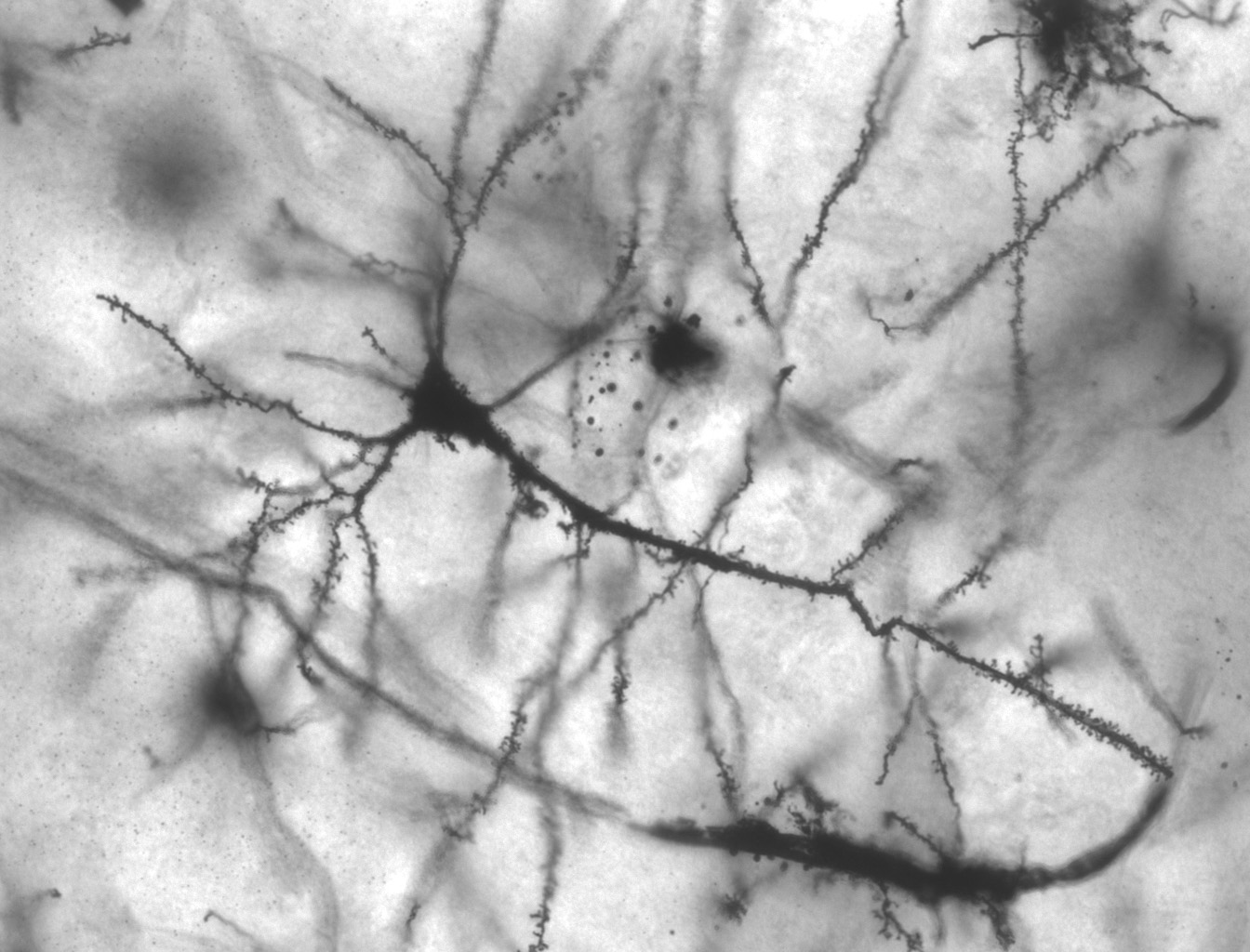
Image: cultured neurons. Via Wikimedia Commons.
Comments