


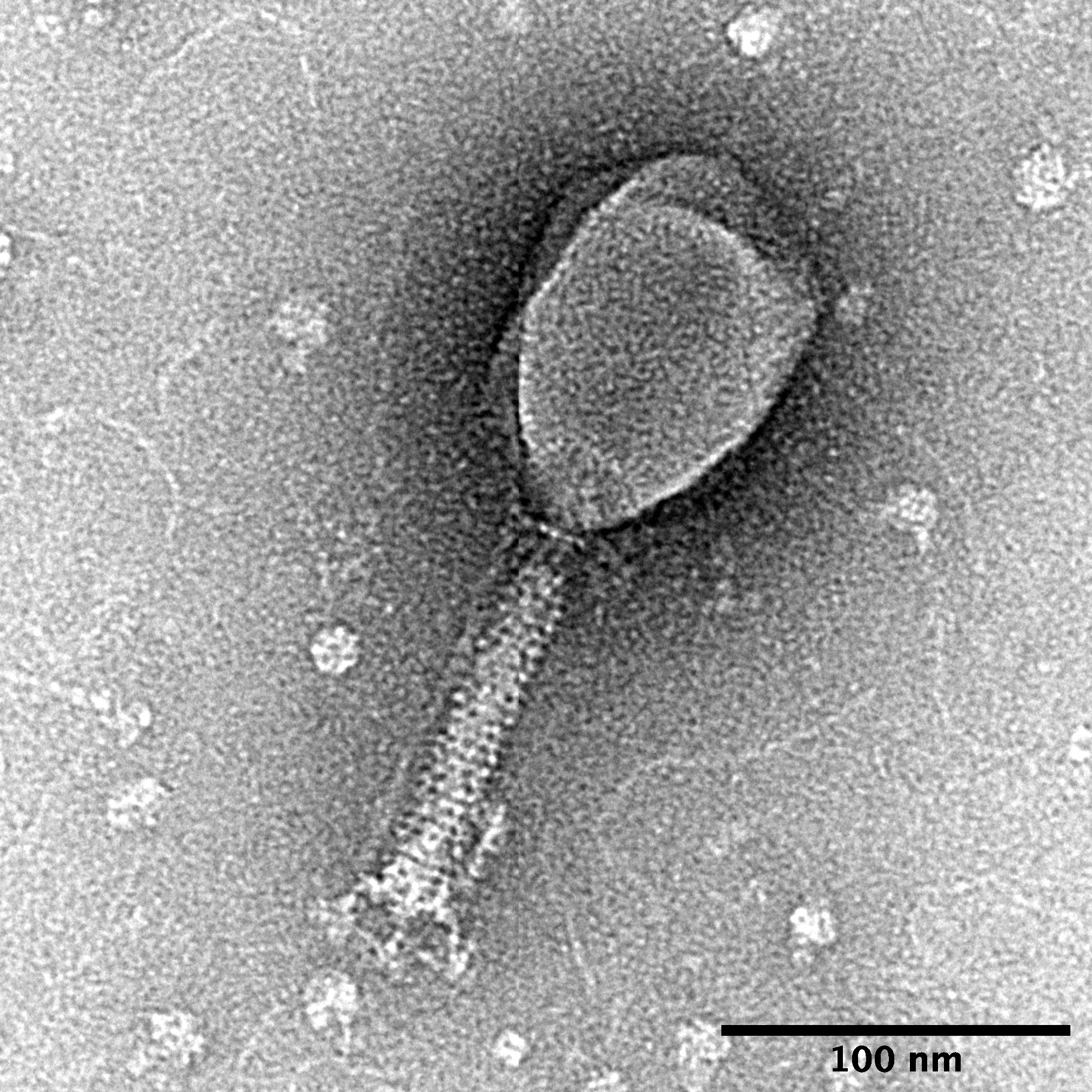
A bacteriophage does not break into a cell so much as inject itself, one strand at a time. It docks onto the bacterial surface and pushes its DNA through a narrow channel, threading the genome across the membrane like cotton through the eye of a needle. That threading moment is a vulnerability. The DNA is stretched out, exposed, and moving in a single predictable direction. A group at MIT has now found a bacterial defense system that waits for exactly that moment and cuts the incoming genome apart before it can finish arriving.
According to PubMed, the work appears in Nature from Daniel Saxton and colleagues in the laboratory of Michael Laub. They call the system SNIPE. It sits constitutively in the inner membrane of Escherichia coli, and in their experiments it blocked infection by phage lambda, one of the most studied viruses in biology.
Catching DNA in the act of entering
Most bacterial immune systems that chop up viral DNA face the same basic problem: how do you cut the invader without cutting yourself? CRISPR-Cas solves it by memorizing short viral sequences. Restriction-modification systems solve it by tagging the host's own DNA with chemical marks, so anything unmarked gets destroyed. Both strategies read the DNA itself to decide friend from foe.
SNIPE does something different. It does not seem to care what the phage DNA says. Instead, the researchers tracked radiolabelled phage genomes and watched infections unfold under time-lapse microscopy, and the picture that emerged is one of timing and location rather than sequence. SNIPE cleaves the phage DNA specifically as it is being injected. The team used proximity labelling to map what SNIPE sits next to inside the cell, and found it associated with host proteins that the phage hijacks to get its genome across the inner membrane. It also latched onto the phage's own tape measure protein, a structural component threaded through the injection channel that helps ferry the DNA inside.
That is the clever part. By parking itself at the injection site and grabbing the machinery of entry, SNIPE guarantees that the only DNA nearby is foreign. The bacterium's own chromosome is never being pushed across the membrane through a phage channel, so it is never in the wrong place at the wrong time. Self and non-self get sorted by geography instead of by reading a code.
Why a virus can't easily dodge it
The tape measure protein is a useful thing to target. Its length roughly sets how far a phage can inject, and it is broadly conserved across a large family of viruses called siphoviruses. SNIPE did not only stop lambda. It defended against several other siphoviruses too, likely by recognizing their tape measure proteins as well. A virus trying to escape this defense would have to redesign a core piece of its own injection apparatus, which is not a small evolutionary ask.
The finding widens the known repertoire of bacterial immunity. Microbiologists have spent years cataloguing the surprising diversity of anti-phage systems packed into bacterial genomes, and most of them still work on principles of sequence recognition or chemical modification. SNIPE is a reminder that a cell can also defend itself by exploiting the physics of how it gets attacked. The virus commits to a single, mechanically exposed step, and the host builds a nuclease that lives right where that step happens.
What this does and does not settle
This is bacteria versus viruses, worked out largely in E. coli and lambda. It is not a therapy, and the authors do not claim it is. Several mechanistic questions remain open. The exact molecular details of how SNIPE engages the tape measure protein, and how universally it recognizes different phages, will need more structural and biochemical work. And the practical reach of the system across wild bacterial populations is still being mapped, even though the authors describe SNIPE as widespread.
Still, the appeal here is conceptual. Anti-phage systems are the raw material behind tools like CRISPR that reshaped molecular biology, and each genuinely new mechanism is a candidate for future engineering. A membrane-anchored nuclease that recognizes an invader by catching it in a compromising posture, rather than by reading its genes, is a strategy nobody had described in a prokaryote before. It suggests there are more ways to tell self from non-self than the field had assumed.
Saxton, D. et al. "A membrane-bound nuclease directly cleaves phage DNA during genome injection." Nature, 2026. doi.org/10.1038/s41586-026-10207-1
PubMed PMID: 41741653.
Photograph: SnaxMikn, CC BY-SA 4.0, via Wikimedia Commons.
Comments