
Checkpoint inhibitors work well in a minority of patients and the field still cannot say in advance who that minority is. Tumour mutational burden and PD-L1 staining both predict weakly. The appeal of a metabolic marker is that plasma is easy to sample repeatedly and metabolites sit downstream of diet, kidney function and the gut microbiome at once, which makes them plausible integrators of whole-body state. It also makes them hard to interpret, because anything that correlates with all three will correlate with outcome for reasons that have nothing to do with the immune system.
A consortium centred on Gustave Roussy in Villejuif measured 154 metabolites in 4,336 plasma samples from 1,714 patients across five tumour types and 16 cohorts in Europe and North America, sampled while on treatment. A machine-learning model combining metabolites with clinical variables settled on a compact set: five metabolites plus age, body mass index and renal function, predicting whether a patient would still be progression-free at twelve months. The amino acid histidine was the favourable signal. Long-chain fatty acids and succinate pointed the other way.
Why it matters: If a cheap, repeatable blood measure identified who benefits from immunotherapy, it would spare patients months on a drug that will not work. The harder and more interesting claim here is the next one, that the marker is partly modifiable.
The study, by Suissa et al., appears in Nature Medicine, and it does not stop at correlation. Mice given oral histidine showed enhanced antitumour immunity, and the authors describe the pharmacology directly: after oral histidine intake, there was a dose-independent increase of plasma and tumor histidine concentrations that could modulate lymphocyte function. The plasma marker can be raised by eating, and raising it changed tumour control in an animal.
How well the model actually predicts
The discrimination numbers need their benchmark. A model that guesses scores 0.5 on the area-under-curve scale; a perfect one scores 1.0. This model reached 0.88 in training and 0.73 in validation. The first number describes the data the model was fitted on and is not evidence of anything. The second is the one that counts, and 0.73 is a real but modest signal, roughly in the range other immunotherapy biomarkers occupy rather than clearly above it.
The validation cohorts were also small, 105 and 30 patients. An area under the curve estimated from 30 patients carries an interval wide enough to accommodate considerably better and considerably worse performance. Against that, the model generalised across seven further external cohorts and histidine behaved consistently in an independent phase III dataset, CheckMate-025, which randomised 743 patients with renal cell carcinoma between nivolumab and everolimus. Replication across independent cohorts is the strongest part of the paper, and it is the part that survives the small validation samples.
The dietary claim, and what it rests on
The finding that drew attention is conditional, and the condition is the interesting half: Histidine-rich diets improved progression-free survival in patients lacking dysbiotic microbiome signatures associated with histidine catabolism. The proposed mechanism is coherent. Histidine helps lymphocytes function; certain gut bacteria consume histidine; in patients carrying those bacteria, eating more of it should not raise what reaches the blood. A treatment effect that appears only where the mechanism predicts it should is better evidence than one that appears everywhere.
The evidence behind it is weaker than the sentence sounds. Dietary intake in the Canadian patients was captured with a short food-frequency questionnaire of 47 items, administered once at baseline. Nobody was assigned to a diet. This is an observational comparison between people who reported eating differently, and diet reporting tracks education, income, comorbidity and how sick a person feels, all of which independently predict how long someone stays on immunotherapy. A single baseline questionnaire also cannot capture what patients ate during treatment, which is when it would matter.
What the study can't say yet
The causal chain is demonstrated in mice and observed in humans, and the two halves have not been joined. No patient in this work was randomised to histidine, so the human result cannot distinguish histidine from whatever else differs between people who eat more of it.
The conditional structure also multiplies the analytic choices. The benefit appears in a subgroup defined by a microbiome signature, which is itself derived from the same data, and subgroup effects defined post hoc are the least reproducible category of finding in clinical research. The authors' own framing is honest about where the field stands, noting that metabolic modulators and dietary nutrients that can improve the anticancer immune response remain unmet medical needs.
Histidine's biological role is not exclusive either. It is a precursor for histamine, it buffers acid, it chelates metals, and low plasma histidine is a long-established marker of inflammation, malnutrition and kidney disease. A patient with more histidine in plasma may simply be less systemically ill, which would predict better survival on any treatment. That the model already includes body mass index and renal function helps, since both are routes by which this confounding would travel, but it does not eliminate them.
Finally, progression-free survival at twelve months is a surrogate. It is the endpoint the model was built to predict, not overall survival, and the two can come apart.
Quick questions
Should patients on immunotherapy eat more histidine? Not on this evidence. The human dietary finding is observational and restricted to a subgroup; the causal work is in mice. It is a hypothesis worth a randomised trial, not a recommendation.
Why would gut bacteria matter here? Some bacteria break histidine down before it is absorbed. That would explain why the dietary association appeared only in patients without those bacterial signatures, and it is the detail that makes the mechanism testable.
What's the one-line takeaway? Across 1,714 patients, plasma histidine tracked longer progression-free survival on immunotherapy and predicted it with modest accuracy, and while histidine supplementation improved tumour control in mice, the human dietary result rests on one baseline questionnaire in a subgroup.
Suissa D, Fidelle M, Reich E, et al. "Metabolic determinants of cancer immunotherapy outcomes identified by plasma profiling." Nature Medicine, 2026;32(8):2918-2932. doi.org/10.1038/s41591-026-04481-9
PubMed PMID: 42350644.
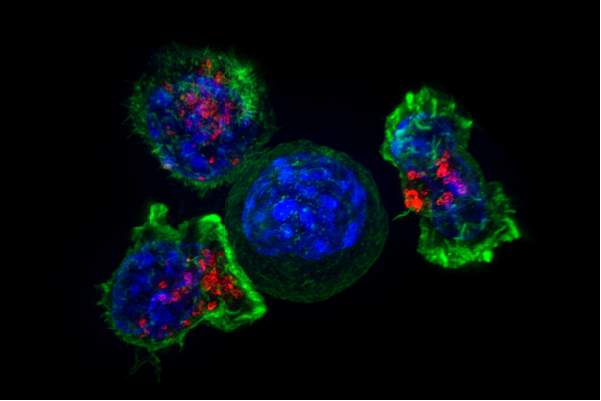
Image: killer T cell attacking a cancer cell. Via Wikimedia Commons.
Comments