
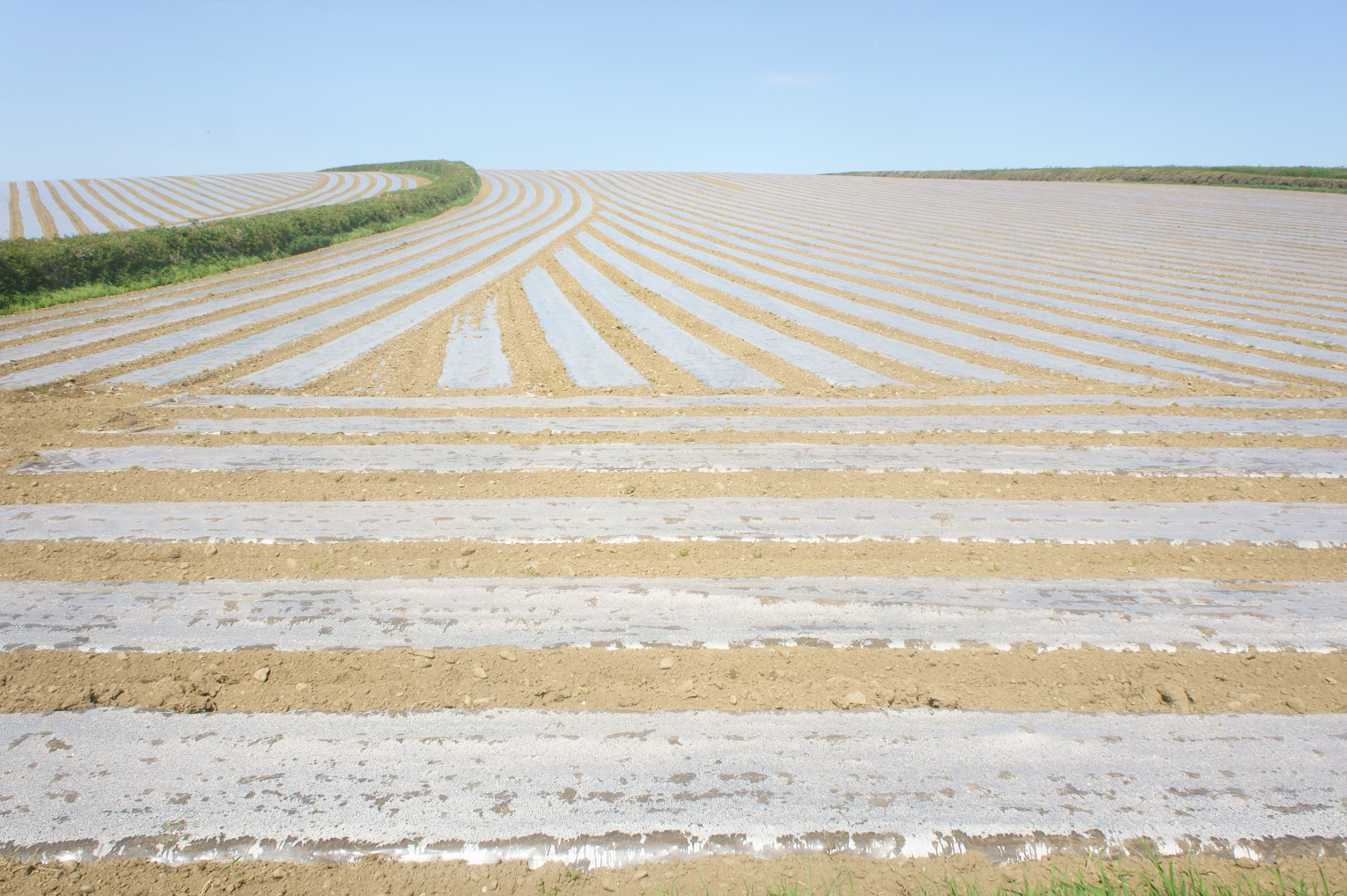
Walk past a farm in early spring and you may see whole fields wrapped in shiny sheets of thin plastic, pinned tight over the soil with crops poking through slits. This is plastic mulch, and it is one of the quietest revolutions in modern agriculture. The film warms the ground, holds in moisture, and blocks weeds. It also never fully goes away.
A new global meta-analysis in Nature Communications tries to weigh both sides of that ledger at once. The researchers pooled results from studies around the world and found that the payoff is real and large. Plastic mulch raised crop yields by 28.7 percent and lifted water use efficiency by 48.9 percent under diversified farming systems. For regions squeezed by drought and shrinking farmland, those are not marginal gains.
A tool that quietly reshaped Chinese farmland
The clearest illustration comes from China, where the authors tracked plasticulture from 2015 to 2024. Over that decade, they estimate the practice delivered an extra 189 million tons of staple food. It also spared 33.5 million hectares of arable land from being pressed into service, because existing fields simply produced more. And by cutting the need to expand and intensify elsewhere, the authors credit it with avoiding 438 million tons of carbon dioxide equivalent in emissions.
Those are the kinds of numbers that get a technology adopted fast. The world needs to grow far more food by mid-century, and the paper frames plastic mulch as one of the few tools that can push yields up while using less water. That is the productivity half of the story.
What stays behind after harvest
The sustainability half is harder to look at. Thin plastic films tear. Fragments get plowed under and stay there. Over years, residues build up in the topsoil, changing how it holds water and air, and breaking down into ever smaller pieces. Some of those pieces end up as nanoplastics small enough to move into food chains. The paper is blunt that this poses ecological and health risks, and that the very quality of the soil the film was meant to protect can degrade underneath it.
There is also a governance gap. The authors note that despite rounds of international negotiation in 2024 and 2025, a binding United Nations treaty on plastic pollution has stalled, held up by disagreements among the parties. So the residue keeps accumulating while the rules do not.
To square the circle, the team proposes six priorities. They want integrated eco-farming that uses artificial intelligence to apply mulch more precisely, faster development of biodegradable films and organic-based alternatives, and blockchain-tracked systems for handling plastic waste. They also call for better reuse and recycling infrastructure, local incentives to support plastic-free farming, and folding plastic management into UN carbon trading frameworks.
Where the caution belongs
It is worth being clear about what this study is and is not. It is a synthesis of existing research, not a single controlled experiment, so it inherits whatever biases sit in the underlying studies. The headline benefit figures come from diversified systems, and results vary with crop, climate, and film type. The most striking food and land numbers are specific to China over one decade and should not be read as a global constant. And the six proposed priorities are recommendations, not tested interventions. Whether biodegradable films truly break down harmlessly in real soils, and how fast, remains an open question the authors flag rather than settle.
Still, the framing is useful. Plastic mulch is not a villain or a miracle. It is a genuinely powerful tool with a genuinely serious downside, and the paper argues those two facts have to be managed together rather than one at a time. The food it helps grow is real. So is the plastic it leaves in the ground. The task ahead is keeping the first without accumulating the second.
Wang, L. et al. "Plastic mulch productivity-sustainability tradeoffs and pathways toward an eco-friendly framework: insights from a global meta-analysis." Nature Communications, 2026. doi.org/10.1038/s41467-026-68798-2
PubMed PMID: 41571666.
Photograph: Stephen Middlemiss, CC BY-SA 2.0, via Wikimedia Commons.
Comments