
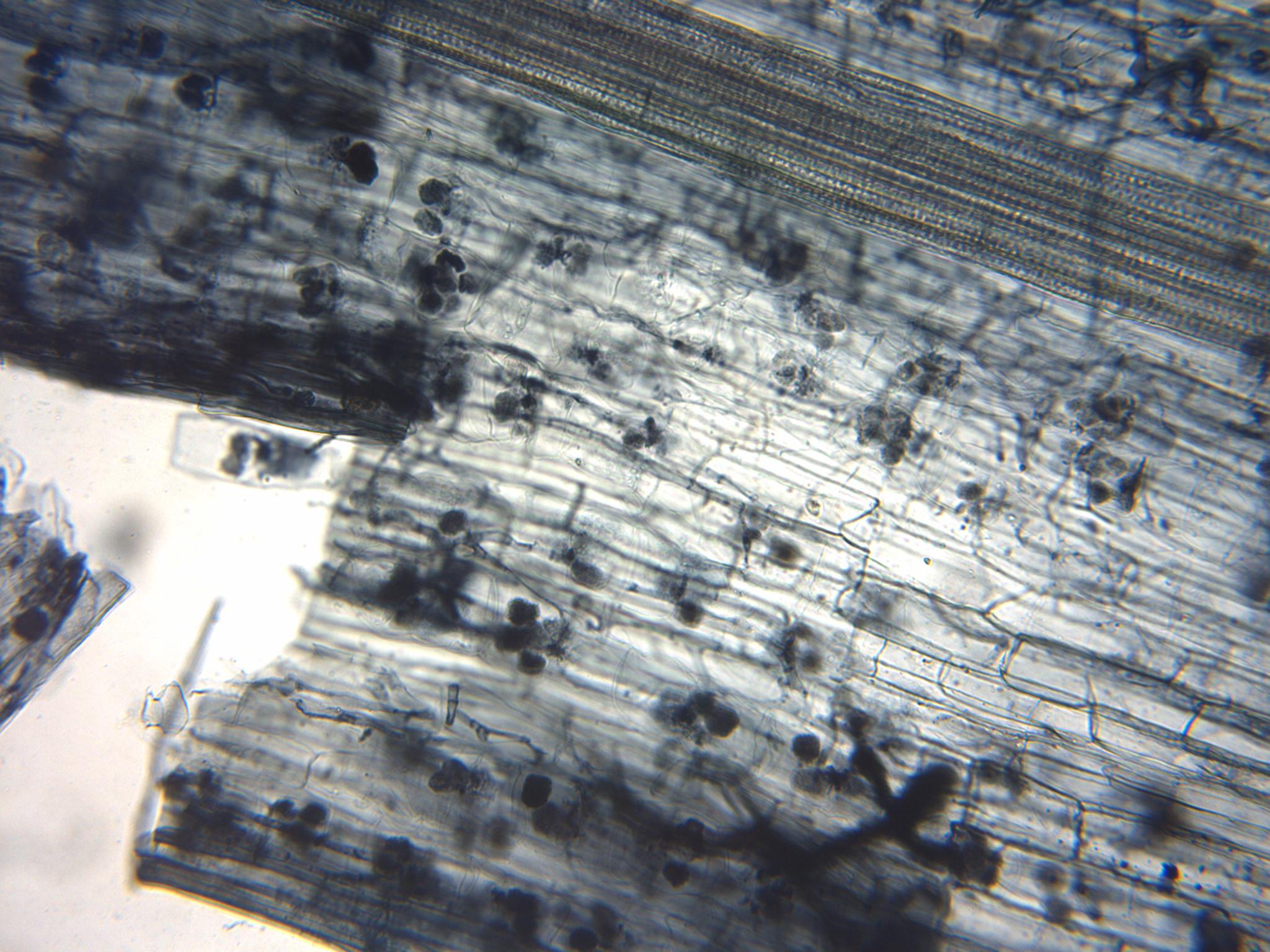
Plants that look completely separate above ground are often wired together below it. Fungal threads called arbuscular mycorrhizal fungi thread through the soil and colonize the roots of many plants at once, forming what researchers call a common mycorrhizal network. For decades this underground web has been described as a nutrient exchange, a place where plants trade sugars for phosphorus. A study published in Cell Host & Microbe argues it does something more surprising. It carries warnings.
Xianhong Zhang and colleagues set up an experiment where two plants shared a fungal connection but nothing else. One plant, the donor, was infected with Botrytis cinerea, the gray mold that rots strawberries and countless other crops. The other plant, the receiver, was healthy and physically isolated. The only route between them was the fungal network. When the donor got sick, the receiver mounted a defense. Cut the fungal link, and the warning never arrived.
A chemical message with a name
The researchers traced the signal to jasmonic acid, a plant hormone that ramps up when tissue is under attack. Infected donor plants pushed jasmonic acid into the mycorrhizal network, and it moved through the fungal threads into the receiver plant. There it acted as a chemical cue, switching on defense responses in a plant that had never met the pathogen.
What makes the finding stand out is what happened next, at the roots. The warned receiver plants changed the mix of compounds they secreted into the soil around their roots, the root exudates. That shift was not cosmetic. It rearranged which microbes gathered there.
Recruiting bacterial bodyguards
The altered exudates pulled in specific bacteria, notably members of the genera Streptomyces and Actinoplanes. Both are known for producing antimicrobial compounds. And these were not passive bystanders. The team linked the recruited bacteria directly to suppression of B. cinerea. So the chain runs like this: a sick plant sends jasmonic acid through fungi, a neighbor receives it, that neighbor changes its root chemistry, and the new chemistry summons bacteria that fight off the mold before it takes hold.
It is a three-part alliance. The plant, the fungus that carries the message, and the bacteria that answer the call all end up working against a shared enemy. None of them planned it. Each is following its own chemistry. But the net result is a plant community that shares an immune early-warning system through the soil.
This reframes the mycorrhizal network as a communication channel, not only a supply line. Plants are not sealed individuals competing in silence. Through their fungal partners, a threat to one becomes information for many. And the microbiome sitting around every root turns out to be a recruitable defense force, tuned by signals the plant sends out on purpose.
Where the caution lies
Some limits are worth keeping in view. This work was done in a controlled setup designed to isolate the fungal connection from every other path between plants. Real soil is messier, crowded with competing fungi, roots, and microbes, and the clean donor-to-receiver signal may be harder to detect or weaker in a field. The study centers on one pathogen and a defined set of players, so how broadly the jasmonic-acid-to-bacteria pathway generalizes across crops and diseases remains open. The authors identify Streptomyces and Actinoplanes as directly linked to suppression, but the full molecular back-and-forth between recruited bacteria and the mold still needs more work.
Even with those caveats, the picture is striking. Beneath a garden or a field, plants may be quietly passing notes about who is under attack, and reshaping the invisible microbial crowd at their roots in response. For agriculture, the appeal is obvious. If a fungal network and the right soil bacteria can prime a crop against disease, that is a route to protection that leans on the plant's own alliances rather than on more chemical spraying. The groundwork, in every sense, is already there.
Zhang, X. et al. "Common mycorrhizal networks facilitate plant disease resistance by altering rhizosphere microbiome assembly." Cell Host & Microbe, 2025. doi.org/10.1016/j.chom.2025.08.016
PubMed PMID: 40961934.
Photograph: Msturmel, Public domain, via Wikimedia Commons.
Comments