

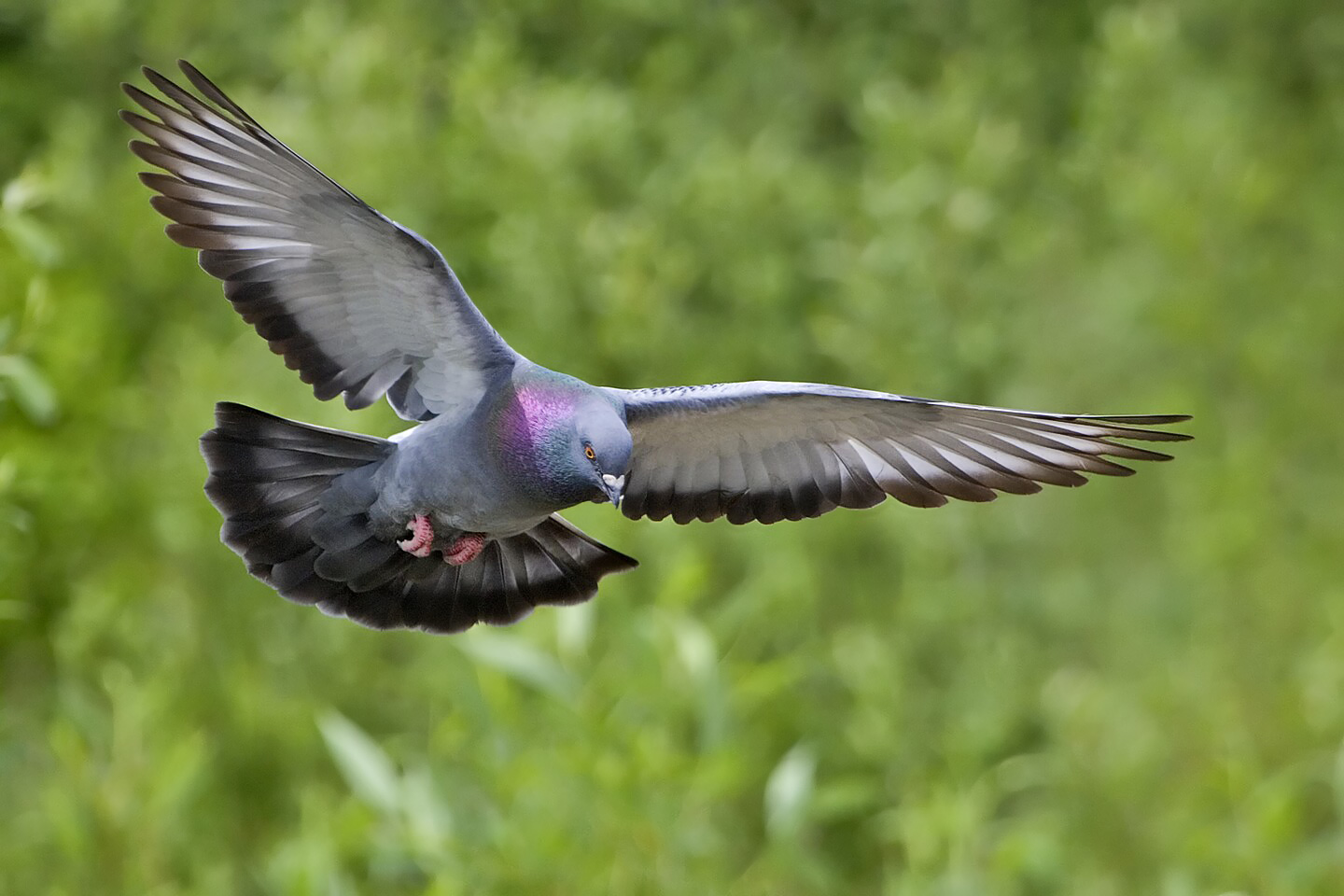
Homing pigeons find their way home across hundreds of miles. Birds migrate between continents without a map. For decades biologists have agreed that many animals can read Earth's magnetic field, and for just as long they have argued about the part that seems like it should be easy: which cells in the body actually do the reading. No one had pinned it down. The field pointed fingers at the beak, at the retina, at the inner ear, and each candidate came with its own controversy.
A team led by Gregory Nordmann at Ludwig-Maximilians-University Munich decided to stop guessing where to look. Writing in Science, they took an unbiased route: switch on a magnetic stimulus, then scan the entire pigeon brain to see what responds.
Reading the whole brain at once
The approach borrows tools from developmental biology. The researchers exposed pigeons to magnetic stimuli, then used whole-brain activity mapping to flag neurons that had recently fired. They made the tissue transparent through a clearing process and imaged it with light-sheet microscopy, which lets you see activation patterns in three dimensions across an intact brain rather than in thin slices.
Two regions lit up on both sides of the brain. One was the medial vestibular nuclei, part of the system that handles balance and head position. The other was the caudal mesopallium, a higher processing area. Crucially, this activation happened whether the lights were on or off. That detail matters. A leading rival hypothesis holds that birds sense magnetism through light-sensitive proteins in the eye, which would make the signal depend on illumination. Here the response was light-independent, which points away from a purely visual mechanism.
A clue in the balance organ
The vestibular signal sent the team to the inner ear, specifically the semicircular canals, the fluid-filled loops that detect rotation of the head. They ran single-cell RNA sequencing on the cristae, the sensory patches inside those canals, to see what the individual cells were making.
They found a specialized set of type II hair cells carrying the molecular machinery needed to detect a magnetic field by electromagnetic induction. Induction is old physics: move a conductor through a magnetic field and you generate a current. The semicircular canals are full of conductive fluid, and a bird turning its head in Earth's field is, in principle, a conductor in motion. The idea that induction could underlie a magnetic sense has floated around for years. This is direct cellular evidence that the hardware for it sits in the ear.
Put together, the pieces suggest a pathway. Magnetic input picked up in the semicircular canals feeds into the vestibular nuclei, which then drive the mesopallium. The authors call it a vestibular-mesopallial circuit, and it reframes magnetoreception less as an exotic new sense and more as an extension of the balance system the bird already uses to know which way is up.
What this does and does not settle
This is one species, the pigeon, and activity mapping tells you where neurons respond, not that the animal is consciously navigating by that signal. The study identifies candidate cells and a candidate circuit; it does not prove the induction mechanism operates during real flight, and it does not close the long-running debate about light-based magnetoreception, which may still play a role in other birds or other behaviors. The molecular machinery the team describes will need to be tested by knocking pieces out and watching whether the magnetic response disappears.
Still, the strategy is the interesting part. Instead of defending one favorite organ, the researchers asked the brain to tell them where to look, and it answered with the inner ear. After decades of a search that kept circling back to the beak and the eye, a balance organ that no one was watching closely may turn out to hold the receptor. That is a good reason to keep reading the whole brain rather than the parts we expect.
Nordmann, G. et al. "A global screen for magnetically induced neuronal activity in the pigeon brain." Science, 2025. doi.org/10.1126/science.aea6425
PubMed PMID: 41264677.
Photograph: Alan D. Wilson, CC BY-SA 2.5, via Wikimedia Commons.
Comments