

Engineers who program living cells run into a problem that has nothing to do with the code they write. When a bacterium divides, everything inside it gets split between two daughters. That includes the proteins running any synthetic circuit the engineers installed. Grow the cells fast and this dilution happens constantly, thinning out the very molecules that are supposed to hold a decision in place. A circuit built to remember a state can simply forget it.
A team at Arizona State University, led by Xiao-Jun Tian, went after this with a trick borrowed from how cells naturally organize themselves. Their paper appeared in Cell on November 7. The idea is to make the key proteins clump together at the exact spot on the genome where they need to act, so that even as growth drains the cell's total supply, enough stays concentrated where it matters.
Why dilution breaks memory
Many synthetic circuits rely on a transcription factor, a protein that switches genes on or off. Some are wired as self-activating loops: the protein turns on the gene that makes more of itself. That feedback is what lets a circuit hold a stable "on" state, a form of cellular memory. It works because the protein keeps its own production going.
Rapid growth undercuts that. As the cell balloons and splits, the transcription factor concentration drops across the board. Below a certain level, the self-activation loop can no longer sustain itself, and the circuit collapses back to "off." The memory is gone. The researchers frame this growth-mediated dilution as a global reduction in every circuit component at once, which is why it has been so hard to design around.
Their answer was to stop treating the whole cell volume as the relevant space. Instead of asking the protein to stay abundant everywhere, they asked it to stay abundant at one address.
Turning proteins into droplets
The team fused their transcription factors to intrinsically disordered regions, floppy protein segments with no fixed shape. These regions are known to drive liquid-liquid phase separation, the process where certain molecules condense out of the surrounding soup into distinct droplets, a bit like oil beading in water. Fused this way, the transcription factors formed what the authors call transcriptional condensates, small hubs that gather the protein right at its target promoter.
Those condensates acted as a buffer. Even when prolonged fast growth was diluting the cell's overall protein pool, the droplets kept a working concentration parked on the gene. In self-activation circuits, this preserved bistable memory across a range of growth conditions, meaning the circuit could hold either its "on" or "off" state without being knocked loose by how quickly the cells were dividing.
The group did not stop at memory. They applied the same condensate strategy to a biosynthesis pathway that makes cinnamic acid, a plant-derived compound used as a chemical building block. Concentrating the relevant machinery improved production efficiency, which points toward a practical payoff beyond the circuit-design demonstration.
What this does and does not settle
The work is a proof of principle, and it comes with the usual boundaries. It was carried out in cells, using specific transcription factors and disordered regions the team selected. Whether the same fusion approach transfers cleanly to other circuits, other proteins, or other host organisms is not something a single study can answer. Condensates are also finicky. Their formation depends on how much protein is present and on conditions inside the cell, so the buffering may hold in some regimes and not others. The cinnamic acid result shows a gain in one pathway, not a general guarantee that yoking enzymes into droplets always helps.
Still, the framing is what stands out. Synthetic biologists have long fought host physiology as noise to be suppressed. Here the response to a physical inevitability, dilution by growth, is to reach for another physical process, phase separation, and let the two balance each other. The authors pitch liquid-liquid phase separation as a design principle for building circuits that keep working while their host cells keep dividing. If it generalizes, it offers a way to make engineered cells behave more predictably in exactly the fast-growing conditions where they are hardest to control.
Zhang, R. et al. "Phase separation to buffer growth-mediated dilution in synthetic circuits." Cell, 2025. doi.org/10.1016/j.cell.2025.10.017
PubMed PMID: 41205601.
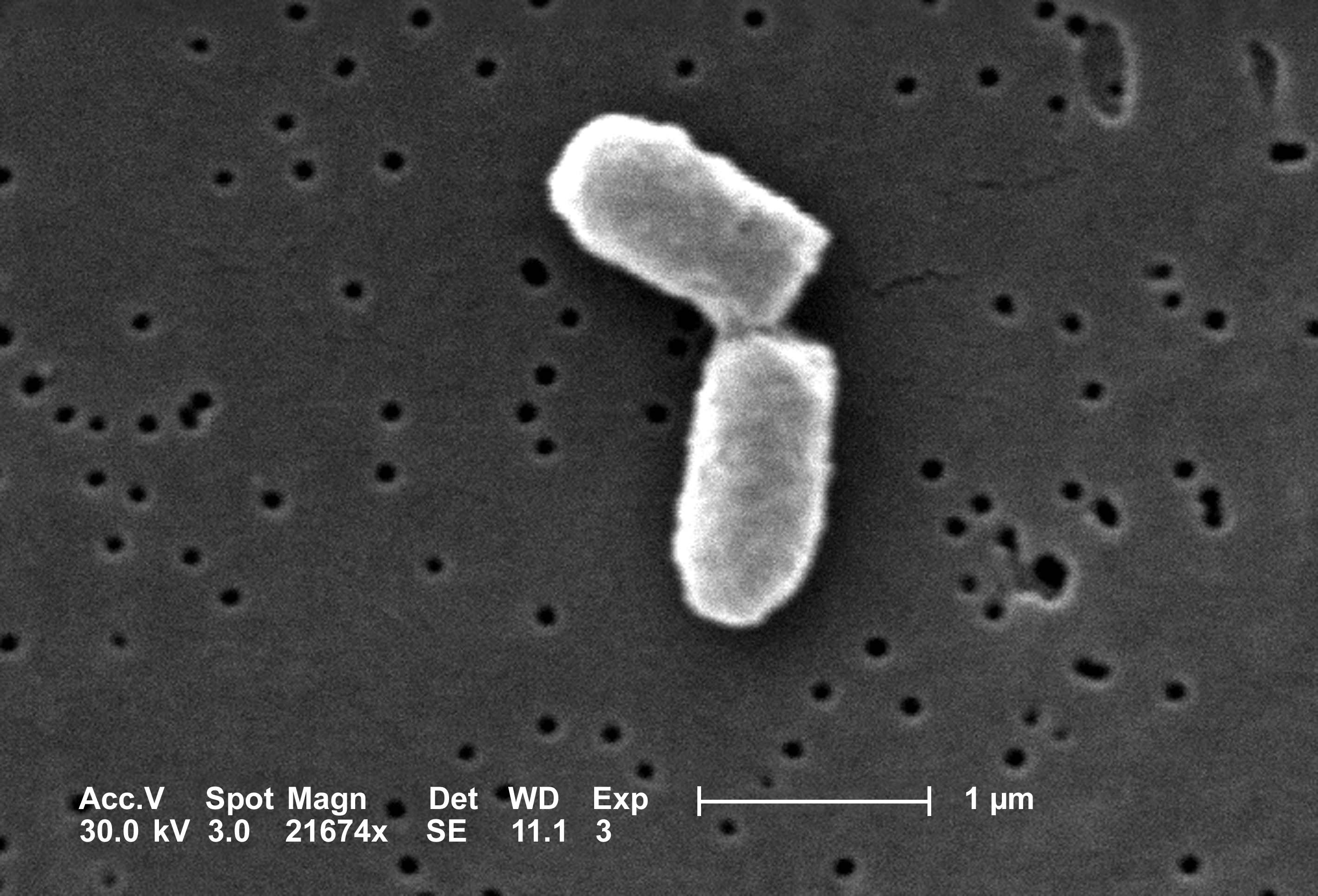
Photograph: CDC/Evangeline Sowers, Janice Haney Carr, Public domain, via Wikimedia Commons.
Comments