There is a comforting story that gets told about farming and bees. Yes, the argument goes, modern agriculture is hard on pollinators, but if you leave a few flowering hedgerows and strips of wild ground around the fields, the bees will be fine. Give them somewhere to nest and forage, and they can ride out the rest.
A new analysis says that story is only half right. Wild bees do benefit from patches of semi-natural habitat near crops. But those green refuges do nothing to protect the bees from pesticides. The two threats stack on top of each other, and one cannot be traded against the other.
The work, led by Anina Knauer at the Swiss agricultural research center Agroscope and published in Nature Ecology & Evolution, pulled together bee survey data from 681 crop fields spread across three continents. That scale matters. Individual field studies often disagree about which pressure on bees is worse, partly because local conditions vary so much. By combining dozens of datasets, the team could ask a cleaner question: when pesticides and habitat loss both press on the same bee community, what happens?
Two problems that refuse to cancel out
The headline finding is that both drivers hurt, and they hurt separately. Higher local pesticide hazard was linked to fewer wild bees and fewer species. So was a shrinking proportion of semi-natural habitat in the surrounding landscape. The effects were additive. A field with lots of nearby wildflower habitat but heavy pesticide use still lost bees to the chemicals.
That last point is the one worth sitting with. The researchers specifically tested whether abundant semi-natural habitat could buffer bees against pesticide harm. It did not. Bees living next to good habitat were just as exposed to the effects of spraying as bees living in barer landscapes. The habitat helped on its own terms, by supporting more bees overall, but it built no shield.
Pesticides also did something habitat loss did not. Beyond simply reducing how many bees and how many species were present, pesticide hazard cut into the functional and phylogenetic diversity of bee assemblages. In plain terms, spraying did not just thin the crowd. It narrowed the range of body types, nesting habits, and evolutionary lineages left behind, which is the kind of loss that can quietly weaken pollination itself.
No safe bee
You might expect certain bees to be more sensitive to one pressure than the other. Big-bodied bumblebees versus tiny solitary species, ground-nesters versus cavity-nesters. The team looked for exactly these patterns, checking whether traits like body size or nesting strategy made a bee especially vulnerable to pesticides or especially vulnerable to habitat loss.
They found no such split. No trait cleanly marked out which bees would suffer most from which driver. That is bad news for anyone hoping to manage the problem by protecting a few hardy species. The pressures reach across the whole community.
What the study cannot settle
This is a synthesis of observational field data, not a controlled experiment, so it maps associations rather than proving cause and effect for any single field. "Pesticide hazard" here is an estimate built from what is applied and how toxic it is, not a direct measurement of the dose each bee absorbed. The 681 fields skew toward regions where researchers do this kind of survey, mostly in the global North, so the picture for tropical smallholder farms is thinner. And the analysis captures a snapshot of assemblages rather than tracking the same populations as they rise or fall over years.
Even with those limits, the practical message is hard to dodge. Restoring flowering habitat around farms genuinely helps wild bees, and the authors are clear that it should continue. But it is not a license to keep spraying. If the goal is to hold onto the pollinators that crops depend on, the study points to cutting the non-target harm of pesticides as work that habitat cannot do for us. Two problems, two solutions, and no shortcut that lets one stand in for the other.
Knauer, A. et al. "Pesticides and habitat loss additively reduce wild bees in crop fields." Nature Ecology & Evolution, 2026. doi.org/10.1038/s41559-025-02924-z
PubMed PMID: 41372456.
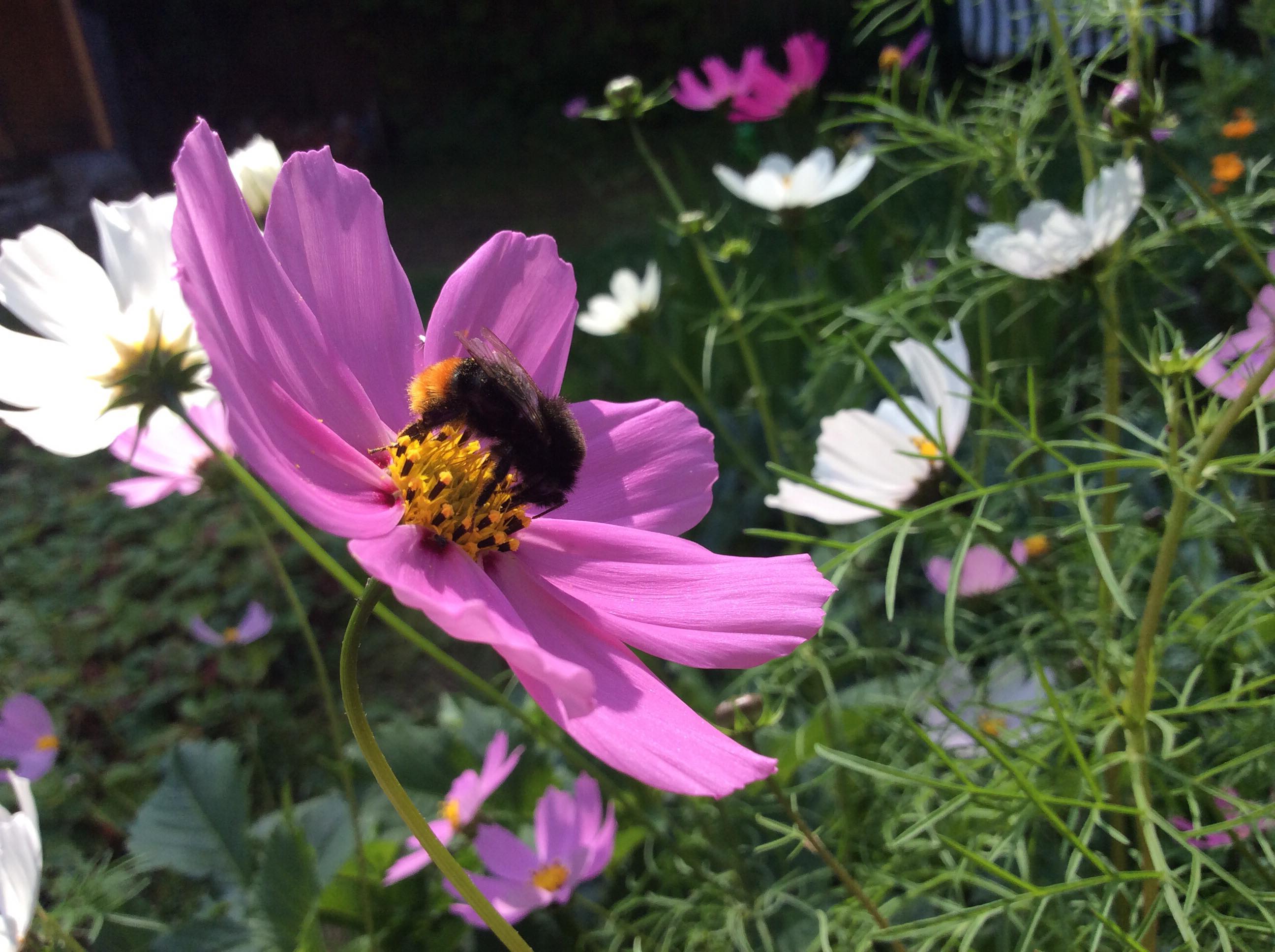
Photograph: Andre Elophe, CC BY 4.0, via Wikimedia Commons.
Comments