
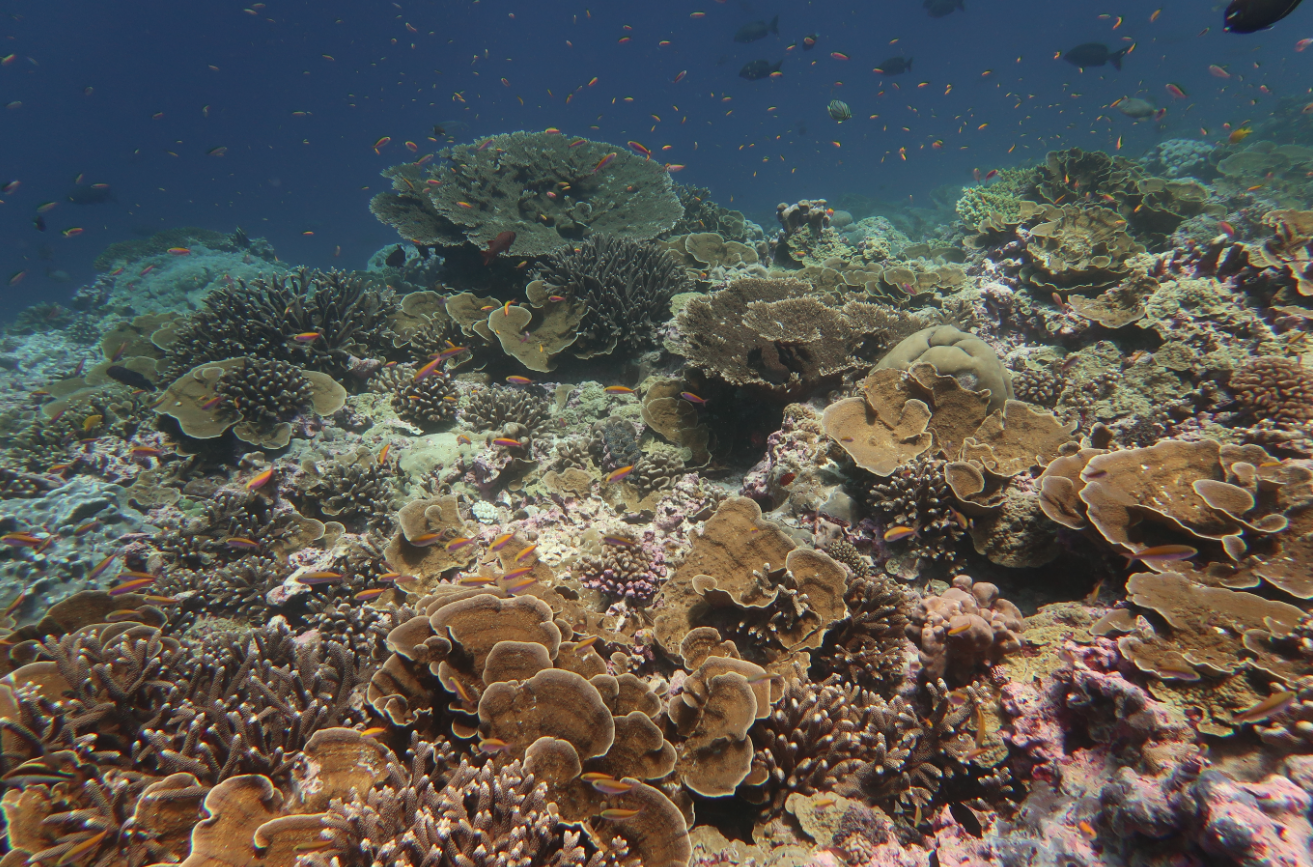
Stand on a healthy Caribbean reef and a healthy reef in the Coral Triangle and, from the coral up, they can look like cousins. Yet one of them feeds far more fish. Reef for reef, the Indo-Pacific consistently produces more fish flesh than the Caribbean, and reef scientists have argued for years about why. A new global analysis lands on an answer that is easy to overlook: it hinges on which fish are eating the drifting food that arrives from the open ocean.
The work, published in Nature Ecology & Evolution, compares the structure of planktivorous fish communities across the two great reef realms. Planktivores are the reef's link to open water. They graze on zooplankton and other drifting particles, then get eaten themselves, moving ocean energy into the reef food web. The team quantified how much biomass those fish carry and how fast they replace it, which is the number that matters for fisheries.
A lopsided ledger
The gap is not subtle. Indo-Pacific reefs supported 6.6 times more planktivorous fish biomass than Caribbean reefs, and 3.4 times greater productivity. That is a large difference between two systems that, on paper, do broadly similar ecological jobs. Something in the Indo-Pacific is converting drifting food into fish at a much higher rate.
The surprise is what does most of the converting. The researchers single out fish that feed on gelatinous plankton, the soft-bodied drifters such as jellyfish and their relatives. In the Indo-Pacific these gelatinous-feeders make up just 4 percent of planktivore abundance. By headcount they are a rounding error. But they account for roughly one-third of planktivore biomass and a quarter of the productivity. A handful of specialists, in other words, carry an outsized share of the whole system's output.
The Caribbean barely has that group. Its reefs are missing the fish that would tap the gelatinous side of the plankton menu, and the ledger reflects the absence. The authors frame this as a missing function rather than simply fewer fish. A trophic pathway that runs strong in one ocean is largely closed in the other.
Deep history in the water
Why would two reef systems diverge so sharply? The paper points to their separate pasts. The Indo-Pacific has a long, relatively stable history that let fish lineages diversify and fill fine-grained feeding niches, including the odd job of eating jellyfish. The Caribbean took a rougher road. Repeated extinction events and what the authors call trophic erosion appear to have thinned out planktivore diversity over geological time, leaving gaps that were never refilled.
That framing matters because it reaches past coral cover and water quality, the usual suspects when people compare reef health. Here the difference is written into the fish fauna itself, the product of millions of years of biogeography. You cannot restore a feeding strategy that a region's fish never evolved.
What it means for reef fisheries
Coral reefs feed hundreds of millions of people, and much of that food traces back to how efficiently reefs pull energy from surrounding water. If a big slice of Indo-Pacific productivity flows through a thin band of gelatinous-plankton specialists, those fish may punch well above their numbers in supporting reef fisheries. It is a reminder that ecosystem output can rest on a few functional players rather than on sheer abundance.
Some caveats are worth keeping in view. The study maps large-scale patterns in community structure and infers productivity from them, so it describes how these systems are built more than it tracks energy moving through them in real time. Diets of gelatinous-feeders are notoriously hard to pin down, and the evolutionary story is a reconstruction from present-day patterns rather than a filmed history. The core comparison, though, rests on fish communities surveyed at a global scale, which is exactly the breadth needed to see a contrast this fundamental.
The takeaway is that two reefs can look alike and still run on different engines. In the Indo-Pacific, part of that engine is a small crowd of fish quietly making a living on jellyfish, and the reef as a whole is richer for it.
Gahan, J. et al. "Missing planktivore functions drive global variation in reef fish productivity." Nature Ecology & Evolution, 2026. doi.org/10.1038/s41559-026-03029-x
PubMed PMID: 41876884.
Photograph: NOAA Fisheries, Public domain, via Wikimedia Commons.
Comments