
Plenty of drugs that have nothing to do with bacteria still leave a mark on the gut. Antidepressants, blood pressure pills, painkillers, chemotherapy agents. Doctors have known for years that these medicines can shift the composition of the gut microbiome, sometimes for the worse. What has been missing is any way to predict the damage. Which of the hundreds of species living in a person's colon will bloom, and which will disappear, when a new prescription arrives?
A team at Stanford has now put that question on a firmer footing. Writing in Cell, Handuo Shi and colleagues built gut bacterial communities in the lab, growing them from human stool samples, and then hit them with 707 clinically relevant drugs. Across roughly 5,000 combinations of community and drug, they tracked who won and who lost. The pattern that emerged was not chaos. It came down largely to competition for food.
One rule does a lot of the work
The core finding is that when a drug knocks back one species, the nutrients that species was consuming become available to its neighbors. Certain bacteria expand not because the drug helps them directly, but because their competitors have been suppressed. Take away the rival at the buffet and whoever is left eats more.
Most of the compositional shifts the team saw came from strain extinction: a species dropping out of the community entirely. And here is the part that matters for anyone hoping to reverse the damage. In many cases, reintroducing the extinct species restored the community to something close to its original makeup. The change was not baked in. It could be undone by putting the lost member back.
Not always, though. Some drugs pushed communities into alternative states that persisted long after the drug was gone. The bacteria settled into a new arrangement and stayed there, even without continued pressure. Those cases are the harder ones, because simply stopping the drug does not return things to baseline.
Resistance was rarely the story
You might expect that under heavy chemical assault, bacteria would evolve their way out, developing resistance the way they do against antibiotics. That mostly did not happen. Despite strong selection pressure across thousands of conditions, resistance emergence was infrequent. The communities were reshaped by ecology, by who could out-compete whom for resources, far more than by evolution.
The researchers also noticed something reassuring about consistency. The qualitative response to a given drug, the direction of the shift, tended to hold across different stool-derived communities. What varied between communities was the magnitude. Nutrient competition quantitatively tuned exactly how much each species rose or fell. That regularity is what makes prediction plausible in the first place. The team found their results lined up with a consumer-resource model, a mathematical framework that treats bacteria as consumers fighting over a shared pool of nutrients.
What this does not settle
These are communities in test tubes, not living intestines. A real gut has a mucus layer, an immune system, a constant flow of new food and waste, and a host that responds to all of it. The in vitro setup strips those factors away to isolate the ecology, which is a strength for finding the underlying rule and a limit for claiming the same numbers will hold in a person. The study also works with communities assembled from stool, which captures much of the gut's bacterial cast but not every niche. And while reintroducing extinct species rescued many communities in the lab, doing that safely and reliably in patients is a separate, unsolved problem.
Still, the direction is useful. If the collateral effect of a drug on the microbiome is governed largely by nutrient competition, then it becomes something you can model rather than discover by accident. That opens a path to screening new medicines for microbiome side effects before they reach patients, and perhaps to designing interventions, a targeted nutrient here, a reintroduced strain there, that steer a disturbed community back toward health.
Shi, H. et al. "Nutrient competition predicts gut microbiome restructuring under drug perturbations." Cell, 2026. doi.org/10.1016/j.cell.2025.10.038
PubMed PMID: 41253145.
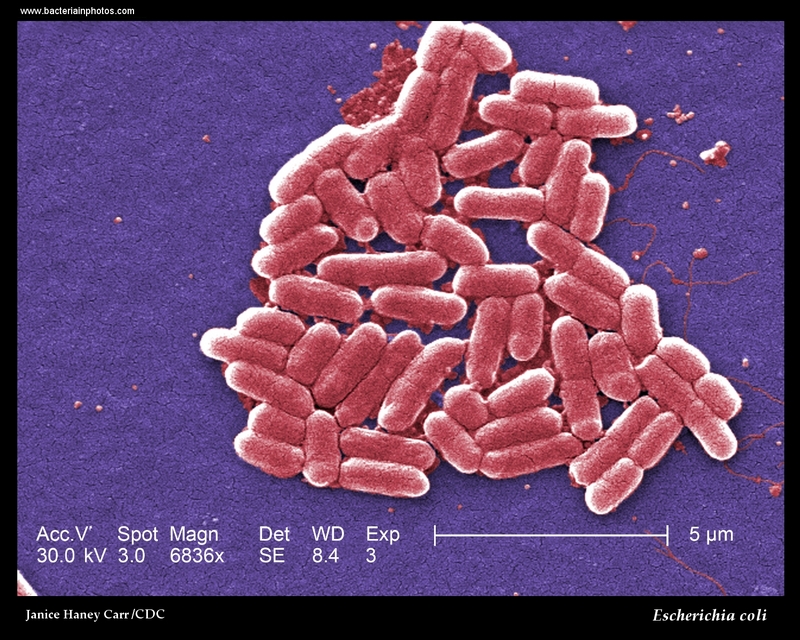
Photograph: Janice Haney Carr, Public domain, via Wikimedia Commons.
Comments