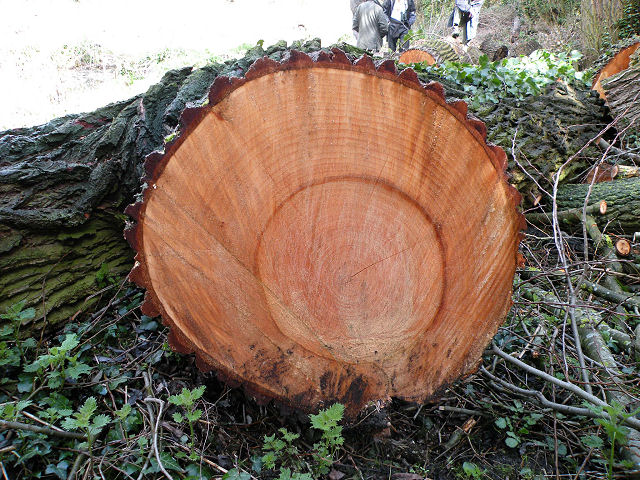
Cut into the trunk of a living tree and you reach a place biologists mostly assumed was empty. The heartwood at the center is dead tissue, dense and dry, the part loggers prize for lumber. For a long time the working assumption was that little could live there. A team at Yale went looking anyway, drilling cores into oaks, maples, and other trees in a Connecticut forest, and found the opposite of emptiness. A single tree, they estimate, carries something on the order of a trillion bacteria packed into its woody tissues.
The number alone is striking, but the more interesting part is what those bacteria are. They are not stray microbes that wandered in from the soil or the leaves. The communities inside the wood are distinct, adapted to that specific habitat, and in many cases specialized down to the individual tree species. Wood, it turns out, is its own microbial world, and it has been sitting inside Earth's largest pool of living biomass without anyone taking a close look.
Two worlds inside one trunk
The clearest finding is that a tree trunk is not one habitat but at least two. The outer sapwood, where water and nutrients still move, holds one kind of microbial community. The inner heartwood holds a completely different one. The researchers found minimal overlap between the two, and minimal overlap with the bacteria found in leaves, roots, or the surrounding soil. Each zone keeps its own residents.
The heartwood community was the surprise. Buried in the oxygen-poor core of the trunk, it was dominated by anaerobic bacteria and, notably, by archaea, a separate branch of microbial life that often shows up in extreme or airless environments. Some of these microbes appear to be running chemistry that matters beyond the tree itself, including processes tied to methane and other gases. That hints at a role in how forests handle carbon and greenhouse gases, though the size of that role is still an open question.
The tree as a holobiont
The authors frame the tree as a holobiont, a term for a host and its resident microbes treated as one working unit. It is the same lens researchers now apply to coral, to the human gut, to plant roots. The idea is that you cannot fully understand the organism by studying it in isolation, because part of its biology is outsourced to the microbes it carries. Applying that framing to the wood of a living tree extends it into tissue almost no one had thought to examine this way.
What makes the result feel new is partly the location. Microbiome science has combed through guts, oceans, soil, and skin. The inside of a tree trunk is a huge, common, and until now overlooked habitat. If a single tree holds a trillion bacteria in communities found nowhere else, the total microbial diversity locked inside the world's forests is large and mostly uncataloged. The paper reads less like a final answer and more like the opening of a door.
What the study can't say yet
Finding the microbes is not the same as knowing what they do. The census here is thorough, but it is still mostly a census. The researchers can describe who lives where and infer likely functions from the genes present, yet they have not shown, tree by tree, that these bacteria help their host or harm it or simply ride along. The link between the internal microbiome and tree health remains a hypothesis to test, not a settled fact.
The work also comes from one forest in one climate. Whether tropical trees, conifers, or trees under drought stress carry the same kind of internal communities is unknown. The biogeochemical claims, especially around methane, rest on genetic potential and measured processes in these samples rather than on a full accounting of how much gas real forests move through their trunks. Scaling any of this up to a global figure would be premature.
Still, the basic picture is hard to unsee. The trees around us are not solid columns of inert wood with a thin skin of life on the outside. They are populated all the way through, each trunk a stacked pair of ecosystems that no one had properly met. For a field that thought it had mapped the obvious places, that is a reminder of how much biology is still hiding in plain sight.
Arnold et al. "A diverse and distinct microbiome inside living trees." Nature, 2025. doi.org/10.1038/s41586-025-09316-0
PubMed PMID: 40770104.
Photograph: Keith Edkins, CC BY-SA 2.0, via Wikimedia Commons.
Comments