
Most of the bacteria living in your gut have never been grown in a laboratory. Scientists know they are there because their DNA turns up in sequencing data, but knowing a microbe exists and being able to change it are two very different things. If you cannot culture a bug, the standard genetic toolkit is useless. You are stuck reading the genome without ever being able to write to it.
A team at Columbia University has now found a way around that wall. Writing in Science, Diego Rivera Gelsinger and colleagues describe a platform they call MetaEdit that edits the genomes of native gut bacteria directly inside a living animal. No isolation step. No pure culture. The edits happen in the messy, crowded community where the microbes actually live.
Delivering the edit through bacterial plumbing
The trick relies on two borrowed pieces of biology. The first is a CRISPR-associated transposase, a version of the CRISPR system that does not cut DNA to destroy it but instead uses a guide sequence to drop a chunk of new DNA into a precise spot. The researchers optimized these transposases to work across many different bacterial species rather than just one lab strain.
The second piece is delivery. The team packaged their editing machinery into a broadly conjugative vector, which is essentially a genetic parcel that bacteria pass to their neighbors through direct contact. Conjugation is how microbes naturally swap genes in the wild, including the genes that spread antibiotic resistance. Here that same plumbing carries a designed payload instead. Because the vector is broad in its range, it can reach a wide slice of the community rather than a single target.
Put together, the system modifies diverse commensal bacteria from both mice and humans, inserting whole new metabolic pathways at single-nucleotide resolution. The authors frame the scale in blunt terms: the approach reaches across gigabases of the microbiome's genetic repertoire.
A dietary on-switch, and a microbe no one can culture
To show the tool does real work, the team pulled off two demonstrations inside mice. In the first, they captured a native murine gut bacterium and wired in a metabolic payload that let them control its growth using dietary inulin, a common fiber. Feed the animal inulin and the edited bug can expand. Withhold it and growth is reined in. That kind of tunable control matters if you ever want an engineered microbe to stay put only as long as it is useful.
The second demonstration is the one that stands out. They edited segmented filamentous bacteria, a group that shapes the immune system in the small intestine and has resisted cultivation for years. These are exactly the microbes conventional genetics cannot touch. Reaching them in place, without ever growing them, is the whole point of building a tool like this.
Powerful, and not yet a therapy
It is worth being clear about what this study is and is not. This is a proof of principle in mice and in laboratory work with human-derived bacteria, not a treatment ready for people. Editing microbes in a living gut raises obvious questions the paper does not fully settle: how do you keep an engineered gene from spreading to species you never intended to change, and how do you contain edits that use the same conjugation machinery microbes already use to share resistance genes? The authors demonstrate control through dietary inulin, but real-world biocontainment is a harder and separate problem.
Still, the direction is striking. For decades, studying the uncultured majority of the microbiome meant working blind. If MetaEdit holds up beyond these first experiments, researchers could start testing what individual microbes actually do by switching functions on and off inside the living community, rather than guessing from sequence alone. That shifts the microbiome from something we mostly observe toward something we can begin to program.
Gelsinger, D.R. et al. "Metagenomic editing of commensal bacteria in vivo using CRISPR-associated transposases." Science, 2025. doi.org/10.1126/science.adx7604
PubMed PMID: 41231980.
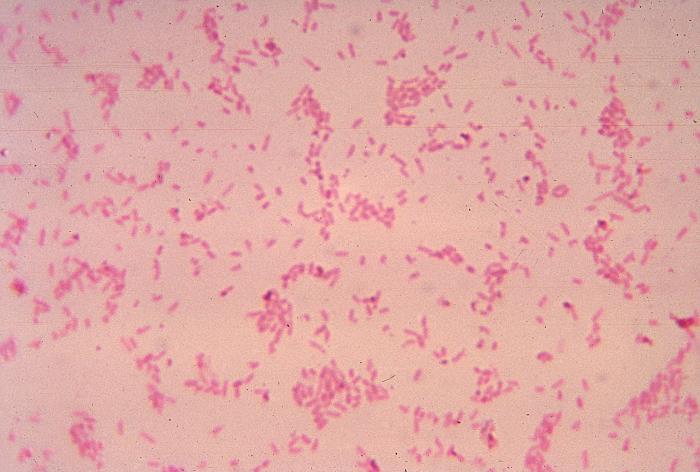
Photograph: CDC/Dr. V.R. Dowell, Jr., Public domain, via Wikimedia Commons.
Comments