


We have all sat next to someone with the flu and wondered how much of it we were breathing in. The honest answer, for a long time, has been that nobody really knew. Detecting genetic traces of a virus in exhaled air is one thing. Catching virus that is actually alive and able to infect a new host is much harder, and until now it was rarely done in a controlled way.
A team led by Nahara Vargas-Maldonado, reporting in Cell, built a machine to do exactly that. They deliberately infected volunteers with influenza virus, then had them breathe into a device the researchers call a modular influenza sampling tunnel, or MIST. Inside the tunnel, the respiratory particles a person expels land on layers of living cells. Those cells let the researchers grow, count, and sequence whatever virus was riding along. At the same time, water-sensitive paper and particle samplers tallied how many droplets came out and how big they were.
Some people were flu fountains, others barely leaked
The headline finding is about difference between people. When the team measured how much infectious virus came out in the breath, the amounts spanned three orders of magnitude. That means one infected person could put out roughly a thousand times more live virus into the air than another infected person. Same virus, same experimental infection, wildly different output.
This lines up with an old idea in epidemiology that a small number of people drive a large share of transmission. What has been missing is direct physical proof at the level of live, culturable virus leaving a real human airway. The MIST provides that. It also caught virus on multiple days after the volunteers were inoculated, so the researchers could watch expulsion change over the course of an infection rather than taking a single snapshot.
How much someone breathed out was not random. It tracked with how much virus was in their saliva and in nasopharyngeal swabs, and it tracked with how sick they felt. People carrying heavier viral loads and showing clearer symptoms tended to release more infectious particles. That connection matters, because saliva and swab samples are easy to collect, and they might serve as a rough stand-in for who is most likely to be spreading virus into a room.
The virus in the air was not a random sample
The genetic side of the work is just as interesting. Influenza does not exist in a body as a single uniform virus. It exists as a swarm of slightly different variants. The team found that the viral variants recovered from exhaled particles matched variants they detected in samples taken directly from the same infected person. In other words, the diversity of the flu swarm was maintained as it moved from the airway out into the air, rather than being narrowed down to one dominant type.
That has consequences for how new flu strains might spread. If exhaled aerosols preserve a broad mix of variants, then the population of virus that reaches the next person starts out diverse, giving the pathogen more raw material to adapt in its new host.
What this does and does not tell us
This was a controlled human infection study, which means a defined virus strain given to a screened group of volunteers under supervision. Real-world flu seasons involve many strains, mixed immunity, children, crowded indoor spaces, and behavior the lab cannot fully copy. The volunteer numbers in these studies are small, so the specific thousand-fold spread should be read as a demonstration of huge variability rather than a fixed figure for the general public. The device also captures what a person expels into a tunnel, not what actually survives across a room and infects someone else. Bridging that last gap still takes more work.
Even so, the result puts hard numbers on something that used to be mostly inference. Flu transmission is not evenly shared. A few people, on a few days, breathing out a lot of live virus, may account for much of what spreads. Being able to catch that virus alive, and read who is doing the expelling, is a concrete step toward figuring out how to interrupt it.
Vargas-Maldonado, N. et al. "Controlled human influenza infection reveals heterogeneous expulsion of infectious virus into air." Cell, 2026. doi.org/10.1016/j.cell.2026.02.025
PubMed PMID: 41861822.
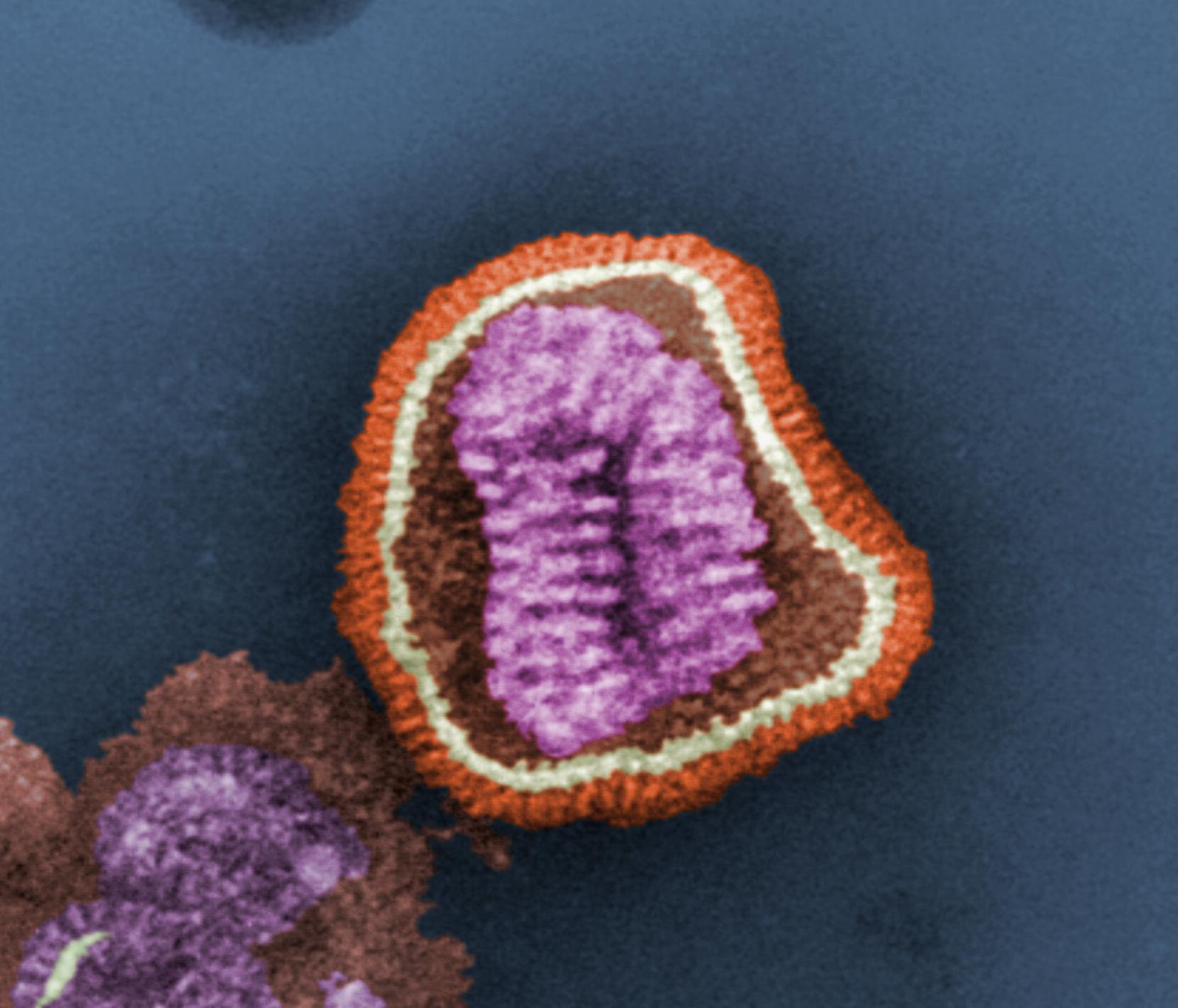
Photograph: Cynthia Goldsmith, CDC/Dr. Erskine L. Palmer and Dr. M. L. Martin, Public domain, via Wikimedia Commons.
Comments