

At first light over Lake Malawi, something begins to sink. Clouds of nearly transparent larvae, each a sliver of a thing, start dropping away from the sunlit surface water where fish are waking up hungry. They do not swim down so much as let themselves fall, and they keep falling past the depth where sunlight gives out, past the depth where the oxygen runs out, into cold black water that most of the lake's animals cannot enter at all. At dusk they come back up. They do this every day of their larval lives.
What makes this strange is that insects are not supposed to be able to do it. For decades the standard explanation for why insects, which have conquered nearly every habitat on land and in fresh water, are essentially absent from the open ocean has rested on the way they breathe. A team working across Canada, Malawi and Scotland has now found insect larvae doing the supposedly impossible thing, in a lake, on a daily schedule.
Why it matters: Insects are the most successful group of animals on the planet, and their near-total absence from the open sea is one of the great oddities of natural history. This finding removes the barrier that was long assumed to explain it, and shows that the physics was never the obstacle we thought.
The work, led by McKenzie et al. at the University of British Columbia, with colleagues at Malawi's Department of Fisheries and the University of St Andrews, focused on the aquatic larvae of a lake fly. These are the insects that erupt from Lake Malawi in swarms so dense they look like smoke on the horizon. The larval stage, spent underwater, is where the surprise lives.
The rule that just broke
Insects do not have lungs. They breathe through a branching network of air-filled tubes called the tracheal system, which pipes air directly to their tissues. It is a superb design on land and a liability underwater, because air is compressible. Take a sealed air space down through the water column and pressure squeezes it, and at some depth it collapses. That vulnerability is exactly what biologists have pointed to when explaining why insects do not live in the open ocean: any insect trying the deep daily commute that ocean plankton use to dodge predators would, in theory, have its plumbing crushed.
The larvae in Lake Malawi have taken that same liability and rebuilt it. Rather than abandoning their air-filled tubes, they have modified the tracheal system into reinforced air sacs that also let them control their buoyancy, tuning whether they rise or sink. So the very structure that was supposed to keep insects out of deep water is the structure these animals use to get there and back.
A body that gets tougher as it grows
The reinforcement is not fixed. Insect larvae grow in stages called instars, moulting between each one, and the researchers found that the crush depth of the air sacs increases with every stage. In the authors' words, The crush depth of their air sacs increases with each instar, with final instars resisting implosion at depths greater than half a kilometer. An older larva is, quite literally, rated for deeper water than its younger self.
What they use that engineering for is escape. During daylight the larvae migrate well over 200 metres down, into what limnologists call the hypolimnion, the deep cold layer of a lake. In Lake Malawi that layer is anoxic, meaning it holds essentially no dissolved oxygen. Fish cannot follow them there. The larvae are trading a few hours in water that would suffocate most animals for the certainty of not being eaten, then returning to the surface under cover of darkness. It is the same predator-dodging rhythm that drives the largest daily animal migration on Earth in the open ocean, performed here by an insect that theory said should have imploded.
What the study can't say yet
This is one lineage in one lake, and the paper does not claim that insects are poised to colonise the sea. Removing the pressure explanation does not automatically explain the ocean's emptiness of insects, which may still turn on salt handling, competition, or the simple accident of which lineages ended up where. The absence remains real, and now it needs a better reason.
It is also worth separating two different numbers. The daily migration that was observed goes well over 200 metres down. The half-kilometre figure is the depth at which the final-stage larvae's air sacs resist implosion, a measure of what the structures can withstand rather than a record of animals tracked to that depth. And the deep layer these larvae exploit is a feature of this particular lake at this particular time. Lake stratification shifts with climate and season, so how durable that refuge is over the long run is not something a single study can settle.
Quick questions
How can they survive water with no oxygen? The trip is temporary. They descend during the day and return to oxygenated water at night, and their air sacs serve buoyancy and pressure resistance rather than acting as a breathing supply for the whole visit.
Does this mean we should expect to find insects in the deep ocean? Not from this work. It shows the pressure barrier is not absolute, which weakens the textbook explanation, but the open ocean remains almost entirely free of insects and this study does not claim to have found out why.
What's the one-line takeaway? An insect in Lake Malawi has turned the air-filled breathing system that was supposed to bar insects from deep water into a crush-resistant diving rig, and uses it to drop hundreds of metres every day to escape fish.
McKenzie et al. "Crush-resistant air sacs allow insect larvae to exploit aquatic habitats at extreme depth." Science, 2026. doi.org/10.1126/science.aed0667
PubMed PMID: 42490499.
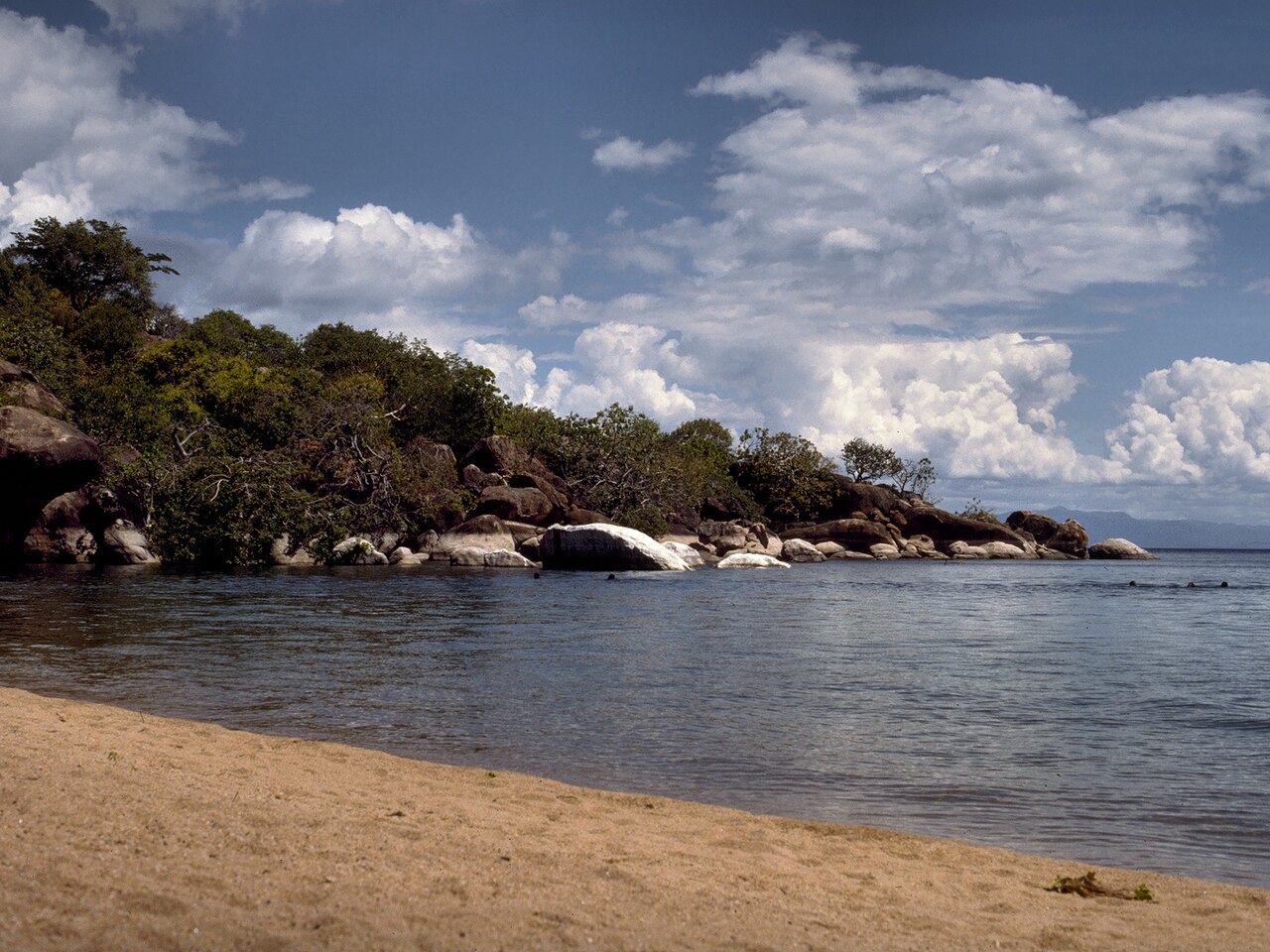
Image: Otter Point, Lake Malawi National Park, Cape Maclear, Malawi. Hans Hillewaert, CC BY-SA 4.0, via Wikimedia Commons.
Comments