


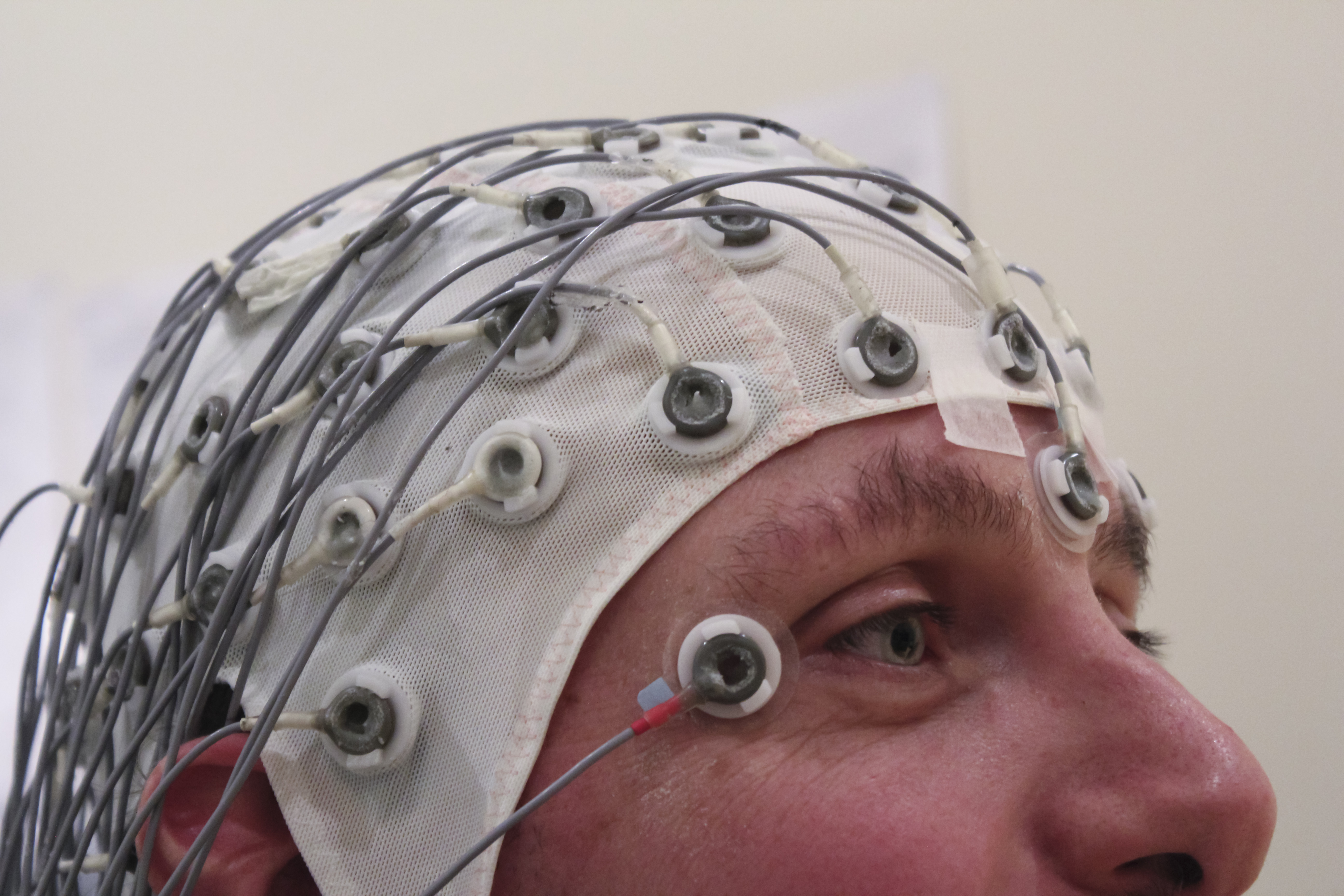
The speech brain-computer interfaces that have made headlines over the past few years all share a small, tiring catch. To produce a word, the user has to try to say it. The lips do not move much and no sound comes out, but the brain still fires off the full motor command as if it were pushing air through a paralyzed throat. Do that for a paragraph and it wears you out. Do it for a conversation and you are exhausted before you have made your point.
So a team spanning Stanford, UC Davis, Emory and Massachusetts General Hospital asked an obvious question with an uncertain answer. What if the user just thought the word instead, the way you silently rehearse a sentence before an awkward phone call? That kind of private, wordless narration is called inner speech. Nobody knew whether it left a strong enough footprint in the parts of the brain these implants listen to. In a study published in Cell, the group reports that it does, and that the footprint is clear enough to turn into text on a screen.
Listening to a voice with no sound
Four people with severe paralysis, each already carrying small arrays of microelectrodes in the motor cortex, took part. This is the strip of brain that plans and drives movement, including the movements of the mouth and tongue. The researchers had participants either attempt to speak or simply imagine saying words while the electrodes recorded the chatter of individual neurons.
Inner speech turned out to be far from silent down at the cellular level. When someone imagined a word, populations of neurons shifted their firing in patterns that closely tracked the patterns seen during attempted speech. The two were not identical. Imagined speech produced a weaker version of the same signal, and the team found a distinct neural dimension that seemed to mark the difference between merely thinking a word and trying to push it out. But the overlap was strong enough that a decoder trained largely on attempted speech could read imagined sentences drawn from a vocabulary of tens of thousands of words, in real time, as the person thought them.
The privacy problem nobody could ignore
That result cuts two ways, and the authors do not pretend otherwise. A system that reads the words you decide to send is a communication tool. A system that can pick up words you never meant to share is something else. To test how far the leakage went, the researchers had participants do tasks that tend to trigger involuntary inner speech, such as silently counting shapes on a screen or recalling a sequence. Some of that unprompted mental content could be decoded, at rates well above chance.
The same paper offers a fix built into how the interface works. The team designed the decoder to stay dormant unless the user first thinks an unusual keyword, a mental password. In their demonstration the phrase was "chitty chitty bang bang," a string of words unlikely to drift through anyone's head by accident. Only after the password registered would the system start turning thoughts into text. It is a simple idea borrowed from everyday computing, and it points to a design principle rather than a finished safeguard: these devices should be built so that the brain, not the engineer, decides when they are listening.
What the study can't say yet
This is a small study, four participants, all with electrodes already placed for other reasons. Inner speech is also not one clean thing. The kind you summon on command in a lab task may differ from the loose, fragmentary self-talk that runs under the surface all day, and the decoding of truly spontaneous private thought was partial, not fluent. The vocabulary tests, while large, are still a controlled setting rather than the open sprawl of real conversation.
There is also a gap between "detectable" and "readable." The team showed that some involuntary inner speech carries usable information, which is enough to justify guardrails, but that is not the same as a device reliably transcribing your private monologue against your will. The mental password was tested as a proof of concept, not hardened against a determined attempt to defeat it.
Still, the direction is worth sitting with. For the people these systems are meant to serve, decoding imagined speech could mean communicating without the fatigue that limits current devices, and maybe faster too. The same measurements that make that possible are the ones that raise the privacy question, which is why the two arrived in the same paper. Reading the mind and protecting it turn out to be the same engineering problem, and this study is the first to treat them that way.
Kunz et al. "Inner speech in motor cortex and implications for speech neuroprostheses." Cell, 2025. doi.org/10.1016/j.cell.2025.06.015
PubMed PMID: 40816265.
Photograph: Chris Hope, CC BY 2.0, via Wikimedia Commons.
Comments