
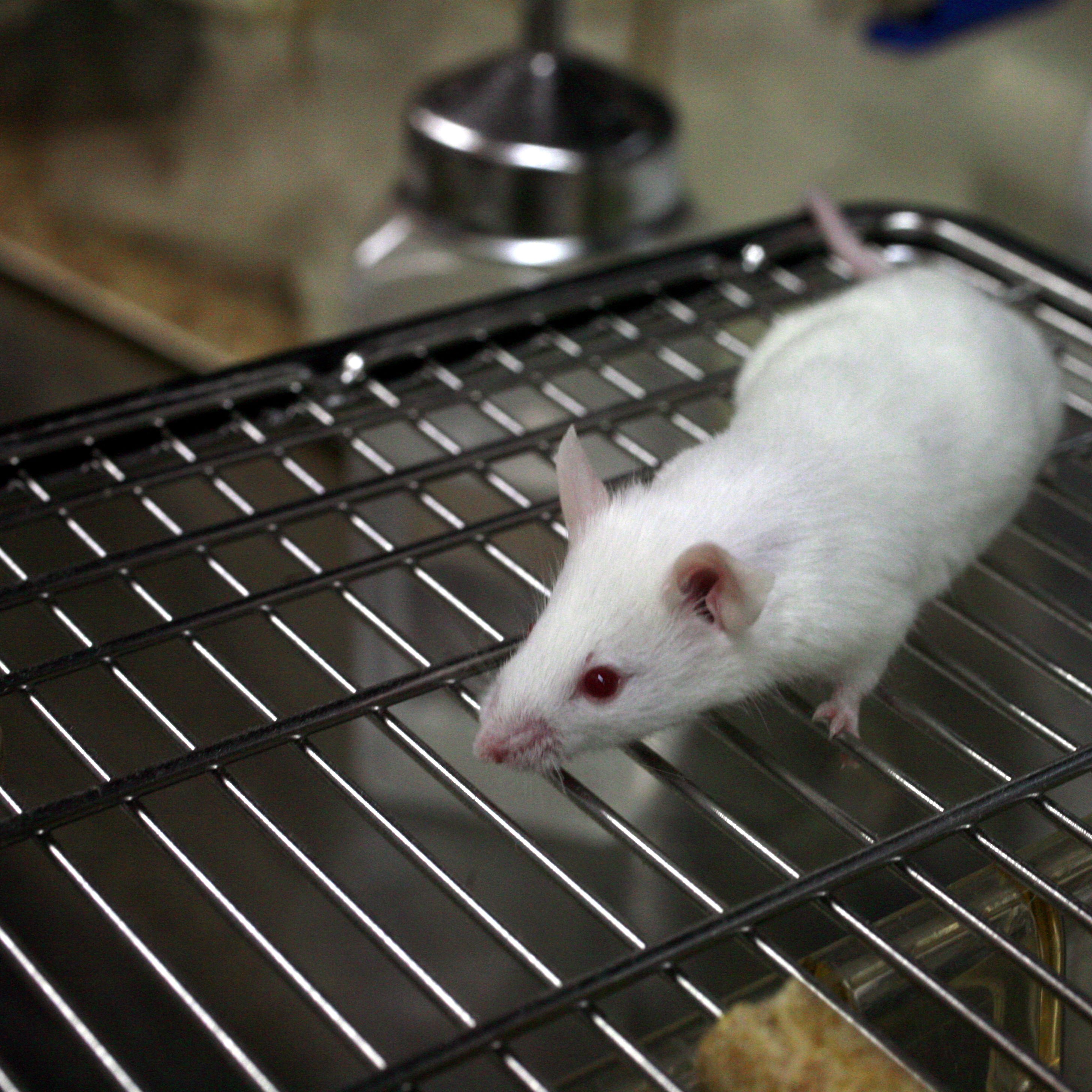
Drop an unfamiliar object into a mouse's cage and watch what happens. A well-fed mouse gives it a cautious sniff and mostly keeps its distance. A hungry mouse behaves differently. It approaches sooner, lingers, and investigates as if the strange thing might turn out to be food. That change in nerve is not just a mood. A new study in Neuron pins it to a measurable shift in a single brain chemical, in one small region, wired directly to the neurons that track how empty the stomach is.
The work comes from Bernardo Sabatini's lab at Harvard Medical School, with Tarun Kamath as first author. The team set out to answer a question that sounds obvious until you try to test it. Hunger makes animals bolder and more willing to take risks. That is useful. A starving animal that stays in its safe corner does not survive. But which circuit actually flips the switch from caution to boldness?
Reading dopamine one lifetime at a time
The researchers focused on the tail of the striatum, a slice of tissue that sits at the back of a larger structure involved in movement, habit, and reward. This region gets dopamine input, and dopamine there is thought to signal something closer to threat or novelty than to pleasure. To watch it in action, the team used fluorescence lifetime imaging of a dopamine sensor, a method that reads out chemical levels from the decay time of a glowing protein rather than raw brightness. That matters because it gives a more stable, quantitative measurement than simply watching a signal flash brighter or dimmer.
When they compared fed and food-deprived mice, the pattern was consistent. Hunger lowered dopamine signaling in the tail of the striatum. And that suppression tracked the behavior. As the caution signal dropped, the animals explored more. The researchers did not just observe the correlation. They mapped the wiring behind it.
From an empty stomach to a bolder step
The trail led back to AgRP neurons, the agouti-related peptide cells in the arcuate nucleus of the hypothalamus. These are the brain's best-known hunger cells. They fire hard during caloric depletion and quiet down after a meal. The paper shows these neurons reach the tail of the striatum indirectly, through a relay in the lateral hypothalamus, and through that path they turn down the local dopamine signal.
So the chain runs like this. An empty stomach drives AgRP activity. That activity, routed through the lateral hypothalamus, suppresses dopamine in the tail of the striatum. With the brake eased, the mouse explores a novel object more readily. It is a clean line from a metabolic state to a specific neuromodulator change to a shift in what the animal chooses to do.
What I find striking is the economy of it. The brain does not need to rewrite a whole behavioral program to make a mouse braver. It nudges one chemical in one place, and the animal's read on risk changes. Hunger is not adding courage so much as removing a note of caution.
What the study does and does not settle
This is mouse work, and the usual cautions apply. The behaviors measured were spontaneous movement and investigation of a novel object in the lab, not the full messiness of foraging in the wild. A polysynaptic pathway through the lateral hypothalamus leaves room for other inputs to shape the signal, and the paper does not claim AgRP neurons are the only voice reaching this region. Whether the same tail-of-striatum mechanism carries over to how humans weigh risk when hungry is an open question rather than a demonstrated fact. Anyone who has made a regrettable decision at the grocery store on an empty stomach might suspect a parallel, but suspicion is not evidence.
Still, the result adds something concrete to a long-standing idea. We have known for years that hunger reshapes behavior. This study offers a physical account of one route by which it happens, down to the neuromodulator and the neurons that push it around. For researchers trying to understand why internal states bias decisions, that is a useful handhold. It also hints at why appetite and risk-taking so often travel together, and where in the brain that link might be built.
Kamath, T. et al. "Hunger modulates exploration through suppression of dopamine signaling in the tail of the striatum." Neuron, 2025. doi.org/10.1016/j.neuron.2025.09.009
PubMed PMID: 41043421.
Photograph: Rama, CC BY-SA 2.0 fr, via Wikimedia Commons.
Comments