
For years the story looked settled. When herpes simplex virus 1 or influenza A gets inside a cell, a protein sensor named ZBP1 detects the intruder and can pull the trigger on programmed cell death, killing the infected cell before the virus finishes replicating. ZBP1 recognizes an unusual, left-handed twist of nucleic acid called Z-RNA. So the assumption was straightforward: the Z-RNA came from the virus. The sensor was reading the enemy.
A team led by Chaoran Yin and Siddharth Balachandran at Fox Chase Cancer Center, working with collaborators across the US, Germany, the UK and China, went looking for those viral Z-RNAs. They did not find them where everyone expected. Reporting in Nature, they show that the Z-RNAs setting off ZBP1 during these infections are made by the host cell, not the pathogen. The alarm the immune system trips is built from the cell's own transcripts.
The genome talks too much when a virus arrives
The researchers mapped the cellular Z-RNAs that accumulate after infection. Most of them traced back to endogenous retroelements, ancient viral fragments long ago stitched into our own DNA, sitting in the intergenic spaces between genes. Normally those sequences stay quiet. What dragged them into the conversation was a breakdown in how the cell finishes its messenger RNAs.
Healthy cells cut and cap their transcripts at defined stop points, a process handled by a machine called the cleavage and polyadenylation specificity factor, or CPSF. Both HSV-1 and influenza A jam that machine. When they do, transcription runs past its usual endpoints, producing messenger RNAs with abnormally long tails that reach into those buried retroelements. The phenomenon has a name: disruption of transcription termination, DoTT for short. Those runaway tails fold into Z-RNA. And Z-RNA is exactly what ZBP1 is waiting for.
So the virus does not deliver the trigger. It causes the cell to manufacture it, as a side effect of sabotaging the cell's RNA-processing machinery.
Testing whether the virus is really the cause
To check that the viral attack on CPSF was doing the work, the team turned to mutant viruses. HSV-1 uses a protein called ICP27 to shut down CPSF and force DoTT; influenza A uses a protein called NS1 for the same job. Viruses stripped of those proteins failed to make host cells pile up Z-RNA, and they were much weaker at switching on ZBP1.
The reverse experiment closed the loop. Forcing cells to produce ICP27 or NS1 on their own, with no infection at all, was enough to trigger the Z-RNA buildup and fire ZBP1. So did a drug that blocks CPSF directly. Same outcome, no virus in sight. That points to the disruption of transcription termination itself, rather than anything specific to a viral genome, as the event the sensor is responding to.
Read together, the findings reframe what ZBP1 is for. It is not simply scanning for foreign genetic material. It is watching for a symptom of infection, the collapse of orderly transcription, and treating that collapse as reason enough to sacrifice the cell.
What the work does not settle
This is mechanism worked out in cells and with two viruses. Whether the same host-derived alarm operates during infection in a living animal, and how much it contributes to fighting off real disease, are open questions the paper does not answer. Plenty of other pathogens interfere with transcription termination, so it is tempting to generalize, but the study only tested herpes and flu. And cell death is a blunt defense; there are situations where killing infected cells helps the host and situations where the collateral damage is part of what makes an illness severe. Sorting out which is which will take more work.
What is striking is the inversion at the center of it. A sensor long thought to detect the virus turns out to detect the cell's own reaction to being attacked. The most reliable sign that something has gone wrong, it seems, is the host genome behaving abnormally, and evolution appears to have wired a kill switch to that signal.
Yin, C. et al. "Host cell Z-RNAs activate ZBP1 during virus infections." Nature, 2025. doi.org/10.1038/s41586-025-09705-5
PubMed PMID: 41082924.
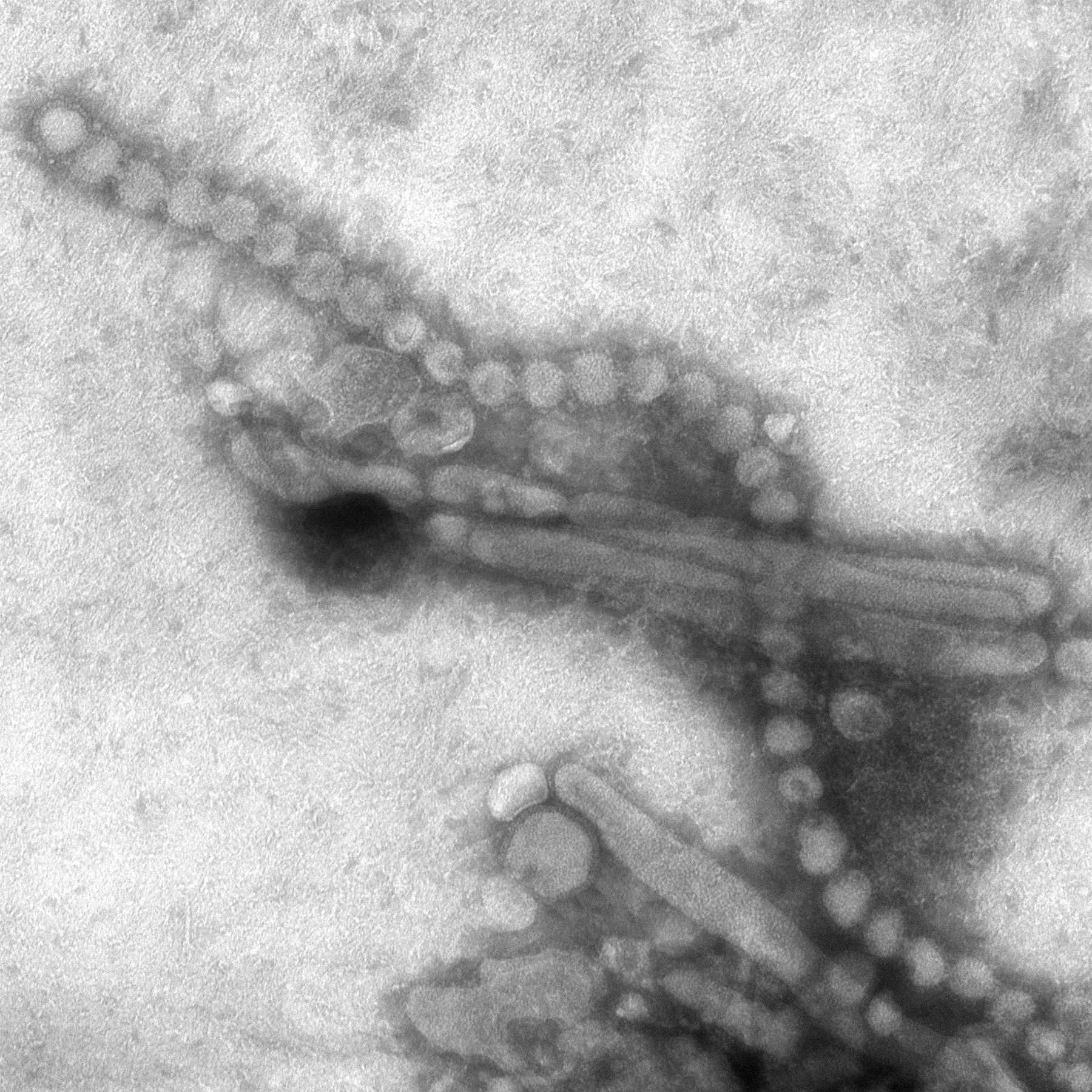
Photograph: Cynthia S. Goldsmith and Thomas Rowe, CDC, Public domain, via Wikimedia Commons.
Comments