
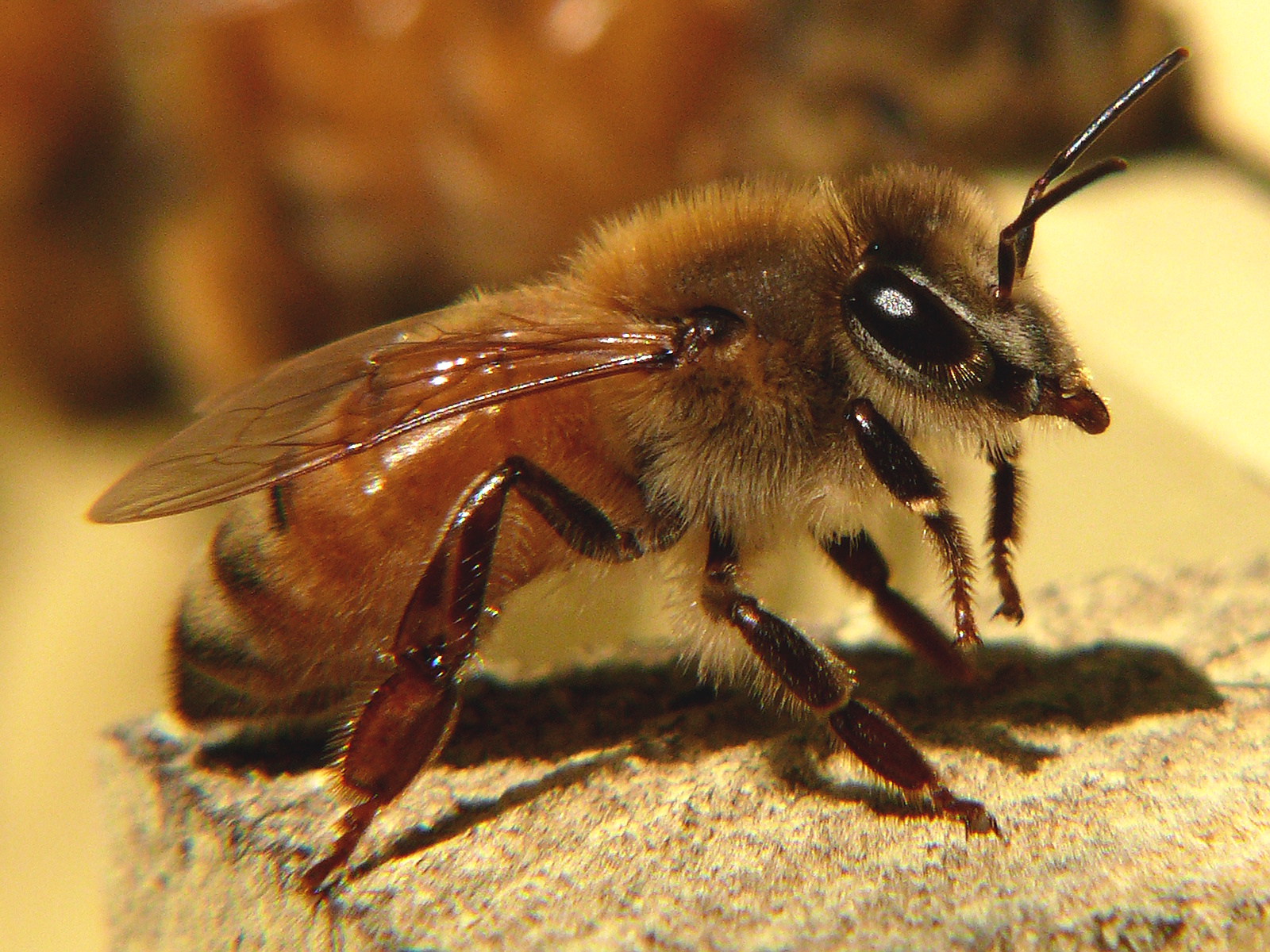
A honeybee carries a small city of bacteria in its gut, and those microbes do more than digest pollen. They seem to talk to their host. The trouble has always been figuring out how. A study published this week in Nature Communications pins down one channel: the bee's resident bacteria bud off tiny membrane bubbles loaded with DNA and RNA, and they do it while staying alive.
That last part matters more than it sounds. Bacteria are known to release membrane vesicles, but the field has been muddled by a basic question. Are these packages a deliberate export, or just wreckage from cells that burst and spilled their contents? If a vesicle is only debris from a dead cell, it says little about active communication. The team, led by Nurila Kambar with senior author Nancy Moran at the University of Texas at Austin, set out to tell the two apart.
Reading a vesicle's origin from its skin
They turned to cryogenic electron microscopy, which flash-freezes samples and images them without stains or chemical fixatives that could distort delicate structures. Frozen mid-action, the vesicles revealed their own architecture. Gram-negative bacteria wrap themselves in two membranes, an inner and an outer. A bubble pinched only from the outer membrane looks different from one that captures both layers, and both look different from the shapeless scraps left when a cell ruptures.
Using that ultrastructure as a fingerprint, the researchers sorted vesicle types across several species. The honeybee symbionts Snodgrassella alvi, Gilliamella apicola, and Gilliamella apis showed clean budding of both outer-membrane vesicles and outer-inner membrane vesicles. By contrast, Escherichia coli and Salmonella enterica, two lab standbys that are not bee symbionts, produced membrane debris and self-assembled clumps. That pattern points to lytic release, the messy kind that comes with cell death.
Cargo from inside the cell
The composition told a similar story. Vesicles from the bee symbionts carried significantly more nucleic acid than those from the non-symbionts. And when the team ran assays on the DNA and RNA inside S. alvi vesicles, the material traced back to the bacterial cytoplasm. In other words, the packages were not scooping up loose molecules from the surroundings. They were carrying the cell's own interior contents, sealed and shipped out.
This connects to something the Moran lab has chased for years. Researchers have engineered S. alvi to trigger RNA interference in honeybees, a way to switch off specific genes in the insect, including genes belonging to viruses and parasitic mites that devastate colonies. How the bacterial RNA reached the bee's cells was never fully clear. Non-lytic vesicles offer a plausible courier. If a symbiont can pack RNA into a stable bubble and hand it off to host tissue, that is a delivery route worth understanding, and potentially worth exploiting.
What the study stops short of showing
The work maps the packaging and the cargo. It does not follow a vesicle all the way into a bee cell and watch it release its contents there. The link to the host is inferred from the cytoplasmic origin of the cargo and from the earlier RNAi results, not from a tracked handoff inside a living bee. The vesicles that carry the most nucleic acid come from cultured bacteria, and a gut is a busier, messier place than a flask. Whether the same budding happens at the same rate inside a foraging bee remains open. And the therapeutic angle, using engineered symbionts to shore up bee immunity, is a direction the authors point toward, not a result they demonstrate.
Still, the method itself is a contribution beyond bees. A reliable way to distinguish non-lytic vesicle production from lytic debris, read straight off membrane structure, gives microbiologists a tool for a question that has generated conflicting reports for years. Pollinator decline has made honeybee health an urgent practical problem, and colonies keep losing ground to viruses and Varroa mites. A gut bacterium that can quietly ship genetic instructions to its host is the kind of biology that could, eventually, be turned into a defense.
Kambar, N. et al. "Symbiotic bacteria produce non-lytic vesicles with nucleic acid cargo." Nature Communications, 2026. doi.org/10.1038/s41467-026-73834-2
PubMed PMID: 42230617.
Photograph: Ken Thomas, Public domain, via Wikimedia Commons.
Comments