
Evolution is supposed to run through genes. Parents pass DNA to offspring, natural selection favors some variants over others, and traits drift across generations. But animals carry a second set of instructions in their guts, and that set can be handed off too. A team led by Taichi A. Suzuki at the Max Planck Institute for Biology in Tubingen set out to test a blunt question: could you shift a mammal's behavior by selecting on its microbiome alone, without touching the host genome at all?
The answer, reported in Nature Communications, is yes. They bred nothing. They moved microbes.
Locomotion that travels with the bacteria
The first step was to show that a behavior could ride along with a gut community. The researchers took feces from wild-derived mouse strains and transferred them into germ-free male mice, animals raised with no microbes of their own. Locomotor activity, meaning how much the mice moved around, tracked with the transplanted microbiome. Recipients started behaving in ways that matched their donors rather than their own lineage.
That set up the real experiment. The team ran four rounds of one-sided selection. In each round they took the microbiomes from the least active donor mice and passed them into a fresh batch of germ-free recipients, then measured activity again and repeated. A control line received microbiomes from randomly chosen donors instead of the low-activity ones.
By the later rounds the two lines had pulled apart. The selection line, seeded each time from the calmest mice, showed a measurable drop in locomotion. The randomly transferred control line did not. Nothing in the recipients' DNA was being selected. The only thing under pressure was which bacteria got to move on to the next generation of hosts.
Down to a single molecule
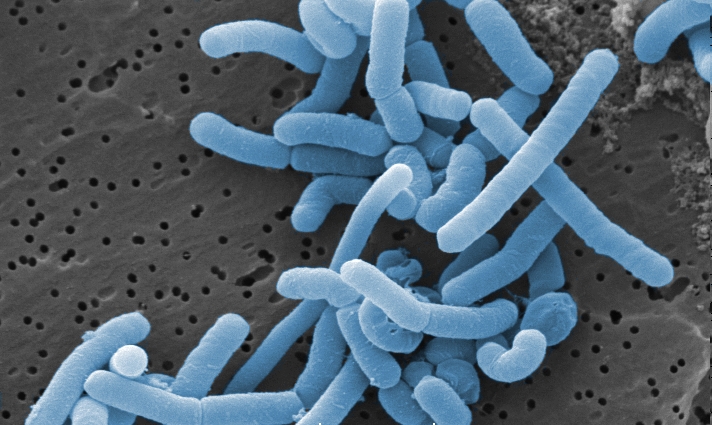
What actually changed inside the gut? The reduced activity lined up with an enrichment of Lactobacillus and with higher levels of one of its metabolites, indolelactic acid. This is the kind of correlation that usually leaves you guessing. The authors went further and tested the two suspects directly. Giving mice Lactobacillus on its own suppressed locomotion. Giving them indolelactic acid alone did the same. Either intervention was sufficient to push activity down.
So the causal chain has a clean shape. Select for calmer hosts, and you end up selecting for a bacterial genus and a small molecule it makes, and that molecule is enough to quiet the animal. The behavior was inherited, but it was inherited through the microbes and their chemistry, not through the mouse's own genes.
What this does and does not show
Some limits are worth stating plainly. The work used only male mice, and locomotor activity is one trait among many, so it would be a stretch to assume every heritable-looking behavior can be routed through the gut this way. Selection was one-sided, pushing activity in a single direction, which is a cleaner design than what wild populations experience. And a laboratory germ-free mouse is a controlled instrument, not a stand-in for a rodent negotiating a real environment with its own established flora. The mechanism connecting indolelactic acid to movement also remains to be filled in.
Still, the core claim is hard to wave away. A trait that natural selection could act on was passed across host generations with the host genome held fixed. That reframes the microbiome as something more than a passenger that influences metabolism or mood. It becomes a channel of inheritance in its own right, one that selection can grab onto.
For a field that has spent years cataloging correlations between gut bugs and behavior, this is a rare demonstration of the arrow pointing the way people suspected. The microbes did not just associate with a quieter mouse. Selected and transmitted on their own, they built one.
Suzuki, T. A. et al. "Selection and transmission of the gut microbiome alone can shift mammalian behavior." Nature Communications, 2025. doi.org/10.1038/s41467-025-65368-w
PubMed PMID: 41145520.
Photograph: Dr. Horst Neve, Max Rubner-Institut, CC BY-SA 3.0 de, via Wikimedia Commons.
Comments