


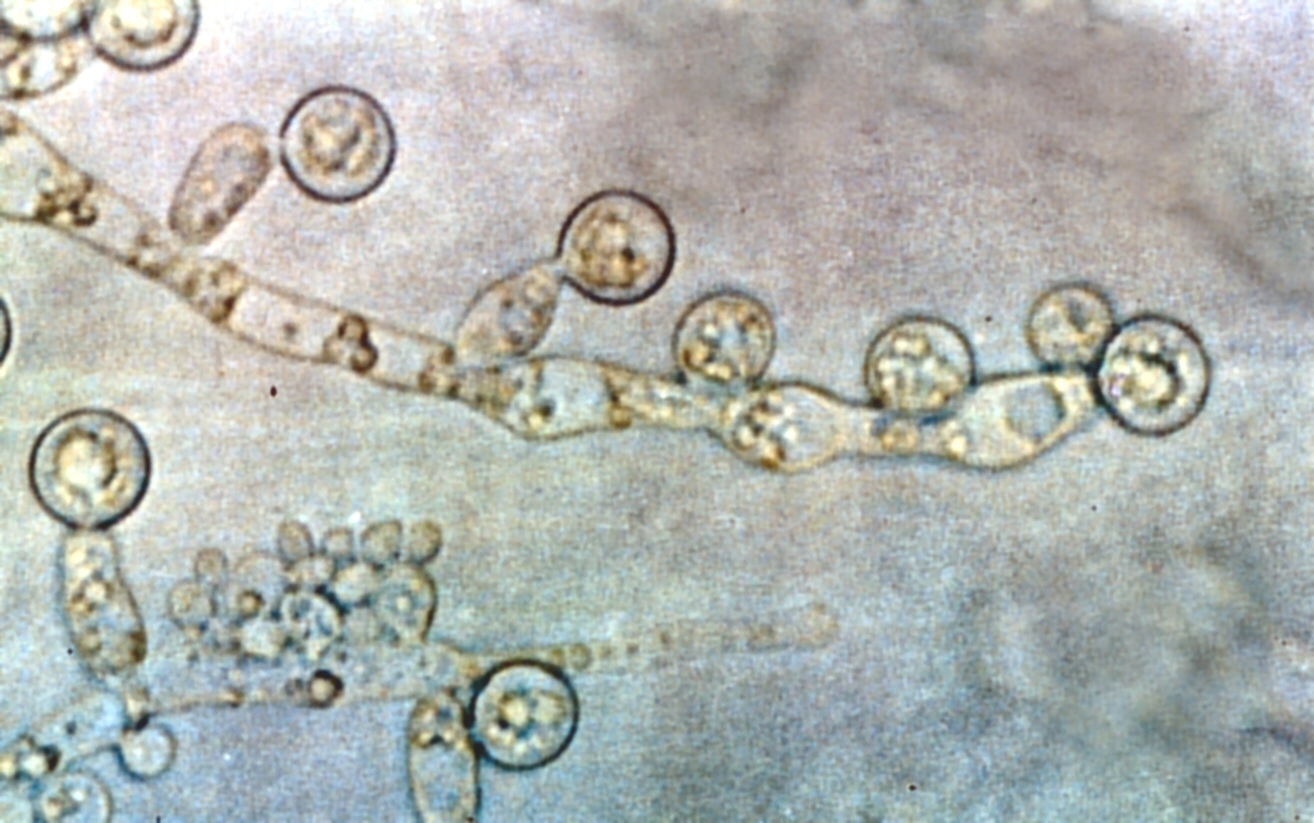
Microbes in the gut are not just neighbors. They compete for the same crowded space, and some of them fight. A new study describes one weapon in that fight and, more surprisingly, how a bacterium decides when to use it. The trigger turns out to be a message the enemy was never sending to the bacterium at all.
The work, published in Nature Microbiology, focused on Yersinia pseudotuberculosis, an enteric bacterium, and its run-ins with Candida albicans, the yeast that lives in many people and can turn dangerous when the balance of the gut breaks down. The researchers found that the bacterium carries a molecular syringe that can kill the fungus. And it seems to know when Candida is present because it can pick up on a chemical the fungus uses to coordinate its own population.
A syringe built for fungi
The weapon is a type VI secretion system, or T6SS. These are spring-loaded injection machines that bacteria use to jab neighboring cells and deliver toxic cargo. Most described T6SS effectors target other bacteria or host cells. This one targets a fungus.
The team identified the effector as a protein they call TfeC, a chitinase. Chitin is the tough polymer in fungal cell walls, so an enzyme that chews through it is a plausible way to damage Candida. Structural and biochemical analyses backed up the idea, and the purified activity could kill C. albicans. In mice, bacteria that expressed TfeC colonized the gut better and drove down fungal abundance. Take away the working T6SS, and the fungus held its ground.
Eavesdropping on a private conversation
The more unusual part is the signal. Fungi like Candida use quorum sensing, releasing small molecules that let a population gauge its own density and adjust behavior accordingly. One of those molecules is tyrosol. It is a fungal word, meant for other fungal cells.
The bacterium reads it anyway. According to the study, Y. pseudotuberculosis senses tyrosol through a two-component system called EnvZ-OmpR, a common bacterial setup for detecting environmental cues. When tyrosol is around, that system switches on the antifungal apparatus, which the authors identify as T6SS4. So the bacterium is effectively listening in on the fungus counting its own numbers, and using that intercepted information to time an attack.
This is a concrete example of interkingdom communication, where a chemical evolved for one purpose in one lineage gets co-opted as intelligence by an organism from a completely different branch of life. The fungus broadcasts. The bacterium decrypts and responds with a weapon.
What this does and does not tell us
The findings come from a mouse model and from experiments with defined bacterial and fungal strains, including engineered mutants that lack the T6SS or specific effectors. That is the right way to establish cause and effect, but it is a controlled setting. The human gut holds hundreds of species interacting at once, and whether this particular sensing-and-striking loop matters amid that noise is not something a mouse can settle. The authors demonstrate the mechanism; they do not claim it governs fungal levels in people.
It is also worth keeping the actors in perspective. Yersinia pseudotuberculosis is a pathogen, not a friendly resident, so "the bacterium suppresses the fungus" is not the same as "this is good for the host." What the work really shows is a design principle: bacteria can tune their aggression to chemical cues leaking from their targets.
Still, the logic is worth sitting with. If microbes routinely eavesdrop on each other's quorum signals, then the chemistry of the gut is less a set of private channels and more an open room where everyone can overhear everyone else. Tyrosol may be one of many molecules doing double duty as both a within-species memo and a between-kingdom tipoff. Mapping those crossed wires could eventually suggest ways to nudge which microbes win, though that is a long way off. For now, the takeaway is simpler. In the gut, listening is a form of combat.
Zhu, L. et al. "Interkingdom sensing of fungal tyrosol promotes bacterial antifungal T6SS activity in the murine gut." Nature Microbiology, 2025. doi.org/10.1038/s41564-025-02208-z
PubMed PMID: 41350923.
Photograph: Dr Graham Beards, CC BY-SA 3.0, via Wikimedia Commons.
Comments