A forest carbon credit is a promise that carbon will stay out of the atmosphere for a century. Trees burn, and beetles and drought kill them, so the promise needs insurance. That insurance is the buffer pool: credits set aside unsold, to be cancelled when a project's forest is destroyed. The buffer pool is the only thing standing between a credit and a claim that quietly fails, and its size is set by estimating how much carbon will be lost to disturbance over a hundred years.
That estimate has been made from the past. The authors of a new analysis state the gap plainly: disturbances that could result in losses of forest carbon stocks are poorly accounted for when estimating the potential role of forests in climate mitigation. A group spanning Tsinghua University and the University of Utah recalculated it from forest inventory records, satellite observations, disturbance modelling and machine learning, mapping century-scale loss risk across the forests of the contiguous United States under a changing climate rather than a stationary one.
Why it matters: If the buffer pool is undersized, credits already sold as permanent are not backed, and the shortfall is not a theoretical accounting concern. It means emissions that were treated as offset are still in the atmosphere.
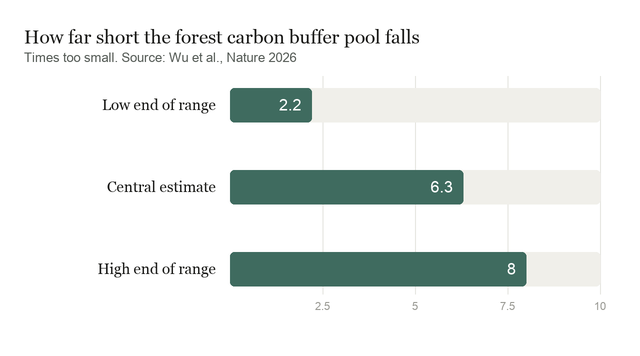
The central result is a multiple, not a percentage. The current buffer pool of the largest CONUS forest climate mitigation programme is likely too small by an average factor of 6.3, and this could range from 2.2- to 8.0-fold too small when considering uncertainties around future climate scenarios, disturbance severity and other carbon pools. Even the most favourable end of that range, reported by Wu et al. in Nature, leaves the pool less than half the size it needs to be.
Why the shortfall is a multiple, not a rounding error
The failure is structural rather than arithmetic. A buffer pool calibrated on twentieth-century fire, drought and insect outbreaks assumes those rates carry forward. Climate change breaks the assumption in the specific way that matters most to an insurance mechanism: it raises the mean and fattens the tail at once. Insurance priced on a stationary distribution is mispriced when the distribution moves, and the error compounds over a hundred-year commitment.
The risk is also concentrated. California and the Intermountain West carry the sharpest increases, and those are not incidental locations. They hold a substantial share of American forest offset projects, because that is where large tracts of high-biomass forest could be enrolled. A pooled national buffer sized on a national average will be drawn down by regional catastrophes, and correlated loss is precisely what pooled insurance handles worst. One bad fire season in the wrong state does not average out against a quiet season elsewhere.
The spatially explicit maps are the practically useful output. A single national buffer rate cannot be right everywhere if the underlying risk varies by an order of magnitude across regions, and a map lets a buffer be sized to the place a project actually occupies.
What the study can't say yet
This is a projection, and the factor of 6.3 is an average across scenarios rather than a measurement. Its own stated range, 2.2 to 8.0, spans nearly a fourfold spread, which is the honest signal of how much depends on emissions pathway, disturbance severity assumptions and which carbon pools are counted. The direction of the finding is robust across that range. The magnitude is not, and reporting the central number without the range would misstate what was established.
Century-scale disturbance modelling also inherits compounding uncertainty from every layer. Fire, drought and insect dynamics interact, vegetation shifts as climate moves, and forests that regrow after disturbance differ from those that burned. Machine learning trained on the observed record extrapolates into conditions outside that record, which is exactly where such models are least reliable and where this analysis necessarily operates.
The scope is the contiguous United States and one crediting programme. Whether the same multiple applies to tropical forest credits, to other registries, or to different project types is not addressed here, and the drivers differ enough that it should not be assumed.
Finally, the paper identifies a mismatch; it does not resolve what follows from it. Whether a shortfall of this size is best fixed by enlarging buffers, shortening permanence claims, pricing regional risk separately or discounting forest credits against other mitigation is a policy question the analysis informs without answering. The authors' conclusion is narrower than the headline: current methodologies used for constructing carbon offset buffer pools require revisions to succeed under climate change. Revision, not abandonment.
Quick questions
What is a buffer pool? A reserve of unsold credits held back from projects as self-insurance. If a project's forest burns, credits are cancelled from the reserve so the promised carbon storage is still accounted for.
Does this mean forest offsets do not work? It means the insurance behind them is sized on the wrong risk. Forests still store carbon; the finding is that the reserve covering loss is too thin under a changing climate.
What's the one-line takeaway? Recalculating century-scale disturbance risk under climate change leaves the largest US forest carbon programme's buffer pool short by a central factor of 6.3, and short even at the most favourable end of a 2.2 to 8.0 range.
Wu C, Badgley G, Goulden ML, et al. "Forest carbon protocols underestimate climate-driven carbon loss risks." Nature, 2026;654(8117):107-113. doi.org/10.1038/s41586-026-10571-y
PubMed PMID: 42162435.
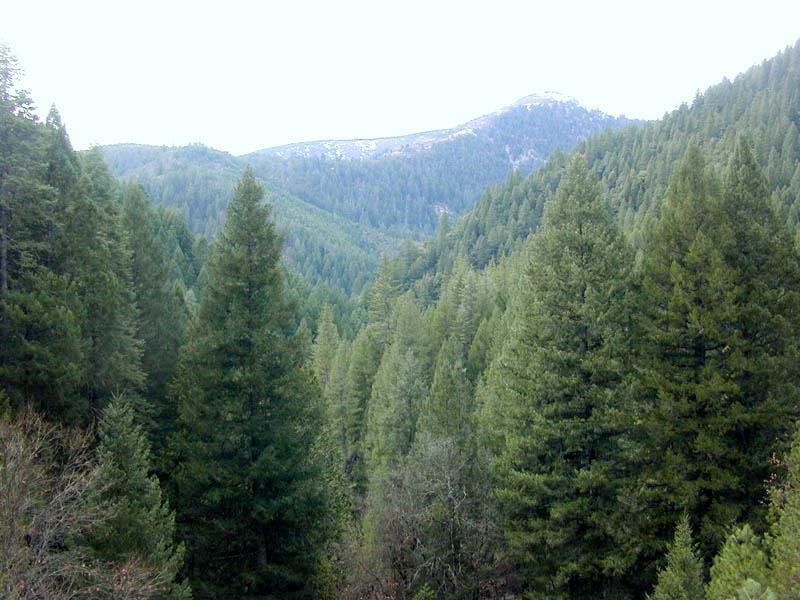
Image: conifer forest. Via Wikimedia Commons.
Comments