
Most of what we know about killer immune cells comes from a short list of usual suspects. T cells, natural killer cells, neutrophils. All of them trace back to the same blood-forming lineage. A study published this week in Cell adds a stranger character to the cast. In planarian flatworms, a research team found a cell that kills by blowing itself apart.
They call it a ruptoblast. When triggered, it undergoes a violent form of death the authors named ruptosis. The cell ruptures and releases diffusible toxic compounds that can destroy neighboring cells, bacteria, and even mammalian cells nearby. This happens in minutes. It is fast, messy, and effective.
A grenade instead of a sniper rifle
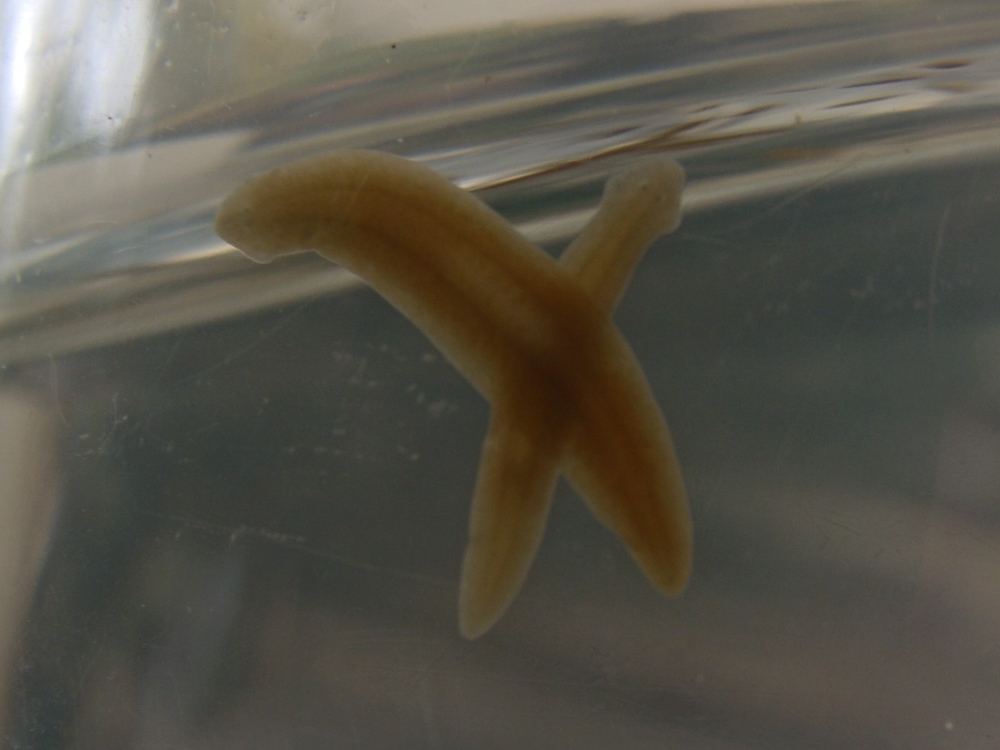
Planarians are the small freshwater flatworms famous for regeneration. Slice one in half and each piece regrows into a whole animal. That regenerative talent has made them a favorite in developmental biology for over a century. Their immune biology has drawn far less attention.
The Stanford and Ben Gurion University team, led by first author Chew Chai, traced ruptoblasts to a gland-like cell type that had gone unrecognized. What sets these cells off is activin, a hormone that doubles as an inflammatory signal. Push activin levels too high and ruptosis begins. The researchers managed this three different ways: injecting the protein directly, creating genetic chimeras, and infecting the worms with bacteria. Each route lit the same fuse.
The payoff of watching that fuse burn was clear. When the team ablated ruptoblasts, inflammation dropped. But the worms also lost much of their ability to clear a bacterial infection. So the explosion is not just collateral damage. It is a defensive weapon with real reach, capable of hitting targets a single cell could never touch through direct contact.
How the blast gets built
The mechanics look unlike other known forms of cell death. Ruptosis does not follow the familiar scripts of apoptosis or the inflammatory death pathways that immunologists usually invoke. Instead it runs on calcium released from the endoplasmic reticulum, the cell's internal storage network, combined with a cytoskeleton-dependent step that amplifies the signal. Once the amplification crosses a threshold, the cell commits. There is no half-detonation.
That amplification detail matters. It explains how a slow chemical cue can produce an all-or-nothing physical event. The cell essentially converts a rising hormone signal into a mechanical burst, coupling the body's hormonal surveillance to an immediate immune response.
The evolutionary angle is the part that reaches beyond flatworms. The authors report that ruptoblast-like cells show up across diverse basal bilaterians, a deep branch of the animal family tree. If that holds, these exploding cells are not a planarian quirk. They point to an ancient strategy for immune defense that predates the blood-cell-based systems we tend to treat as the default.
What this does not settle
This is a discovery paper, and it leaves the obvious questions open. The work shows ruptoblasts exist, what triggers them, and that they help clear bacteria in worms. It does not identify the exact cocktail of cytotoxic molecules released, nor does it work out how a planarian avoids shredding its own healthy tissue when so much diffusible poison is loosed at once. The claim that these cells guard other animals rests on their appearance in related species, not on functional tests in those species. And nothing here maps onto human immunity in any direct way. Flatworms are not people, and activin does very different jobs in us.
Still, finding a genuinely new mode of immune killing is rare. Cytotoxic biology felt fairly settled. A cell that answers a hormone by detonating, and takes the local bacteria with it, is a reminder that the immune toolkit is older and weirder than the textbook version suggests.
Chai, C. et al. "Explosive cytotoxicity of ruptoblasts bridges hormone surveillance and immune defense." Cell, 2026. doi.org/10.1016/j.cell.2026.05.008
PubMed PMID: 42229422.
Photograph: Eduard Sola Vazquez (User:Esv), CC BY-SA 3.0, via Wikimedia Commons.
Comments