


People with hemophilia B are missing a working copy of one gene. That gene makes Factor IX, a protein in the clotting cascade. Without enough of it, bleeds happen easily and are slow to stop, and the standard defense is to inject Factor IX concentrate on a schedule, often for life. The premise of gene therapy is blunt by comparison: put a functional gene into the liver once and let the body manufacture its own Factor IX.
A team led by researchers at the Institute of Hematology in Tianjin has now reported how that idea performed in a formal trial program in China. Writing in Nature Medicine, they describe a phase 1/2 dose-finding study followed by a multicenter phase 3 trial of an adeno-associated virus (AAV) vector called BBM-H901. According to PubMed, the work appeared on November 20, 2025.
Why a padua variant does the heavy lifting
The therapy does not deliver an ordinary copy of the Factor IX gene. It carries the Factor IX-Padua variant, a naturally occurring version that is roughly several times more active than the normal protein. That matters because AAV liver gene therapy tends to produce modest amounts of protein. Starting with a hyperactive version means a given quantity of gene product goes further, so a lower vector dose can push clotting activity into a useful range.
The phase 1/2 portion enrolled 6 male participants and set out to find a workable dose while watching for dose-limiting toxicities. No dose-limiting toxicity showed up in the ten weeks after infusion, and no grade 3 drug-related adverse event occurred within 52 weeks. The most common drug-related problem was transaminitis, a rise in liver enzymes, in about a third of participants. Elevated liver enzymes are a known signature of AAV liver gene therapy and are usually managed rather than dangerous, but they are the reason these patients need close monitoring after treatment.
What the phase 3 numbers actually say
The larger phase 3 trial treated 26 participants at the dose chosen in the earlier study. The headline endpoint was the annualized bleeding rate, essentially how many bleeds a person has per year. Within 52 weeks of a single infusion, the mean annualized bleeding rate fell to 0.60, with a 95% confidence interval running from 0.18 to 1.99. The upper edge of that interval sat below the study's predefined superiority margin of 5.0, the bleeding rate assumed for patients on standard preventive Factor IX treatment in China. In plainer terms, one dose beat the benchmark for ongoing prophylaxis.
Two other figures fill in the picture. At week 52, the vector-derived Factor IX activity averaged 41.9 IU per deciliter, which lands in a range where spontaneous bleeding becomes uncommon. And 80.8 percent of participants had zero bleeds across the full year of follow-up. None developed a target joint, the term for a joint that bleeds repeatedly and accumulates damage over time.
The parts worth holding lightly
These are strong signals, but they come with boundaries. The cohorts are small, 6 and 26 participants, and drawn entirely from centers in China, so the results describe this population rather than every patient everywhere. Everyone enrolled was male, which fits the X-linked inheritance of hemophilia B but leaves other groups unstudied here. The follow-up runs one year; AAV gene therapy is a one-shot intervention, and the questions that matter most for it are about durability, whether Factor IX output holds steady over five or ten years or slowly fades. A year cannot answer that. There is also the vector-immunity issue that shadows all AAV therapies: because the immune system can recognize the delivery virus, redosing later is generally not an option, which raises the stakes on how long the first dose lasts.
Still, the trial adds a sizable, carefully documented cohort to a field that has been building toward this for a decade. A protein made hyperactive by a quirk of human genetics, packaged into a virus and delivered once, kept most of these patients bleed-free for a year. The next chapter is simply time.
Xue, F. et al. "Factor IX-Padua AAV gene therapy in hemophilia B: phases 1/2 and 3 trials." Nature Medicine, 2026. doi.org/10.1038/s41591-025-04012-y
PubMed PMID: 41266685.
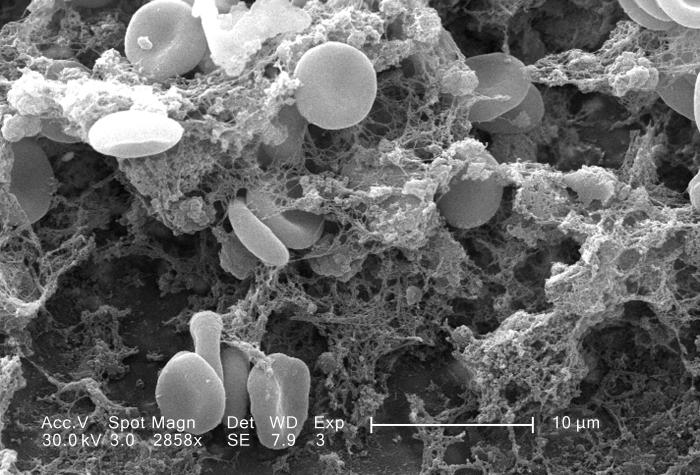
Photograph: Janice Carr, Public domain, via Wikimedia Commons.
Comments