

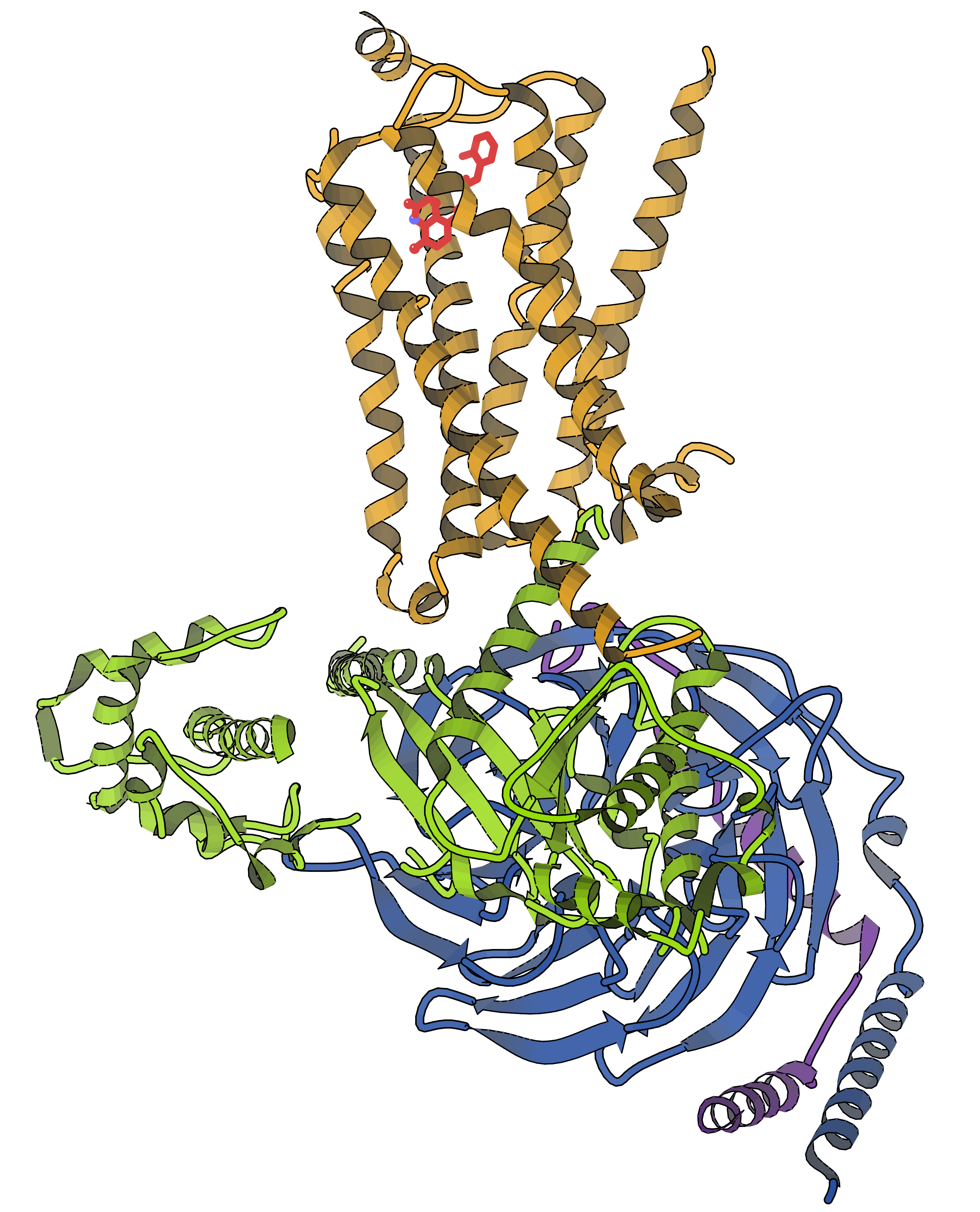
Almost every drug that acts on a G-protein-coupled receptor, or GPCR, aims for the same spot. It is the orthosteric site, the pocket where the receptor's natural signal molecule normally docks. Roughly a third of approved medicines work this way. But that pocket is crowded real estate, and hitting it selectively across a family of closely related receptors is hard.
A team led by Yan Zhang at Zhejiang University decided to aim somewhere else entirely. In a paper published in Nature on February 16, they describe a class of designed proteins that ignore the front-door pocket and instead clamp onto the receptor's transmembrane region, the bundle of helices buried in the cell membrane. They call the designs GPCR exoframe modulators, or GEMs.
Borrowing a trick from biology
The idea did not come from scratch. Cells already regulate GPCRs using other membrane proteins that press against the receptor from the side. The researchers took that natural arrangement as a template and asked whether a computer could invent brand-new proteins to do the same job on demand.
They used what they describe as a hallucination-like design approach. Rather than copying an existing protein, the method lets a neural network dream up a plausible protein backbone that satisfies a target shape, then refines it. The team fed the process three structural prompts meant to steer each design toward a particular way of gripping the receptor. Out came proteins that had never existed in any organism, built to wedge against the transmembrane domain.
As a test case they picked a dopamine receptor, a well-studied GPCR tied to conditions ranging from Parkinson's to schizophrenia. They built four GEMs and worked through them one by one.
Four proteins, four behaviors
What makes the result more than a binding demo is that the designs did not all do the same thing. Because they touch a site away from the natural pocket, they act as allosteric modulators, tuning the receptor rather than blocking or triggering it outright. The four GEMs split into different modes. One boosted the effect of the receptor's natural agonist. Another damped signaling down. A third produced biased signaling, nudging the receptor toward one downstream pathway over another.
The team backed these functional readouts with structural work showing where and how the proteins sat against the transmembrane helices. That matters. A designed binder is only convincing when you can see it doing what the model predicted, and the structures confirmed the intended binding modes.
The most striking case was the agonist-boosting design. GPCRs sometimes carry loss-of-function mutations that leave the receptor sluggish or dead, and such mutations underlie various diseases. The positive-modulator GEM restored activity to several of these broken dopamine receptor variants. A protein invented on a computer, propping up a receptor that a genetic mutation had disabled.
Promising, but early
This is a proof of concept, not a therapy. The work centers on one receptor and a handful of designs, tested in cell and biochemical assays rather than in animals or people. Designed membrane proteins are notoriously finicky, and whether GEMs can be delivered into the body, hit the right receptor among thousands, and behave safely is unknown. The transmembrane surface is chemically greasy and structurally similar across many GPCRs, so the selectivity that motivated this approach still has to be proven case by case.
Even with those caveats, the direction is worth watching. GPCRs are among the most valuable targets in medicine, and most efforts to drug them fight over the same small pocket. Showing that you can design a protein to grab the receptor's outer frame, and dial its behavior up, down, or sideways, opens a different route. The authors frame it as evidence that deep-learning design is ready to tackle membrane proteins, a domain that has lagged behind soluble ones. If the approach generalizes, the toolbox for controlling these receptors could get considerably larger.
Cheng, S. et al. "De novo design of GPCR exoframe modulators." Nature, 2026. doi.org/10.1038/s41586-025-09957-1
PubMed PMID: 41699180.
Photograph: Dcrjsr, CC BY 3.0, via Wikimedia Commons.
Comments