

Most drugs that hit G protein-coupled receptors are small molecules. That family of receptors sits in the cell membrane, relaying signals for everything from pain and itch to blood sugar and migraine, and it is the target of roughly a third of approved medicines. Proteins would seem like an obvious alternative. They are large, specific, and can be tuned with atomic precision. The problem is that nobody could reliably design a protein to grab one of these receptors and do something useful once it got there.
A team at the University of Washington reports a way around that. In a paper published this week in Nature, researchers led by Edin Muratspahic and David Baker at the Institute for Protein Design describe building small proteins, called miniproteins, entirely from scratch on a computer, then showing they bind GPCRs tightly and flip them on or off as intended.
Designing a binder is only half the job
Getting a protein to stick to a receptor is one thing. Getting it to act as a drug is another. A molecule that binds might do nothing, or block the receptor, or switch it on. The team wanted control over which.
So they paired their computational design pipeline with a screening trick they call receptor diversion, a microscopy-based readout that lets them sift through many candidate designs quickly and pick out the ones with the behavior they wanted. Out of that came both agonists, which activate a receptor, and antagonists, which shut it down. They made agonists for receptors tied to itch and pain. They made antagonists against receptors implicated in cancer, in metabolic conditions like diabetes and obesity, and in migraine. These are not easy proteins to work with. GPCRs are embedded in the membrane and constantly shifting shape, which is exactly why designing binders for them has lagged behind other targets.
Structures that match the blueprint
The strongest evidence that the method actually works came from looking at the finished complexes. The team used cryo-electron microscopy to solve the structures of five of their designs bound to their receptors. In each case, the real structure sat close to the computational model they had drawn beforehand. When a design behaves the way the software predicted at the level of individual atoms, that is a sign the underlying method is sound rather than lucky.
One design went further than a lab demonstration. A miniprotein built to block a chemokine receptor was tested in mice, where it mobilized hematopoietic stem and progenitor cells. These are the cells collected for bone marrow transplants. The designed protein moved them out of the marrow at a level comparable to a drug already used in the clinic for that purpose, and with fewer adverse effects.
Where the evidence stops
A result in mice is not a result in people. The stem-cell mobilization finding is promising, but it is a single animal experiment, and the distance between that and an approved therapy is wide. None of these miniproteins has been near a human patient.
There are other open questions. Proteins injected as drugs can trigger immune responses, get cleared quickly, or struggle to reach their target tissue. The paper is about design and validation, not about solving those delivery and safety hurdles. And while five solved structures is convincing, it is still a handful out of the broader set of designs the team worked with.
Still, the direction matters. GPCRs have been a frustrating target for protein engineering precisely because of their complexity. A pipeline that produces binders with a chosen function, backed by structures that match the plan, turns a difficult one-off craft into something closer to a repeatable process. If it holds up, the same approach could be pointed at other members of this large receptor family, many of which remain poorly drugged.
Muratspahic, E. et al. "De novo design of miniproteins targeting GPCRs." Nature, 2026. doi.org/10.1038/s41586-026-10656-8
PubMed PMID: 42168559.
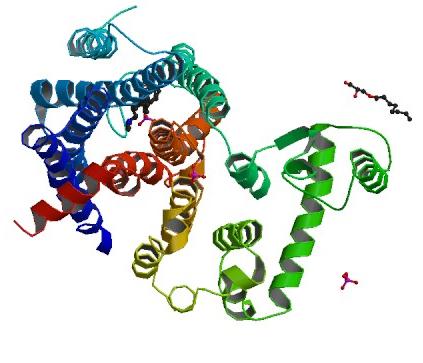
Photograph: T. Shimamura et al, CC0, via Wikimedia Commons.
Comments