


Drug design normally requires a pocket. A small molecule has to bind somewhere on a protein and hold, which is why mutant p53 has resisted fifty years of effort: the mutations break the protein's structure rather than creating a groove to aim at, and p53 is altered in 40 to 50% of cancers. Restoring a broken transcription factor to working order has proven no easier.
A group at the Gladstone Institutes and Berkeley, with Jennifer Doudna among the authors, sidesteps the requirement entirely by not targeting the protein. They target its messenger RNA, and not in order to destroy it. The mutant transcript is used as a signal that identifies the cell, and the response to that signal is deliberately indiscriminate.
Why it matters: This separates recognition from killing. If a cancer cell can be identified by any transcript it carries, the mutation no longer has to be druggable in the conventional sense, which reopens a large category of cancer drivers currently out of reach.
The tool is Cas12a2, reported by Zeng et al. in Nature. Unlike the Cas9 used for genome editing, Cas12a2 does something bacteria evolved as a suicide mechanism: once its guide RNA matches a target, it stops being precise and begins cutting nucleic acids around it without discrimination. In a bacterium facing a virus, destroying the infected cell protects its neighbours. Here that collateral activity is aimed at chromatin. A cell carrying the mutant transcript has its genome shredded, sets off a DNA damage response, and dies.
Where the precision actually lives
The design choice worth understanding is that the weapon is not precise and is not meant to be. All the selectivity sits in the sensor, in whether the guide RNA distinguishes a mutant transcript from the wild-type version that differs from it by a single base.
The team tested that directly rather than assuming it. Guides against two p53 mutations, R248Q and R280K, were run against cells carrying the target mutation, against normal cells, and against a control line engineered to express a different p53 mutation, R175H, at comparable transcript levels of roughly 400 to 500 per cell. That third comparison is the informative one, because it asks whether the system discriminates between two mutant transcripts rather than merely between mutant and normal. As the authors report, Both gRNAs showed strong selectivity for target mutant cells. Growth arrest and DNA damage appeared in cells carrying the matching mutation and not in the others.
The work also left the dish. Delivering Cas12a2 mRNA and its guide RNA targeting c-MYC and p53 R248Q transcripts using lipid nanoparticles (LNPs) reduced tumor burden in vivo in mouse models. Lipid nanoparticles are the same delivery class used for messenger RNA vaccines, which matters because the manufacturing and regulatory path for them already exists.
What the study can't say yet
Delivery is the binding constraint, and the paper's own numbers show it. Tracking a reporter in lung tumours, a single intravenous dose of nanoparticles activated roughly 7 to 18% of the labelled cancer cells. Lung-targeted formulations of this class have reported 15 to 20% efficiency for Cas9 in healthy tissue. A therapy that kills only the cells it reaches, reaching under a fifth of them, reduces tumour burden without eradicating a tumour, which is what the mouse results show. Nothing here reports cures or survival.
The safety argument is also structurally unusual and deserves to be stated as such. With a conventional targeted drug, a specificity failure means the drug binds something else and may do nothing. Here a specificity failure means a healthy cell has its chromatin destroyed. The consequence of a false positive is maximal, so the tolerable error rate is far lower than the phrase "strong selectivity" conveys, and selectivity measured in engineered cell lines at controlled transcript levels is not the same as selectivity across the transcriptomes of every tissue a nanoparticle reaches.
Mouse models are also permissive. Immunocompromised animals carrying human tumour cells cannot show whether an immune response to a bacterial protein would blunt repeat dosing, and repeat dosing is what partial killing implies. Human immunity to Cas proteins is a known obstacle for CRISPR therapeutics generally.
Targeting c-MYC is a different proposition from targeting mutant p53, too. A mutant transcript is absent from healthy cells; c-MYC is overexpressed rather than unique, so selectivity there depends on a threshold rather than on a sequence difference, and where that threshold sits in normal proliferating tissue is not established here.
The authors' conclusion is appropriately hedged, framing the approach as one that cancer-specific cell targeting by transcript-activated chromatin shredding could be a useful new approach to cancer therapy. Could be, and the demonstration is a mechanism working in cells and reducing tumour burden in mice.
Quick questions
How is this different from CRISPR gene editing? Editing repairs or disables a specific DNA sequence. This does not edit anything. It uses an RNA match as a trigger and then destroys the cell's genome non-specifically, so the goal is killing rather than correcting.
Why not just destroy the mutant RNA? Cells make more RNA continuously, so silencing a transcript requires sustained dosing. Using the transcript as a trigger for cell death makes a single successful recognition sufficient.
What's the one-line takeaway? A CRISPR enzyme that shreds chromatin indiscriminately once its guide finds a match was programmed to recognise mutant p53 transcripts, killing cells carrying that mutation while sparing cells carrying a different one, and shrinking mouse tumours in the fraction of cells the delivery reached.
Zeng J, Cheng Z, Chen H, et al. "Targeting cancer-specific mutations with RNA-triggered chromatin shredding." Nature, 2026;656(8126):199-206. doi.org/10.1038/s41586-026-10738-7
PubMed PMID: 42259916.
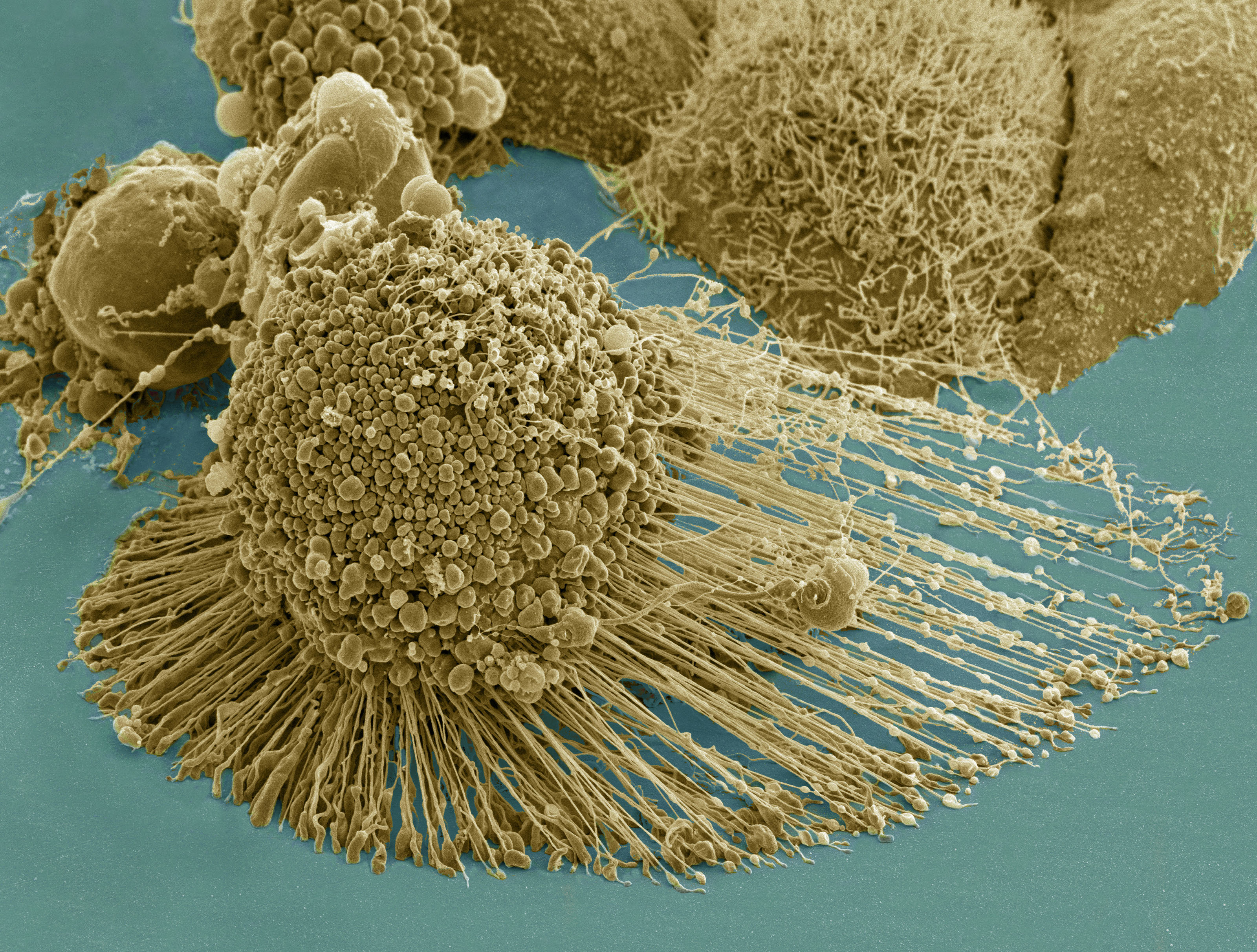
Image: CRISPR nuclease illustration. Via Wikimedia Commons.
Comments