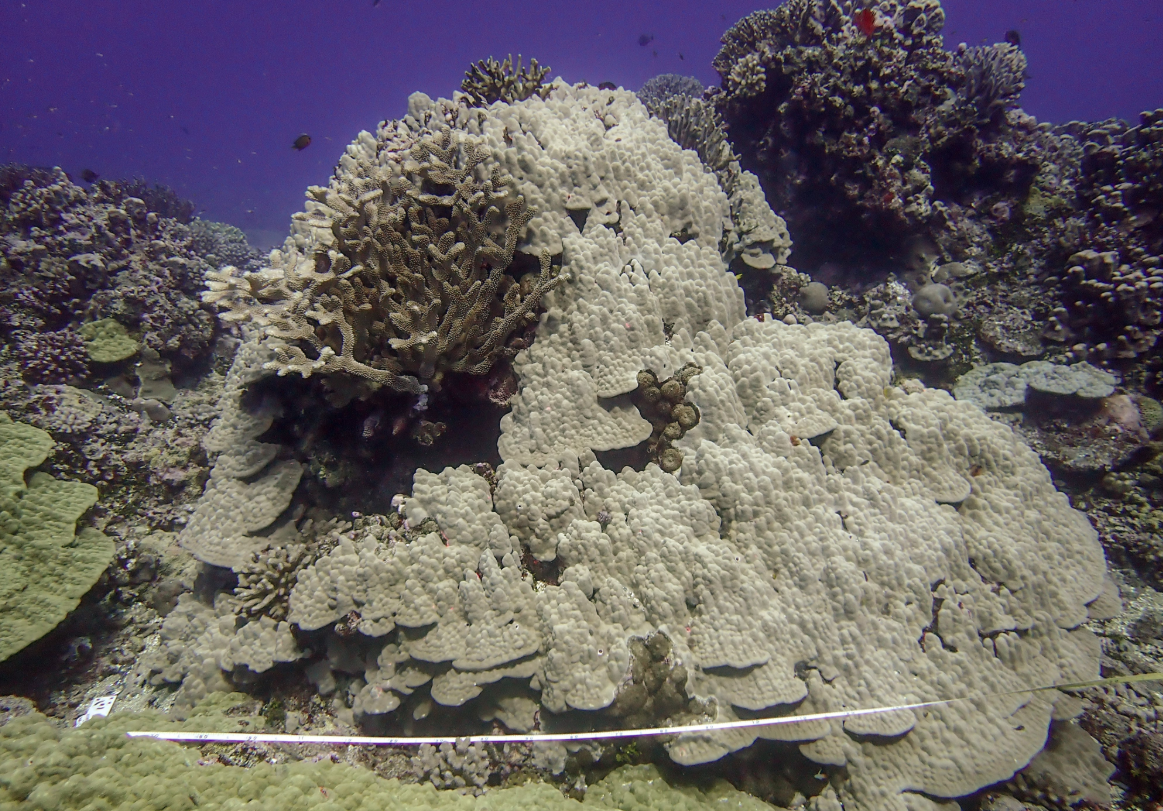
A single lump of reef-building coral is not one organism. It is a host animal plus algae, plus a dense crowd of bacteria and archaea living in its tissue, its skeleton, and the mucus it secretes. Biologists call the whole package a holobiont. What has been missing is a serious accounting of who those microbes are and what they can do. A new study in Nature takes that accounting to the scale of an ocean, and the headline is uncomfortable: we have barely met most of them.
The work draws on the Tara Pacific expedition, which sampled corals across the Pacific over more than two years. Fabienne Wiederkehr, Shinichi Sunagawa and colleagues reconstructed microbial genomes from 820 samples of three representative coral genera, gathered at 99 reefs spread across 32 islands. From that material they pulled out 4,224 microbial species. Only about 10 percent of them had any genomic information available beforehand. Among the 645 species found exclusively in the Tara Pacific samples, fewer than 1 percent were previously known at the genome level.
A genomic blind spot the size of an ocean
That gap matters beyond bookkeeping. Corals are among the most studied animals on the planet, partly because reefs are collapsing and everyone wants to know why. Yet the microbial half of the partnership has remained largely dark. When 90 percent of the bacteria and archaea in your samples have no reference genome, you cannot easily ask what they metabolize, how they respond to heat, or whether they help the host survive a bleaching event. The catalogue the team assembled is a step toward being able to ask those questions with real data instead of guesses.
The second finding shifts the frame from ecology to chemistry. The researchers looked at biosynthetic gene clusters, the stretches of DNA that encode the machinery for making complex small molecules. Reefs have long been prospected for such compounds, usually from sponges. Here the coral-associated microbes matched or exceeded the biosynthetic potential of those traditional sources. In other words, the microbes tucked inside corals may be as promising a place to look for new natural products as the sponges that get most of the attention.
Strange enzymes from an overlooked group
Digging into the biosynthetically rich bacteria, the team flagged new groups within the Acidobacteriota, a phylum that tends to be abundant in many environments but stubbornly hard to grow in a lab. These groups encode enzymology that had not been described before. The authors point to that unfamiliar chemistry as an opening for protein engineering, where an enzyme doing something unexpected in nature can become a starting point for something useful in a flask.
Put together, the two results push in the same direction. The coral holobiont is not just a fragile ecosystem worth protecting for its own sake. It is also a store of molecular information, most of it never sequenced, some of it encoding chemistry nobody has cataloged.
What the catalogue does not settle
A few limits are worth keeping in view. This is a genomic survey, so it maps potential rather than proof. A biosynthetic gene cluster in a genome does not guarantee the molecule is actually produced, or that it does anything for the coral or for us. The study also covers three coral genera in one ocean, a deliberate slice rather than the full sweep of reef diversity, so numbers from elsewhere could look different. And reconstructing genomes from mixed community samples always leaves gaps and ambiguities that follow-up culturing and chemistry will need to close.
Still, the practical takeaway is hard to miss. The authors frame reef conservation partly as the protection of a molecular reservoir, and the arithmetic backs them up. Reefs are declining fast, and much of what lives inside these corals has never been read. Lose the coral and you lose the library before anyone has opened most of the books.
Wiederkehr, F. et al. "Coral microbiomes as reservoirs of unknown genomic and biosynthetic diversity." Nature, 2026. doi.org/10.1038/s41586-026-10159-6
PubMed PMID: 41741644.
Photograph: NOAA, Public domain, via Wikimedia Commons.
Comments