

The genetic code has 64 codons. Sixty-one spell out amino acids and three say stop, and most amino acids get more than one codon. That redundancy is old. It has been baked into life for billions of years, and it usually looks like something you inherit, not something you edit. A team working with a common pond alga decided to edit it anyway.
Writing in PNAS, Pawel Mordaka and colleagues at the University of Cambridge and University College London report that they rewrote genes inside the chloroplast of Chlamydomonas reinhardtii so that 13 codons were never used. The working code dropped from 64 to 51. The cells did not seem to mind. They grew and photosynthesized like normal.
Why bother deleting codons
Freeing up codons is the point. If a cell never uses a particular codon, that codon becomes available to reassign. You can hand it to a synthetic amino acid, or use it as a barrier that ordinary viruses cannot read, since a virus arriving with the standard code would garble the recoded genes. Bacterial genome projects have pushed this idea before, trimming the E. coli code by seven codons through enormous synthesis efforts. That work was heroic and slow.
The chloroplast is a shortcut. It is a small, self-contained genome, about 205,000 base pairs in this alga, sitting apart from the nucleus. The researchers focused on codons that have two matching transfer RNAs, the adaptor molecules that read codons during protein synthesis. They removed two of the three stop codons plus selected codons for arginine, glycine, isoleucine, leucine, and serine. In each case a redundant twin codon remained to carry the load.
From one gene to a whole operon
They started with a gene encoding a subunit of the chloroplast's own RNA polymerase, the machine that transcribes chloroplast DNA. Their tidiest strategy was blunt. Swap each unwanted codon for a permitted, frequently used synonym. Do that across the gene and see whether the cell notices. It did not. A reporter protein was expressed at normal levels, and the recoded strains grew as well as unmodified ones.
The same swap then worked on harder targets. A subunit of the chloroplast translocon, which imports proteins. Genes for the reaction center subunits of both photosystems, which are highly expressed and interrupted by introns. And an 8.5-kilobase stretch of DNA carrying several genes at once, a real operon rather than a single test case. Recoding an entire multi-gene block without breaking it is the kind of result that matters if the goal is eventually a fully rewritten chloroplast.
The last experiment probed how much freedom the recoded code allows. The researchers turned to the large subunit of Rubisco, the enzyme that fixes carbon dioxide into sugar and arguably the most important protein in the plant world. They built many versions of the gene with different mixes of permitted codons and screened them by asking a simple question: does photosynthesis come back in an alga that otherwise cannot grow without it? More than 70 different sequences passed. The code had room to spare.
What this does and does not show
These are lab conditions. Cells were grown under standard laboratory settings, and a gene that behaves under those conditions can still stumble under stress, in the field, or across a full life cycle. The chloroplast is also a friendlier arena than a nuclear genome or a whole organism, so the ease seen here will not transfer everywhere without work. The team compressed to 51 codons, not to some theoretical floor, and the point was to show the strategy works, not to claim they hit a limit.
Even so, the direction is clear. For all lines the researchers recovered homoplasmic cells, meaning every copy of the chloroplast genome carried the edit rather than a mix of old and new. A photosynthetic organism can run a meaningfully smaller genetic code and keep making the enzymes that feed it. That is a foothold for building algae with reassigned codons, whether to encode new chemistry into crops and feedstocks or to make them resistant to the viruses that plague large algal cultures. The redundancy in the code, it turns out, was negotiable.
Mordaka, P.M. et al. "Chlamydomonas chloroplast genes tolerate compression of the genetic code to just 51 codons." PNAS, 2026. doi.org/10.1073/pnas.2506263123
PubMed PMID: 41493811.
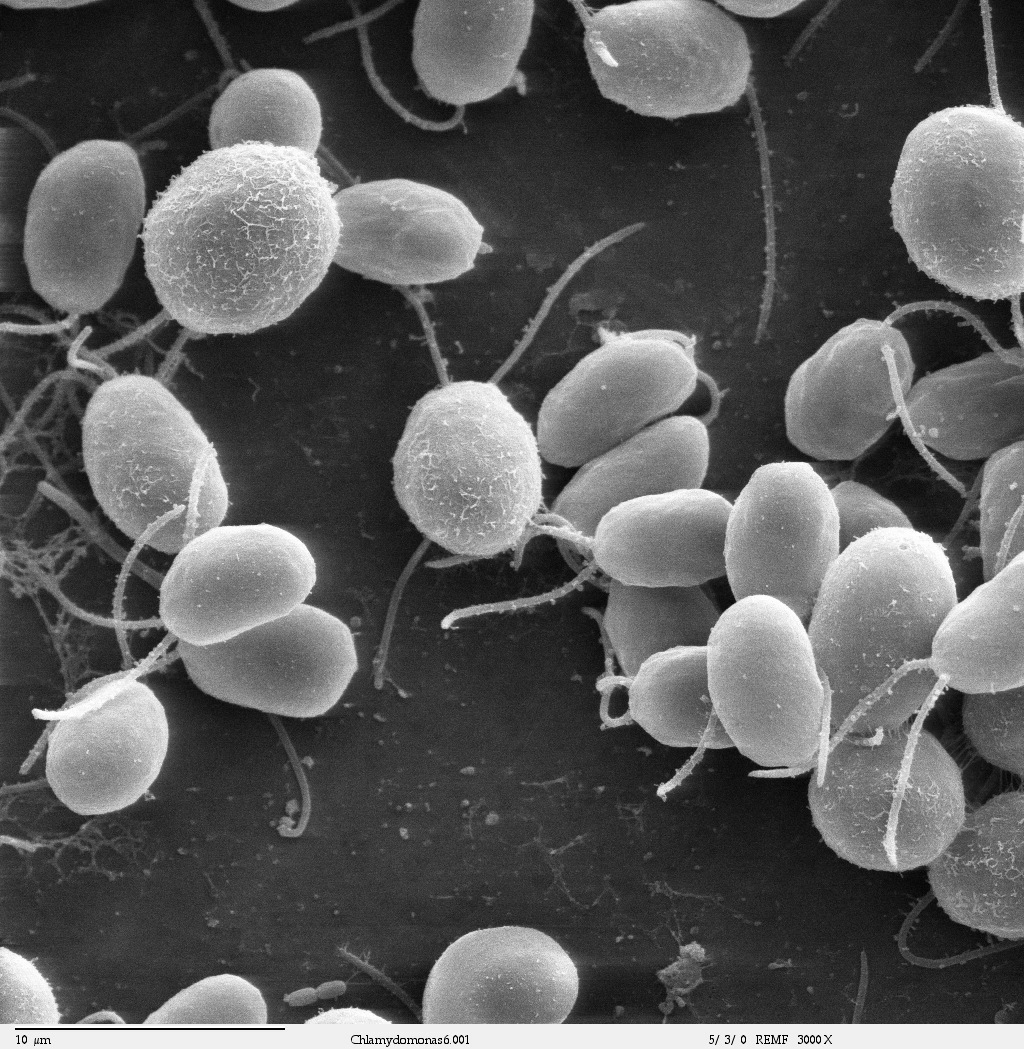
Photograph: Dartmouth Electron Microscope Facility, Dartmouth College, Public domain, via Wikimedia Commons.
Comments