

Allergic asthma affects more than 340 million people, and the immunology behind it is well mapped. An inhaled allergen is picked up by dendritic cells in the airway, carried to nearby lymph nodes, and used to instruct T cells, which then drive the inflammation. What is much less clear is what normally restrains that sequence, since most people breathe in the same house dust mite proteins and do not develop asthma.
A group working across Leipzig and Massachusetts General Hospital went looking for a brake, and found one in a receptor called CD97.
Why it matters: Most asthma biology describes what drives inflammation. A molecule whose removal makes the disease worse is a different kind of finding, and it points at the sensitisation step rather than the symptoms.
Removing it makes things worse
Mice lacking CD97 developed more severe asthma, not less. More eosinophils in the airway, more mucus, higher allergen-specific IgE, higher type 2 cytokines. The pattern held with two different allergens and in both acute and chronic versions of the model, and in the chronic version the animals also ended up with more airway smooth muscle, which is the structural remodelling that makes long-standing asthma hard to reverse.
Not everything moved. Airway hyper-responsiveness was unaffected in the acute models and IL-17 did not change, so this is specifically about the type 2 arm of the response rather than a general worsening.
Which cells, and when
CD97 sits on immune cells and also on airway lining cells, and the lining is where allergens first arrive, so it was a reasonable suspect. Deleting CD97 only in airway epithelium changed nothing. Deleting it only in white blood cells reproduced the full effect. The brake is on the immune cells.
The timing experiment is the cleaner one. Giving an antibody against CD97 once, before the animals were ever sensitised, worsened the eventual disease. Giving the same antibody later, while inflammation was underway, did nothing at all. Whatever CD97 does, it does during the initial decision about how to respond to the allergen, not during the attack.
Consistent with that, mice without CD97 accumulated more of the two dendritic cell types that drive type 2 responses, and within a day of sensitisation had more T cells carrying GATA3, the transcription factor that commits a T cell to the type 2 program.
A change in what the cell says
Dendritic cells grown from these mice were more activated and, importantly, secreted less IL-12. Since IL-12 is the signal that pushes T cells toward the type 1 program, less of it leaves the type 2 route relatively unopposed. In culture these cells drove stronger T cell proliferation and more type 2 cytokine release, and transferring them into ordinary mice was enough to produce the inflammation.
Sequencing found 153 genes differing between the two genotypes, and the enriched categories were secreted and extracellular proteins. The receptor is not changing what the dendritic cell is so much as what it says to the cells around it.
The human half
The mouse work would be suggestive on its own. The human comparison is what gives it weight. Volunteers with allergy, some asthmatic and some not, had a measured dose of allergen placed into one lung segment by bronchoscope, with airway cells sampled before and 24 hours after.
At baseline the two groups looked the same. After the challenge, CD97 expression was significantly lower in the phagocyte populations of the asthmatics, including the dendritic cell subset that also expanded in them. T cells, B cells, NK cells, mast cells and epithelial cells showed no difference. The same cell type that matters in the mouse is the one that differs in people, and only after allergen exposure.
What the study can't say yet
Nobody knows what CD97 is binding. The obvious candidate, CD55, was tested by knockout and made no difference to asthma, though the authors note the deletion was incomplete in the relevant cells so it cannot be ruled out. Other known human partners cannot be assessed in mice at all, because mouse CD97 lacks the necessary binding domains. As Aust and colleagues state in Nature Communications, Further studies are required to identify the CD97 interaction partner(s) mediating its effects in allergic asthma. Without that, there is a brake but no account of what presses it.
It is also not settled that dendritic cells are the whole story. Both they and T cells carry CD97, and the experiments cannot separate a receptor acting on the presenting cell from one acting on the T cell it is talking to. The authors say conditional deletion in naive T cells would be needed.
The human data are a correlation measured at one timepoint. Lower CD97 in asthmatics after challenge is consistent with the mouse mechanism, but nothing here shows the reduced expression causes the disease rather than accompanying it. And every mouse in the study was female, chosen because they model asthma more readily, which leaves the male case untested.
One practical note follows directly from the result. Because blocking CD97 worsened disease, a drug would have to strengthen this pathway rather than inhibit it, which is the harder of the two things to do.
Quick questions
What is a type 2 immune response? The branch of immunity that evolved against parasites and that, misdirected at harmless allergens, produces the eosinophils, IgE and mucus of allergic asthma.
Why does the timing of the antibody matter so much? Because it separates causes from consequences. A molecule that matters only before sensitisation is shaping how the immune system first learns the allergen, not how it later reacts.
What's the one-line takeaway? CD97 restrains the dendritic cells that start an allergic response, removing it makes asthma worse in mice, and people with asthma show less of it on the same cells after an allergen challenge.
Aust et al. "CD97/ADGRE5 attenuates the induction of adaptive type 2 immune responses in allergic asthma." Nature Communications, 2026;17(1). doi.org/10.1038/s41467-026-76948-9
PubMed PMID: 42660929.
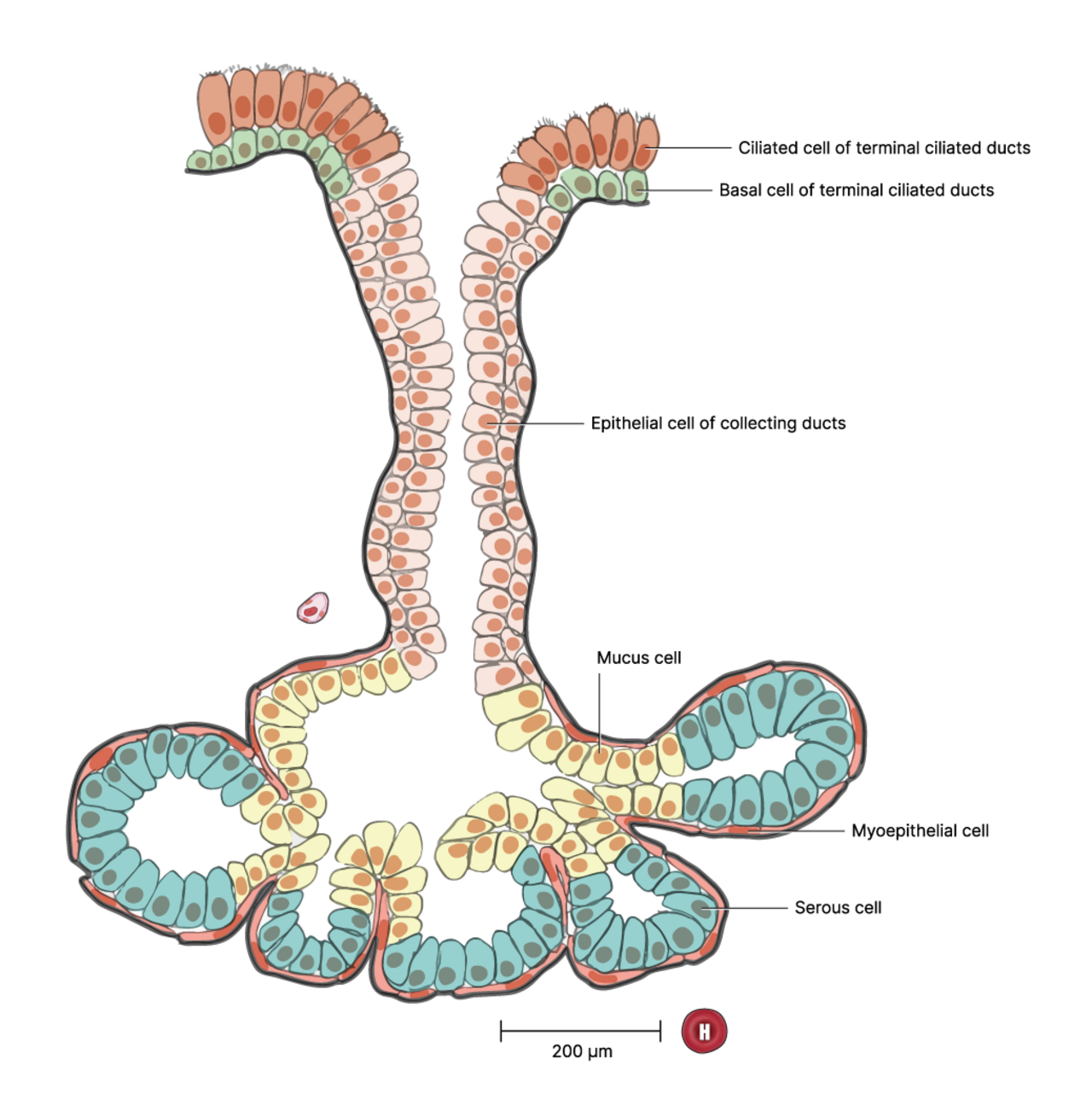
Image: Bronchial submucosal gland, NIH BioArt, NIAID, CC BY 4.0, via Wikimedia Commons.
Comments