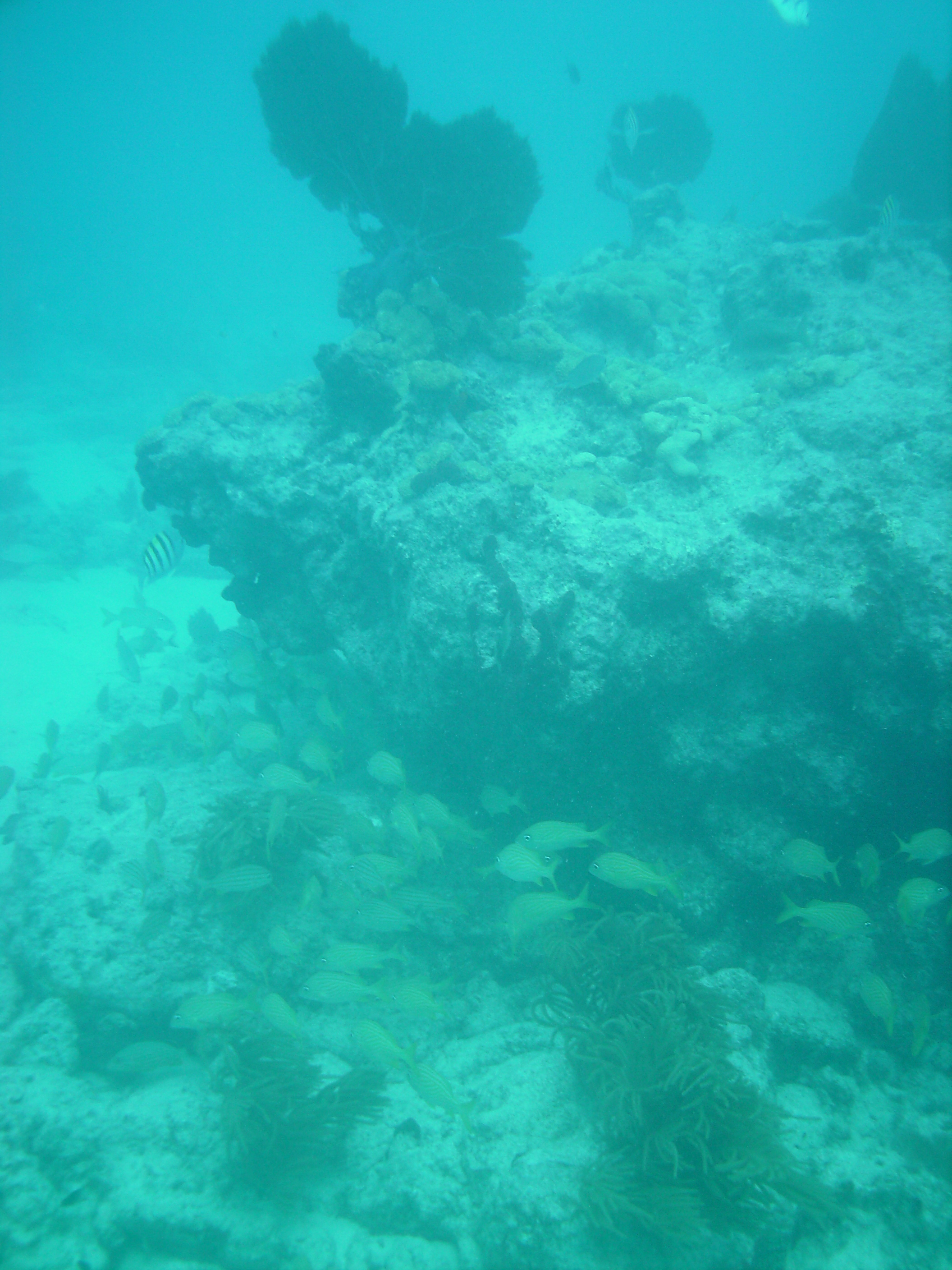
Pull an ear stone out of a fish and you get a tiny calcium carbonate pebble that grew, ring by ring, while the animal was alive. It also traps a trace of protein, and that protein carries a chemical signature of what the fish ate. A new study in Nature reached into 7,000-year-old reef sediment in Panama and the Dominican Republic, pulled out fossil otoliths, and used them to reconstruct who was eating whom on Caribbean reefs long before people started fishing them hard. The picture that came back is of a food web that has since collapsed inward on itself.
Reading diet from a nitrogen ratio
The method rests on a quirk of nitrogen. As nitrogen moves up a food chain, the heavier isotope accumulates relative to the lighter one, so a predator carries a higher ratio than its prey. Jessica Lueders-Dumont and colleagues measured that ratio in protein locked inside otoliths and coral skeletons, comparing modern specimens against fossils roughly seven millennia old. Because the protein is bound inside the mineral, it survives long after soft tissue is gone. That let the team estimate each animal's trophic position, then stack those positions to gauge how tall the whole food chain stood. It is a way of interviewing dead fish about their diets.
They focused on fishes at low to middle trophic levels, the grunts and their neighbors that form the broad base of a reef. Those animals are easy to overlook next to sharks and groupers, but they are where most of the biomass and most of the feeding action sits. The team analyzed material from two widely separated Caribbean sites, which matters because a pattern showing up in both places is harder to write off as a local fluke.
Food chains cut by more than half
The central number is striking. Modern Caribbean food chains run 60 to 70 percent shorter than they did 7,000 years ago, at both the Panama and Dominican Republic sites. High-trophic-level fishes dropped in trophic position over time, which fits the familiar story of large predators being fished out. But low-trophic-level fishes did the opposite. Their trophic level held steady or even rose. The chain compressed from both ends at once.
There was a second change layered on top. Across every trophic group, the range of diets narrowed. The team found a 20 to 70 percent reduction in trophic range on modern reefs, meaning individual fish are eating a more uniform diet than their ancestors did. The best explanation, the authors argue, is that modern reef fish have become dietary generalists where earlier populations included more specialists. Less specialization means less of the fine-grained partitioning that once let many species share one reef without stepping on each other.
Why a shorter chain is a fragile one
A reef with fewer trophic layers and blurrier feeding roles is a simpler machine. Simpler can mean more brittle. When many species do roughly the same job, the redundancy that once buffered a reef against a lost species or a bad year thins out, and the authors flag this simplification as something that could raise the risk of outright ecosystem collapse.
Some caveats are worth keeping in view. This is a reconstruction from two regions, not a global census, and the fossil and modern samples come from different individuals rather than a continuous record. Trophic position inferred from isotopes is an estimate, not a menu, and the 7,000-year baseline is itself just one slice of a long and shifting history. What the study does well is put hard numbers on a loss that ecologists have long suspected but struggled to measure. The reefs people snorkel over today are not a faded version of the original. They are structurally different, and the fish ear stones buried in the sediment are the receipts.
Lueders-Dumont, J. et al. "Fossil isotope evidence for trophic simplification on modern Caribbean reefs." Nature, 2026. doi.org/10.1038/s41586-025-10077-z
PubMed PMID: 41673163.
Photograph: Jstuby, Public domain, via Wikimedia Commons.
Comments