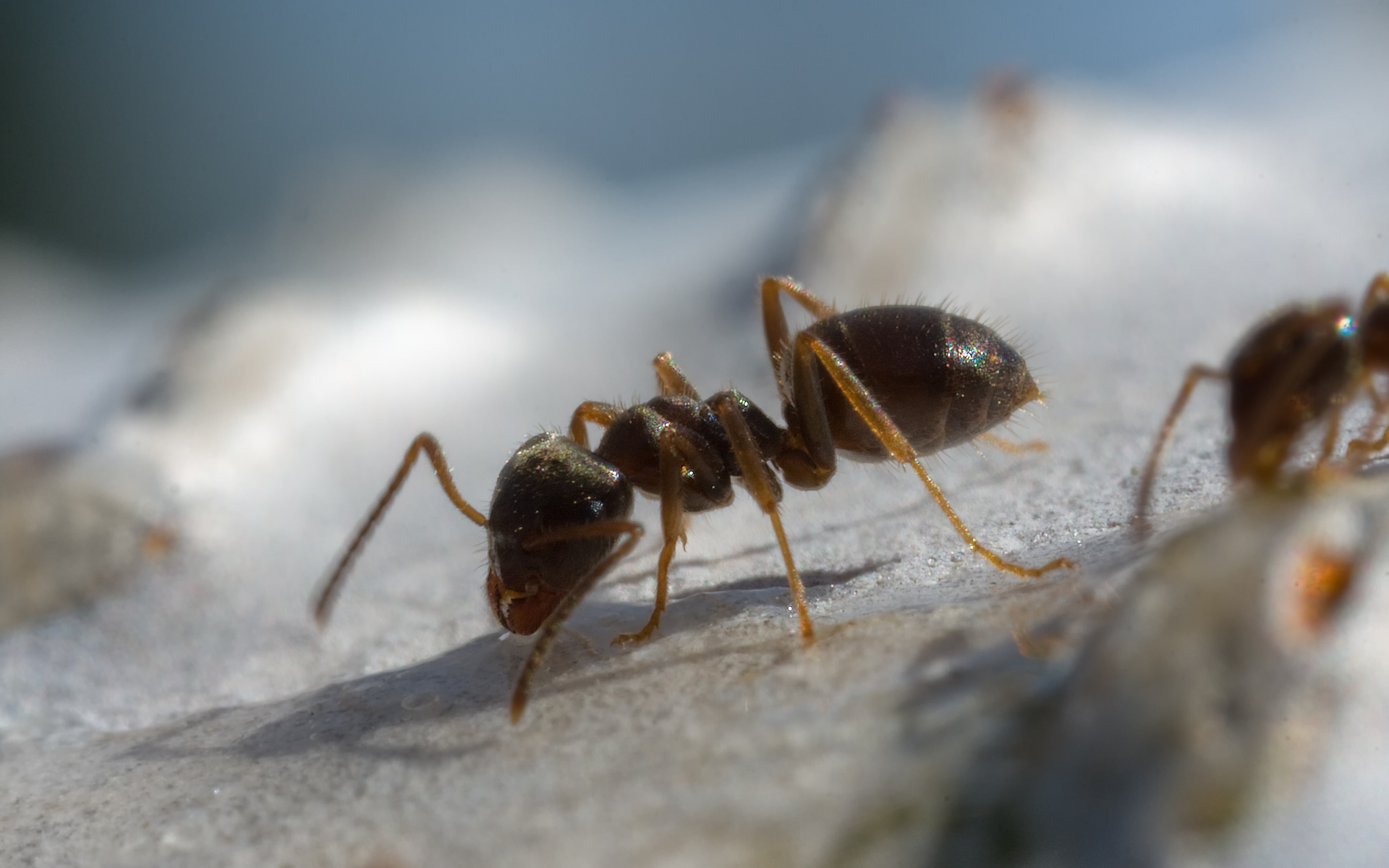
Inside a wood-ant nest, an intruder walks freely among thousands of workers armed with jaws and formic acid. It is a small beetle. The ants should tear it apart. Instead they treat it as one of their own, feeding it and grooming it. The beetle pulled off this con by doing something drastic: it turned off the genes that make its own smell.
A team led by researchers at Caltech worked out how, and what the trick costs. Their report in Cell describes a rove beetle that has become an obligate guest of ants, unable to survive outside the colony. The mechanism is a piece of chemical sabotage aimed at the beetle itself, and once triggered it cannot be undone.
Going scentless on purpose
Insects wear their identity on the outside. A layer of cuticular hydrocarbons, or CHCs, coats the body and acts as a chemical badge. Ants read these waxy compounds constantly, using them to tell nestmate from stranger. Get the blend wrong and you are attacked.
The beetle sidesteps the whole problem. Through transcriptional silencing, it shuts down its own CHC biosynthesis. That leaves it, in the authors' phrase, a chemical blank slate. It carries almost no scent of its own. When ants groom the beetle, they transfer their own hydrocarbons onto its surface. The beetle ends up wearing the colony's exact chemical signature. The match is described as perfect, and it is enough to earn full acceptance.
It is a clever inversion. Most animal mimics work hard to manufacture a convincing copy of a signal. This beetle does the opposite. It manufactures nothing and lets its hosts paint the disguise on for free.
The trap in the trick
Here is where the story turns. Those same cuticular hydrocarbons do a second job. Beyond signaling, the waxy layer is what keeps an insect from drying out. It is a desiccation barrier. By switching off CHC production, the beetle also stripped away its own waterproofing.
So the beetle now needs the ants for two separate reasons. It needs their grooming to keep the borrowed scent fresh and its cover intact. And it needs the humid, sheltered environment of the nest because it can no longer hold its own water. Leave the colony and it is both exposed as a fraud and prone to dying of dehydration.
The silencing is irreversible. The researchers argue this locks the lineage into what they call a Catch-22. Undo the silencing and the beetle regains its waterproofing, but it also regains a scent that ants would immediately flag as foreign. Undo the beetle's attraction to ants instead and it avoids that exposure, but then it has no waterproofing and no humid refuge. Either escape route is worse than staying put. The two traits are tangled together through epistasis, and the tangle has no exit.
Why dependence can be a one-way door
Biologists have long puzzled over why so many symbiotic organisms evolve into total dependence on a host, giving up the ability to live alone. This beetle offers a concrete answer for at least one case. The authors call it symbiotic entrenchment. Dependence did not arise from slow decay of unused abilities. It came from a single alteration that happened to serve the symbiosis while quietly demolishing the option of leaving.
A note on scope. This is one beetle lineage and its ants, studied in depth rather than across many species, so the Catch-22 framing is best read as a well-supported mechanism for this system rather than a universal law of symbiosis. The work does not claim every obligate guest got stuck the same way. What it does show is that a lineage can be sealed into a relationship by the very trait that made the relationship possible, without any host coercion and without gradual loss.
It reframes how we might think about the countless insects, microbes, and other organisms that live inside their partners and cannot leave. Some of them may not have drifted into captivity over long ages of disuse. They may have shut a door on themselves in a single move, and then found the handle gone.
Naragon, T. H. et al. "Symbiotic entrenchment through ecological Catch-22." Cell, 2026. doi.org/10.1016/j.cell.2025.12.041
PubMed PMID: 41650968.
Photograph: Richard Bartz (Makro Freak), CC BY-SA 2.5, via Wikimedia Commons.
Comments