


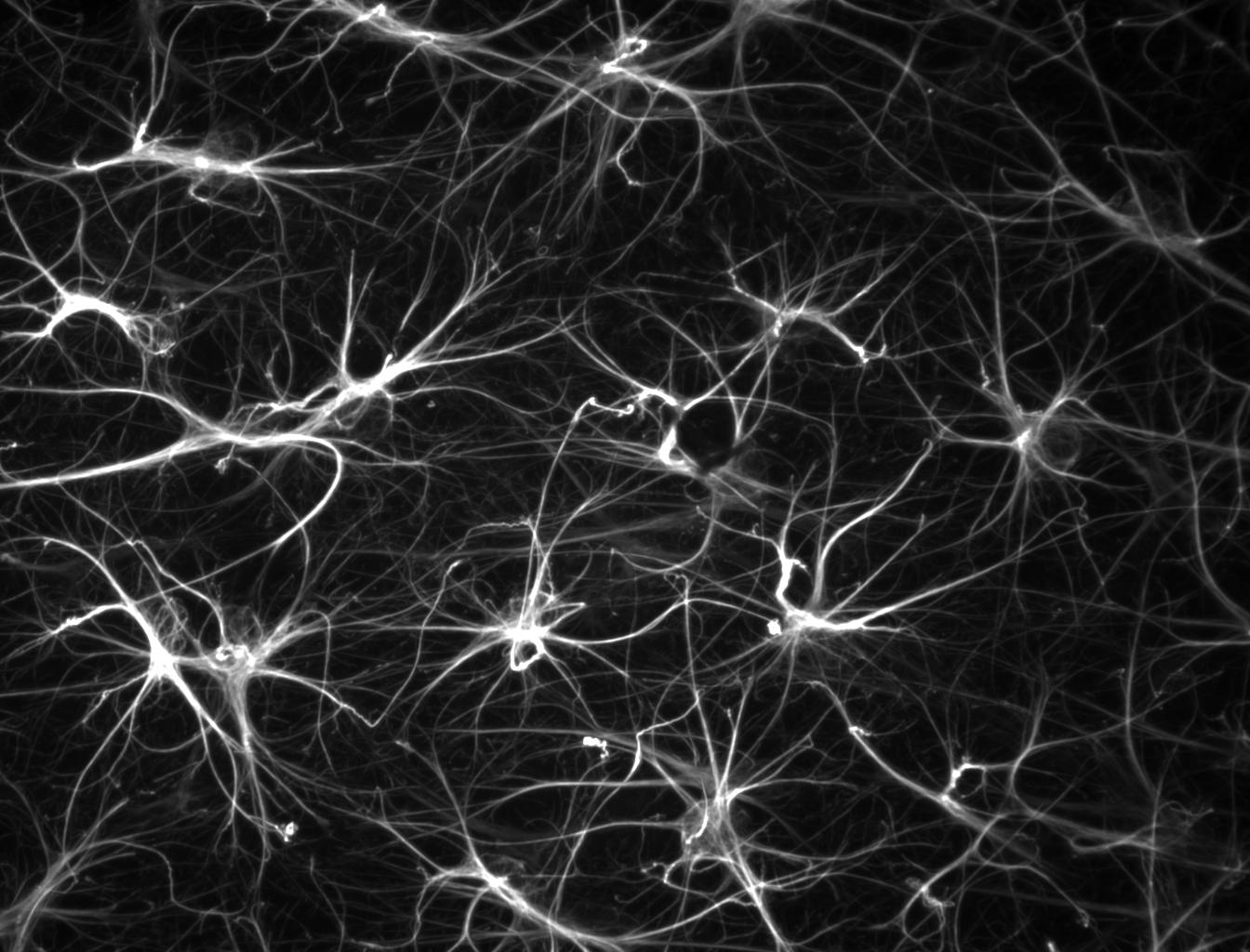
For a century, the story of memory has been a story about neurons. They fire, they wire together, they hold the trace. The other half of the brain, the glial cells that outnumber neurons and were long treated as packing material, rarely got a speaking part. A new study in Nature hands one type of glia a real role. It reports that astrocytes, the star-shaped cells that drape themselves over synapses, form their own coordinated ensemble that helps make a frightening memory stick.
The team, led by Ken-Ichi Dewa and Jun Nagai at the RIKEN Center for Brain Science, studied fear memory in mice. They built a method to tag and image cells across the whole brain based on activation of the gene Fos, a classic marker of recent activity. Neurons light up this way all the time. What the researchers wanted to know was whether astrocytes did too, and whether the ones that did formed any kind of pattern.
A second set of cells lights up during recall
They did form a pattern. Astrocytes carrying the Fos tag showed up preferentially in brain regions that already held neuronal engrams, the sparse groups of neurons thought to store a specific memory. And the astrocytic response was not tied to the moment of learning. It was broader during recall of a fear memory than during the original conditioning. In other words, the astrocytes seemed to react most when the animal met the frightening situation again, not when it first happened.
That timing pointed to a two-step mechanism, which the authors then worked out. The first fear experience nudges astrocytes into a slow, day-long change of state. Part of that change is turning up receptors for noradrenaline, the alerting chemical the brain releases under stress. So the cells are quietly reconfigured, waiting. When the animal encounters the fear again, noradrenaline floods in from long-range projections, and the primed astrocytes now respond strongly. They sit at a crossroads: signals from nearby engram neurons on one side, the noradrenaline surge on the other. Catching both at once tips them into a second state change, marked by Fos and by a secreted molecule called IGFBP2.
Emotional first, then repeated
The logic here is worth pausing on. The astrocytic ensemble is not built by any single event. It needs an emotionally salient experience to prime the cells, and then a repeated experience to trigger them. That maps onto how survival-critical memories usually arrive. A predator, a bad fall, a poisoned food are frightening the first time and often encountered more than once. The system seems tuned to notice exactly that combination and to treat it as worth reinforcing.
When the researchers interfered with the astrocytic ensemble, using both drugs and genetic tools, the consequences landed on the neurons. Disrupting the astrocytic signaling changed the engrams themselves and degraded the memory. Stability suffered, and so did precision, meaning the animals' recollection became both shakier and blurrier. The astrocytes, then, are not passive witnesses. They feed back onto the neuronal trace and help hold it in place across days.
That word, days, is central to the paper's framing. Recalled memories briefly become fragile and have to be re-stabilized, a process neuroscientists have studied for years mostly in neurons and molecules that act over minutes to hours. Here is a cell type operating on a slower clock, carrying a multiday record in a subset of astrocytes, ready to capture the next repetition.
What this does and does not show
The findings come from mice and from fear conditioning, a specific and well-worn laboratory model. Whether the same astrocytic ensemble supports other kinds of memory, or shows up in a human brain, is not something this work can answer. IGFBP2 and the noradrenaline pathway are strong leads, but a molecule that changes with a memory is not automatically the thing that stores it, and the perturbation experiments, while pointed, do not fully separate cause from correlation. The brain-wide tagging method is also new, and new methods tend to reveal both real biology and their own quirks.
Still, the direction is clear enough to matter. If astrocytes help decide which frightening experiences get locked in, they become a plausible handle on memories that are too well locked in, the intrusive, over-consolidated kind that show up in trauma. For now the useful takeaway is simpler. The cells long treated as the brain's support staff appear to keep their own ledger of what scared you, and neurons are reading from it.
Dewa, K.-I. et al. "The astrocytic ensemble acts as a multiday trace to stabilize memory." Nature, 2025. doi.org/10.1038/s41586-025-09619-2
PubMed PMID: 41094146.
Photograph: Yann Bernardinelli, CC BY-SA 3.0, via Wikimedia Commons.
Comments