

The case for programmable antibiotics rests on a single argument. Conventional drugs are fixed molecules, so when bacteria evolve around one you need a new molecule, which takes a decade. An antisense oligomer is a sequence, and a sequence can be rewritten the way an mRNA vaccine is updated. Resistance stops being terminal and becomes a software problem.
That argument only holds if resistance actually arises at the sequence. A group at TWINCORE in Hannover, with collaborators in Wurzburg and Oxford, evolved four gram-negative pathogens against these compounds and found that it usually does not. Bacteria adapted instead to the peptide that carries the drug through the membrane, and which peptide was used determined almost everything about how readily resistance emerged.
Why it matters: If resistance targets the delivery vehicle, then rewriting the drug sequence does not help, and the programmability argument fails. Choosing the carrier turns out to be the decision that determines whether the class is evolutionarily durable.
Three carriers, very different outcomes
The design is a selection ramp: sixteen daily passages starting below the inhibitory concentration and doubling every four passages to four times it, with ten independent replicates per combination. That produces 90 evolved lines and, importantly, a distribution rather than an anecdote.
The standard carrier, a peptide abbreviated KFF, performed worst. Resistance rose across the board, reaching an average 17.6-fold increase in the minimum inhibitory concentration in one species. Its mirror-image D-form, which resists the protease that degrades the L-form, averaged a 1.3-fold increase. A structurally unrelated carrier called RXR averaged 1.4-fold, and in eight of ten populations the concentration required did not rise at all. Same payload, same target gene, same protocol; the difference is entirely the peptide.
Why the D-form works so much better is instructive. The two KFF peptides are chemical mirror images with identical sequence, but bacterial proteases only cleave the natural L-form. That cleavage is not incidental damage; it is a required step, because the transporter carries the oligomer across only after the peptide has been stripped off. Making the carrier protease-resistant removes the dependency on that transporter entirely, and with it the cheapest available route to resistance. The same molecule, handed to the cell in a form its enzymes cannot process, stops selecting for the mutation that would otherwise dominate.
Two routes, both confirmed by reconstruction
Sequencing the evolved populations pointed at the transporter. Mutations in sbmA, the inner membrane protein that carries KFF-conjugated oligomers into the cytoplasm, appeared across every species treated with that carrier, extending a finding previously reported only in E. coli to Klebsiella and Salmonella. A neighbouring outer membrane gene was hit too, suggesting a two-stage entry route.
Population sequencing shows association, so the team rebuilt the candidate mutations individually in a clean background. Deleting the transporter pair pushed the inhibitory concentration above 80 micromolar against an ancestral 5, more than sixteenfold. Separately, a single amino acid substitution in a peptide chain release factor, a protein that rescues stalled ribosomes and has nothing to do with uptake, produced a fourfold increase on its own. Two mechanistically distinct routes, each sufficient alone, which is a stronger claim than any correlation from the evolved lines.
What happened when resistance did hit the sequence
Only two of the 90 evolved lines mutated the binding site itself, and both were among the RXR populations, the only two of that set to gain any resistance at all. Both changes sat in the centre of the target window, where mismatches disrupt binding most, and both stayed at around 30 percent frequency, consistent with the modest resistance observed.
Two lines out of ninety suggests these mutations are costly, and there is corroborating evidence: the team's attempt to engineer that same change into a clean strain kept failing, because the targeted gene is so stringently essential that reducing its expression cripples growth. The conserved binding region is conserved for a reason. As Mulkern and colleagues argue in Nature Communications, even were such variants to arise more often in real treatment, updating the sequence would circumvent them, which is exactly the escape route the technology promises.
What the study can't say yet
The authors name the central limitation themselves, noting that the spectrum of resistance determinants recovered in any evolution experiment is shaped by the selection regime applied, and that a gradual ramp may favour different routes than abrupt high-dose exposure or intermittent treatment. A slow ramp rewards incremental adaptation; a sudden lethal dose rewards whatever rare variant already exists. Real dosing resembles neither.
This is also broth, not infection. Nothing here involves a host, an immune system, competing flora, or the fitness costs these mutations would carry in a body rather than rich medium, and a transporter deletion that is nearly free in a flask may not be in a urinary tract. Several proposed mechanisms remain hypotheses: why mutations in translation termination confer resistance is unresolved, with the authors offering two competing explanations and declining to choose.
Quick questions
What is an asobiotic? A short synthetic oligomer designed to bind the messenger RNA of an essential bacterial gene and block translation, conjugated to a peptide that carries it into the cell.
Why does the carrier peptide matter more than the drug? Because blocking uptake defeats every sequence at once, whereas mutating the binding site defeats one sequence and is easily answered by writing another.
What's the one-line takeaway? Across 90 evolved bacterial lines, resistance to antisense antibiotics arose mainly against the delivery peptide rather than the drug sequence, and swapping that peptide reduced the resistance that emerged from 17.6-fold to none in most populations.
Mulkern et al. "A systematic identification of resistance determinants to antisense antibiotics suggests adaptation strategies dependent on the delivery peptide." Nature Communications, 2026;17(1). doi.org/10.1038/s41467-026-76357-y
PubMed PMID: 42586984.
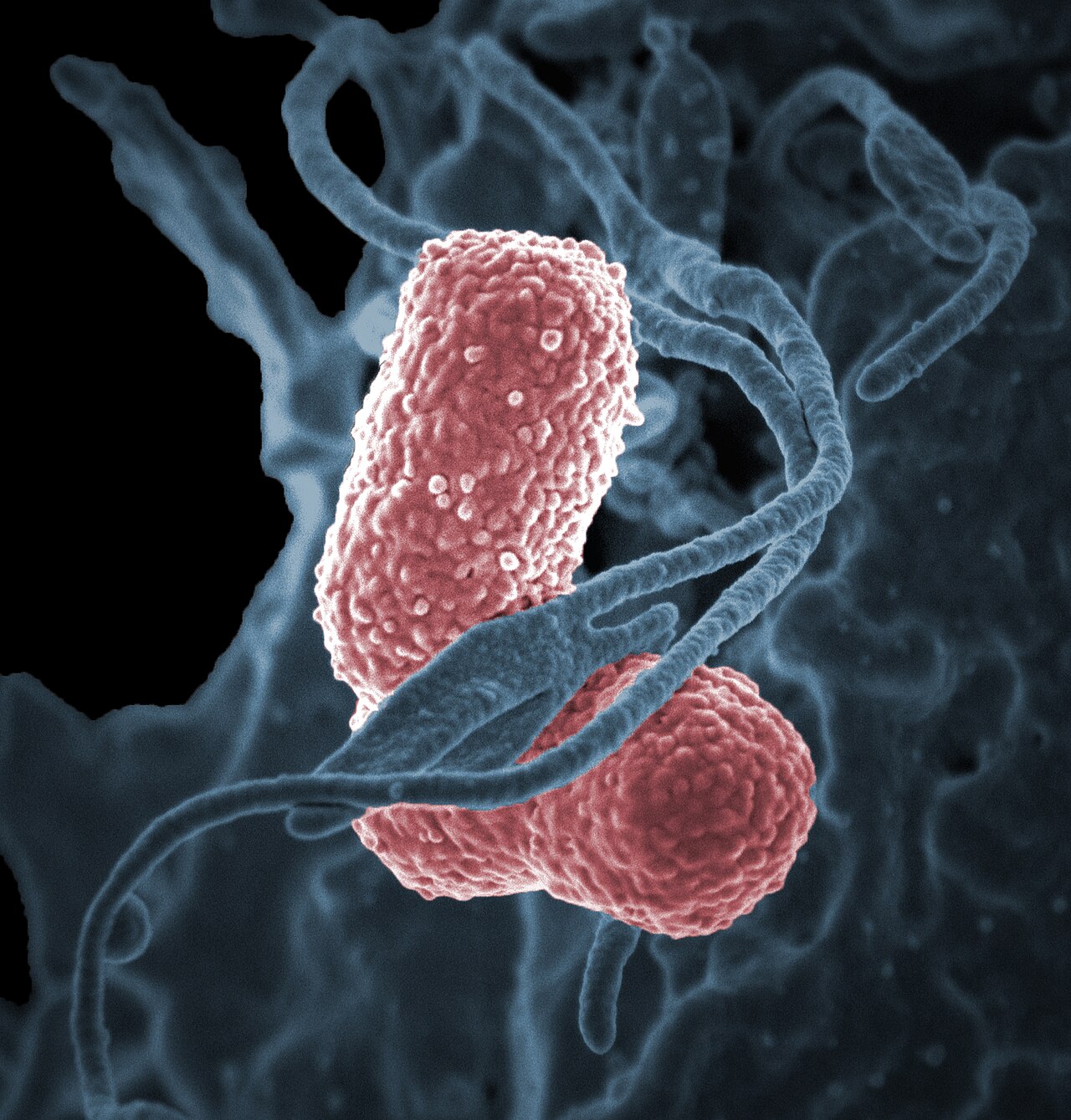
Image: Klebsiella pneumoniae, scanning electron micrograph by NIAID, CC BY 2.0, via Wikimedia Commons.
Comments