A phylogenetic tree without a root is a statement about relatedness and not about history. Move the root and the same branching pattern tells a different story about what came first. For the Archaea, one of the three domains of life, the root has been placed in three incompatible positions, and the choice determines what the ancestor of the entire domain is thought to have been.
The stakes are concrete. If the root falls within DPANN, a collection of lineages dominated by host-associated organisms with drastically reduced genomes, then archaea began small and dependent, and methanogenesis, the hallmark archaeal metabolism, evolved later. If it falls at the base of the Euryarchaeota, the ancestor was a complex, free-living organism that already made methane. A team spanning the Royal Netherlands Institute for Sea Research, Bath, Amsterdam and Budapest has now brought a different class of evidence to the question, and it points to the second answer.
Why it matters: Whether the last common ancestor of an entire domain was a free-living hyperthermophile or a reduced symbiont is a claim about the early biosphere, and about whether the tiny dependent lifestyle so common among archaea today is where they started or where some of them ended up.
Why the usual method fails here
The standard way to root a tree is to include an outgroup, something known to lie outside the group of interest, and see where it attaches. For archaea that means bacteria, and the branch connecting the two domains is so long that it attracts other long branches to it for purely statistical reasons. The paper reports this plainly: outgroup rooting and non-reversible models were unable to distinguish among a broad set of potential root placements. The method does not give a wrong answer so much as no answer.
The alternative used here is reconciliation, which compares each individual gene's tree against the species tree and asks which root makes the pattern of gene duplications, transfers and losses least improbable. Because it needs no outgroup, it can use only archaeal sequences, which means far more gene families become usable and the long-branch problem largely disappears.
The modelling assumption that was doing the damage
Reconciliation had been tried before and pointed elsewhere, and the explanation the authors give for the discrepancy is the most interesting part of the work. Earlier attempts used small taxon sets and a simple model in which rates of gene duplication, transfer and loss were fixed across the tree. That assumption is a limitation the authors describe as capable of inducing artefacts, particularly when the dataset includes a diverse set of reduced genomes from symbionts.
DPANN is precisely such a set. Symbiotic lineages lose genes rapidly, and a model forced to apply one loss rate everywhere must explain that excess loss some other way, most conveniently by placing those lineages deep. Letting the rates vary across the tree removes the pressure, and DPANN moves from the root to a position sister to the TACK and Asgard archaea. As Huang and colleagues report in Nature Communications, their analyses converge on a narrow root region at or near the base of the Euryarchaeota instead.
What the ancestor looks like
Reconciliation reconstructs ancestral gene content as a by-product of rooting, so the same analysis describes the organism. The last archaeal common ancestor comes out relatively complex rather than reduced, free-living rather than host-dependent, and equipped for methanogenesis, with a gene complement consistent with either the methylotrophic or the carbon-dioxide-reducing route. The authors suggest it was a hyperthermophile suited to hydrothermal vents or geothermal subsurface systems, where hydrogen, carbon dioxide and methylated compounds such as methanol are abundant under strongly reducing conditions.
The corollary reframes a large fraction of archaeal diversity. If DPANN is derived rather than basal, then the streamlined, host-attached lifestyle of those lineages is a secondary adaptation reached repeatedly, not a relic of how archaea began.
What the study can't say yet
Restricting the analysis to archaea buys the advantage and imposes the cost. Gene transfers between archaea and bacteria become invisible, because the method only sees the archaeal part of any family. The authors check this, showing the same root emerges from the families least prone to inter-domain transfer, which is the right test and not a guarantee.
The convergence is also across methods that share assumptions rather than across independent evidence. A different model family, GFmix, put the root one node away, which is close enough to define a small region but is not the same point. And ancestral reconstruction can only work from genomes that still exist, so an ancestor is inferred from surviving descendants while the lineages that would most inform the reconstruction are extinct. Calling the ancestor a methanogen is an inference about gene content, not a fossil.
Quick questions
Why not just use bacteria as an outgroup? Because the branch separating the domains is so long it distorts the analysis, and here it failed to favour any root placement over the others.
Why does a rate assumption change the answer? Because symbiotic lineages lose genes unusually fast, and a model that cannot allow that will place them deep in the tree to account for the losses another way.
What's the one-line takeaway? Allowing gene gain and loss rates to vary across the tree moves the archaeal root to the base of the Euryarchaeota, implying the ancestor of all archaea was a complex free-living hyperthermophilic methanogen and that reduced symbiotic lineages came later.
Huang et al. "Phylogenetic reconciliation supports a methanogenic ancestor of the Archaea and a derived origin for host-associated lineages." Nature Communications, 2026;17(1). doi.org/10.1038/s41467-026-76386-7
PubMed PMID: 42595756.
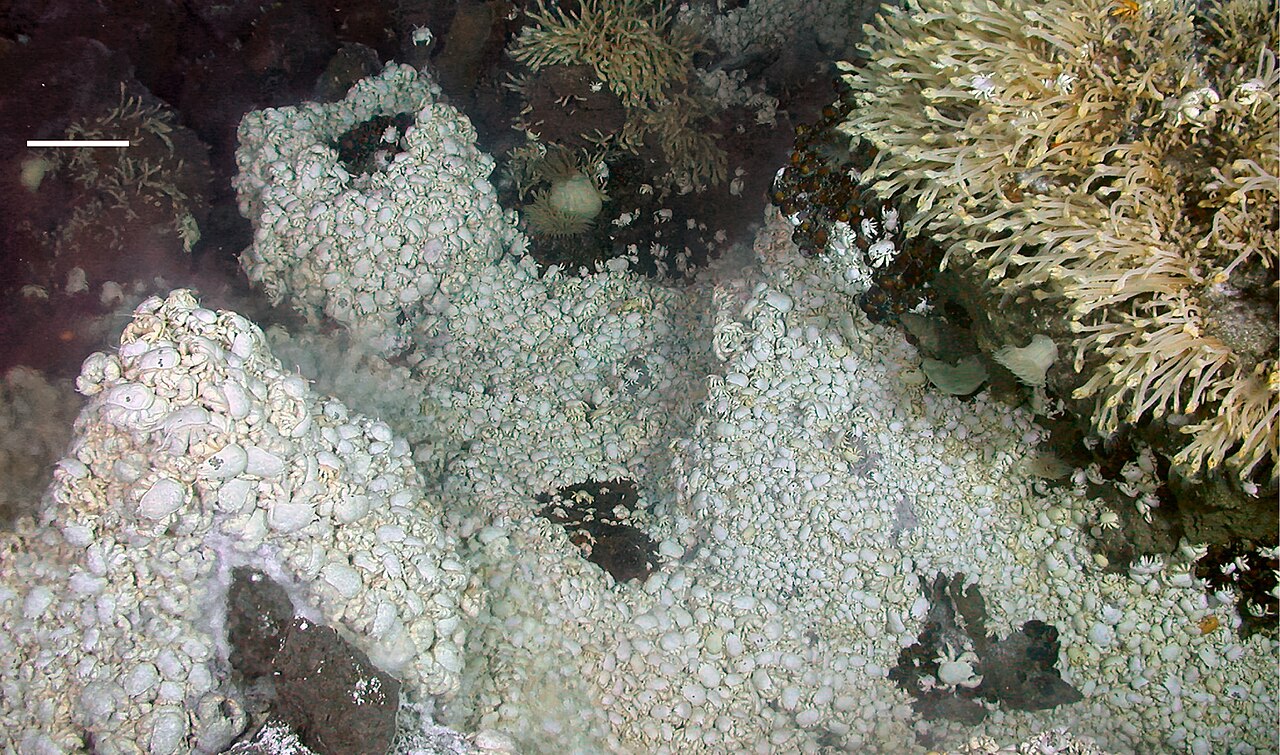
Image: Anomuran crabs at a deep-sea hydrothermal vent, A. D. Rogers et al., CC BY 2.5, via Wikimedia Commons.
Comments