

Mass extinctions are usually explained by the size of the blow. A large igneous province erupts, carbon dioxide spikes, oceans warm and lose oxygen, and a substantial fraction of life dies. The framing treats the biosphere as a fixed target and the perturbation as the variable. It leaves unexplained why perturbations of comparable magnitude have produced wildly different biotic outcomes at different points in Earth history.
A group spanning the Open University, the University of New Mexico, Vilnius University and the Potsdam Institute has approached it from the other direction, asking whether the state the climate system was already in determines how much damage a given shock does. Their answer is that the Phanerozoic, the 539 million years of abundant fossil life, was not a continuum. It resolves into five long-lived climate regimes separated by comparatively sharp transitions, and the biosphere was systematically most vulnerable at the boundaries.
Why it matters: If extinction risk depends on which regime the Earth system occupies and not only on the size of the disturbance, then the same forcing is dangerous at some times and survivable at others. That reframes the question from how large a perturbation was to where it landed.
Finding states in a noisy record
The method is the interesting part, because deep-time proxy records are irregularly sampled, non-stationary and carry substantial dating uncertainty, which defeats ordinary correlation. Instead the team applied recurrence analysis to paired carbon and oxygen isotope series, a technique from dynamical systems that asks when a system revisits states it has occupied before. Quasi-stationary intervals show up as block-like textures; transitions appear as breaks in that texture.
Five such blocks emerged across the Phanerozoic. The authors named them Haggis bins, after the mottled appearance of the recurrence plots and the Scottish dish it reminded them of, which is a rare moment of levity in a paper otherwise built from stable isotope ratios and bifurcation analysis. What makes the partition credible is that three independent diagnostics converge on it: joint recurrence structure across both isotopes, early-warning indicators based on rising autocorrelation, and a conceptual climate-carbon model. As Sudakow and colleagues note in Nature Communications, that convergence implies the regimes are not artefacts of one proxy compilation or one statistical method.
Why a climate system would have discrete states at all
The model supplies a mechanism rather than leaving the pattern descriptive. It couples an energy balance carrying ice-albedo feedback to a carbon cycle in which carbon dioxide sources are opposed by temperature-dependent silicate weathering. Because the albedo feedback makes the equilibrium condition nonlinear, a single carbon dioxide concentration can admit several valid temperature solutions at once. The system settles onto one branch and stays there for tens of millions of years.
That structure predicts exactly the observed behaviour. Slow changes in background forcing reshape the landscape of available equilibria without immediately moving the system, and then a finite perturbation, a volcanic carbon pulse or an impact, pushes it across to a different branch. Regimes persist because they are attractors, and transitions are abrupt because they are switches rather than slides.
Measuring stress rather than counting deaths
The biological side avoids simply tallying extinctions. Vulnerability here combines turnover, the sum of origination and extinction, against sample-standardized standing diversity, so a biota churning rapidly relative to its diversity scores as stressed regardless of whether the net balance is negative. Every interval of elevated extinction except one brief mid-Pliocene window falls in positive vulnerability territory. The contrast across regimes is stark: the Cambrian greenhouse ran persistently stressed, while the cool Cenozoic is the calmest interval in the record.
What the study can't say yet
Correlation between regime boundaries and elevated vulnerability is not causation, and the authors decline to claim it. Their own framing is hierarchical: long-lived regimes set the baseline stress landscape, and shorter-time environments and event-scale perturbations explore that landscape without necessarily requiring a regime change. Not every extinction pulse sits at a boundary, and the relationship between boundaries and different classes of extinction event is acknowledged as heterogeneous.
The analysis is also built for global composite records and explicitly not for individual rock sections, where a local gap or unconformity can produce apparent synchronous change across several proxies that is really an artefact of missing time. Early-warning indicators such as rising autocorrelation were developed for systems sampled far more densely than deep time allows, and the appropriate timescale separation remains unresolved. Carbon dioxide reconstructions exist only for the last 420 million years, so the oldest of the five regimes was characterized without them.
Quick questions
Does this predict anything about present-day climate? Not directly. The framework operates on multi-million-year regimes, and the paper makes no claim about where current forcing sits relative to a boundary.
Why measure turnover instead of extinction? Because rapid replacement indicates a biota being restructured even when losses and originations roughly cancel, which extinction counts alone would miss.
What's the one-line takeaway? The last 539 million years of climate resolve into five persistent states rather than a continuum, and life shows systematically elevated stress at the transitions between them.
Sudakow et al. "Transitions between persistent climate-carbon regimes coincide with elevated Phanerozoic biosphere vulnerability." Nature Communications, 2026;17(1). doi.org/10.1038/s41467-026-75655-9
PubMed PMID: 42552311.
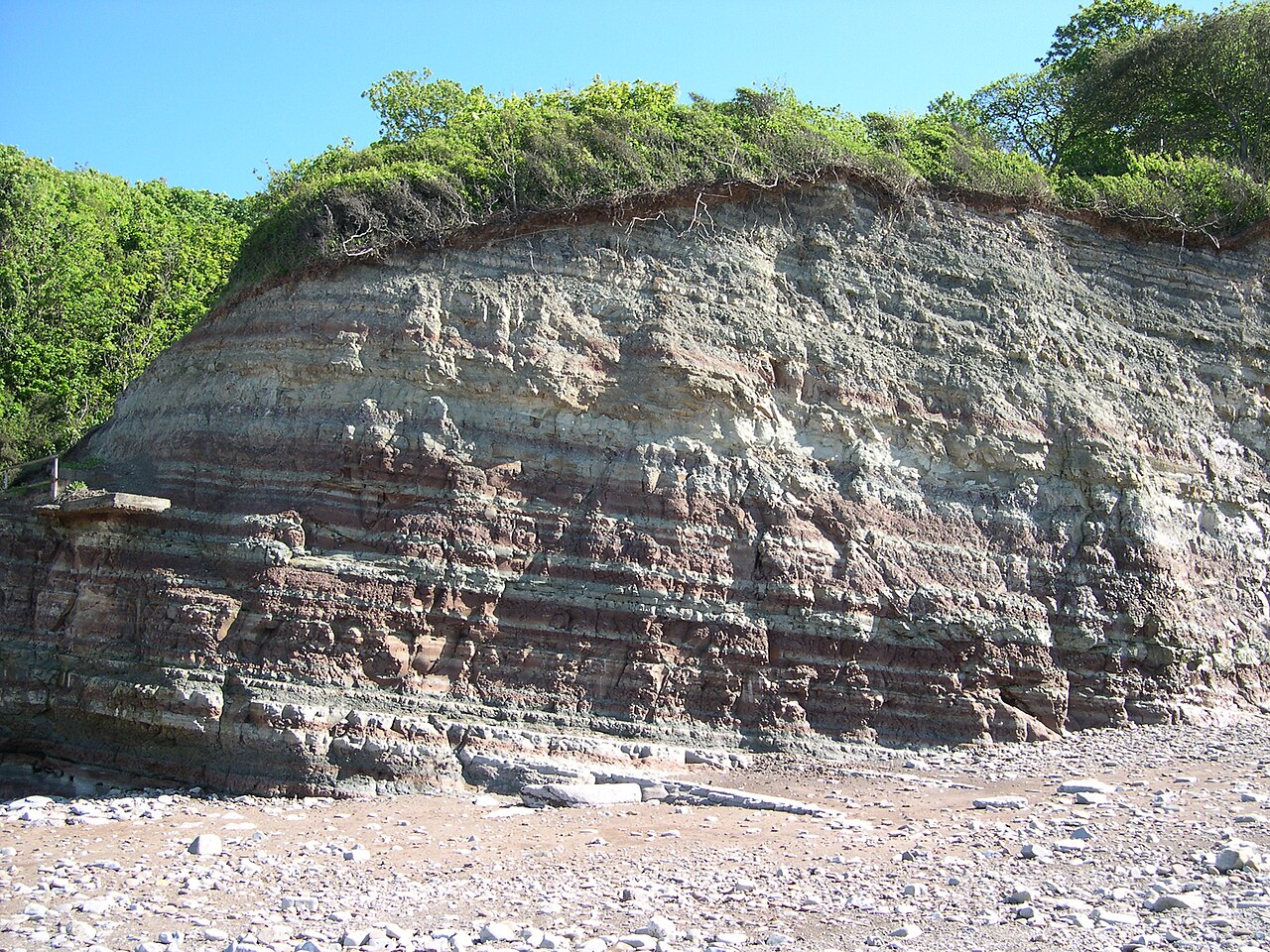
Image: Triassic sedimentary strata, Somerset, Margaret W. Carruthers, CC BY 2.0, via Wikimedia Commons.
Comments