

Most stories about the immune system and gut bacteria start with a fight. The body spots a microbe, decides it is a threat, and tries to kill it. That framing has shaped decades of research, and it misses something the gut does constantly, which is get along with the trillions of bacteria it depends on. A study published in Nature in May 2025 describes one of the tools it uses to do that, and the tool turns out to be a protein that grabs onto certain friendly bacteria without harming them at all.
The researchers, led by a group at the Shanghai Institute of Nutrition and Health, were looking at a family of proteins called apolipoprotein L. In humans, one relative of this family is famous for punching holes in the parasite that causes sleeping sickness. So the obvious guess was that these proteins act like weapons. What the team found in mice was almost the opposite.
A protein that sticks, not stabs
The gut lining cells, called enterocytes, only made two of these proteins, APOL9a and APOL9b, when microbes were present. Germ-free mice raised without any bacteria barely produced them. That was the first clue that the proteins were part of a conversation with the microbiome rather than a general defense.
To see what the proteins were doing, the team sorted out which bacteria they attached to. They tagged the APOL9 proteins, mixed them with gut bacteria, and used cell sorting plus genetic sequencing to read off the identities of whatever the proteins grabbed. The answer was strikingly narrow. APOL9a and APOL9b coated bacteria from a single group, the Bacteroidales, and left most others alone. The human version of the protein, APOL2, did the same thing.
The reason for that precision came down to a fatty molecule. The targeted bacteria carry a lipid called ceramide-1-phosphate on their surface, and the APOL9 proteins recognize it like a key fits a lock. When the researchers knocked out the bacterial genes that build this lipid in Bacteroides thetaiotaomicron, one of the most common residents of the human gut, the proteins mostly stopped binding. The coat was gone.
Coating that carries a message
Here is where the surprise deepens. In the sleeping-sickness case, apolipoprotein L destroys its target. In the gut, coating a bacterium with APOL9 did not lyse it. Instead the wrapped bacteria started shedding tiny bubbles from their outer surface, called outer membrane vesicles. Think of them as little packages that bacteria pinch off and release into their surroundings.
Those packages carried a signal the host could read. They ramped up interferon-gamma signaling in the mouse gut, which in turn pushed the intestinal lining cells to display more MHC class II, a molecule that helps present fragments of microbes to the immune system. In plain terms, the coated bacteria were prompted to hand over information that keeps the gut's immune surveillance sharp.
When the researchers deleted the Apol9a and Apol9b genes in mice, that whole chain broke. The animals showed a weaker MHC class II response along the gut lining, and they were far more vulnerable to intestinal pathogens. Some died early from infections that mice with the proteins survived. A protein that never kills a single commensal turned out to be load-bearing for the barrier that fends off dangerous microbes.
What the study can't say yet
The work was done almost entirely in mice and in dishes. The human protein APOL2 binds the same bacterial lipid, which is encouraging, but nobody has shown that people who make less of it have weaker gut immunity or more infections. That link is a hypothesis for now.
There is also the question of how far this reaches. The proteins recognize one lipid on one order of bacteria, so this is one channel in a system that surely has many. It is not clear whether the same trick shapes immunity elsewhere in the body, or whether other members of the apolipoprotein L family play similar quiet roles with different partners. The study also does not settle whether the mechanism ever backfires, for instance in inflammatory bowel disease, where the balance between the gut and its bacteria goes wrong.
What the paper does establish is a cleaner way to think about the relationship. The host is not just tolerating its bacteria and occasionally attacking intruders. It is actively selecting specific partners, marking them, and using them as informants. The marking depends on a molecule the bacteria themselves make, which means the arrangement is built on a shared chemical language rather than a truce. For a field that has long framed the immune system as a border guard, that is a useful shift. Sometimes the guard is less interested in keeping microbes out than in putting the right ones to work.
Yang T et al. "Targeting symbionts by apolipoprotein L proteins modulates gut immunity." Nature, 2025. doi.org/10.1038/s41586-025-08990-4
PubMed PMID: 40369072.
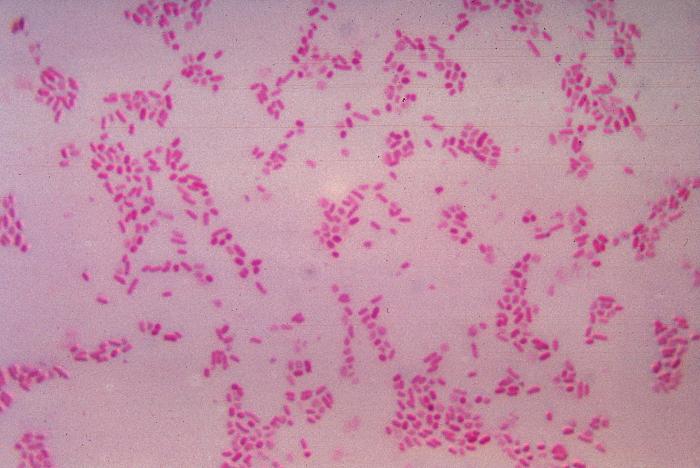
Photograph: CDC/Dr. V.R. Dowell, Jr., Public domain, via Wikimedia Commons.
Comments