


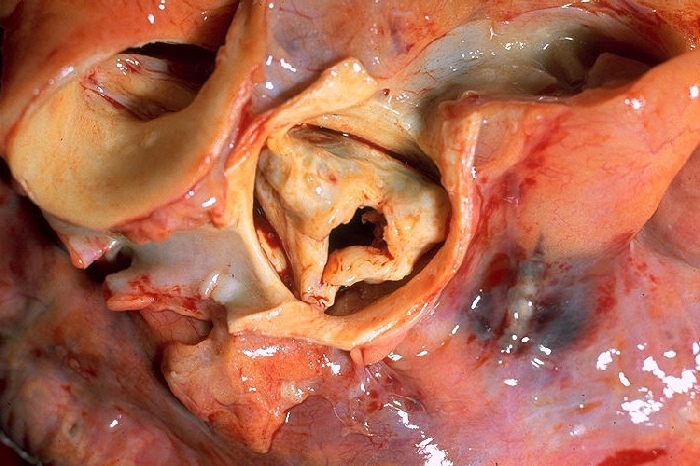
If your aortic valve stiffens and narrows with age, a condition called aortic stenosis, there is no pill that helps. The only real fix is a mechanical one: surgeons or catheter teams replace the valve. That is remarkable given how common the disease is in older adults, and it reflects a basic gap in knowledge. Nobody has been sure which biological processes to target with a drug. A new study in Nature Genetics tries to close that gap the hard way, by reading the genomes of nearly three million people and then testing what a couple of the flagged genes actually do to human valve cells.
The scale is the headline. A team led by Aeron M. Small pooled 86,864 people with aortic stenosis out of 2,853,408 individuals across multiple ancestries, then ran a genome-wide association meta-analysis to find DNA variants that show up more often in patients. They pulled out 241 independent risk regions on the autosomes and 3 more on the X chromosome. That is a big jump in the known genetic architecture of a disease that used to have only a handful of confirmed hits.
From statistical signals to suspect genes
A risk locus is just a stretch of the genome. It does not tell you which gene matters or what that gene does. To get closer, the researchers ran a transcriptome-wide association study using data from real human aortic valves, linking genetically predicted gene activity to disease risk. That approach surfaced 54 genes not previously connected to aortic stenosis whose expression appears to nudge risk up or down.
They also broke the analysis apart by sex and ancestry rather than treating everyone as one pool. Sex-stratified scans turned up 5 risk loci specific to one sex. Ancestry-stratified work added 11 loci in people of European ancestry and 1 in people of African ancestry. Splitting the data this way tends to lower statistical power, so finding distinct signals suggests some biology really does differ across groups, and it is a reminder that studies built mostly on European genomes can miss variants that matter elsewhere.
Silencing two genes stopped valve cells from hardening
Genetics on its own can generate a long list of plausible culprits and no proof. So the group did something many association studies skip. They took biologically interesting genes from their results into the lab and switched them off in human valvular interstitial cells, the cells that drive the calcium buildup behind a stiffening valve. Silencing two of them, CMKLR1 and LTBP4, sharply reduced mineralization in those cells.
Those two names point at real pathways. CMKLR1 is a receptor tied to signaling by polyunsaturated fatty acids, and LTBP4 sits in the transforming growth factor beta system, a signaling network already known to influence how tissues remodel and calcify. Both are the kind of target a drug could in principle engage. The authors also built a new polygenic risk score, a single number combining many small genetic effects, meant to flag people at higher risk before a valve ever narrows.
What this does and does not show
The lab result is a cell-culture finding, not a treatment. Turning down a gene in a dish is a long way from a safe, effective medicine in a person, and CMKLR1 and LTBP4 both act in pathways that do other jobs in the body, so blocking them could carry costs. The polygenic score is promising but needs testing in fresh groups of patients to show it predicts who actually develops disease, and scores like these often perform worse in populations underrepresented in the original data. Association studies also point to correlations; they do not, by themselves, prove a gene causes disease.
Still, the direction of travel matters. This is one of the largest genetic portraits yet of a disease that medicine currently treats only with hardware, and it does not stop at a list of loci. By carrying specific genes into human valve cells and watching calcification drop, the work hands drug developers a short list of testable ideas for a condition that has resisted every pharmacological attempt so far.
Small, A. M. et al. "Genomic and transcriptomic analyses of aortic stenosis enhance therapeutic target discovery and disease prediction." Nature Genetics, 2026. doi.org/10.1038/s41588-025-02417-6
PubMed PMID: 41419686.
Photograph: CDC/Dr. Edwin P. Ewing, Jr, Public domain, via Wikimedia Commons.
Comments