


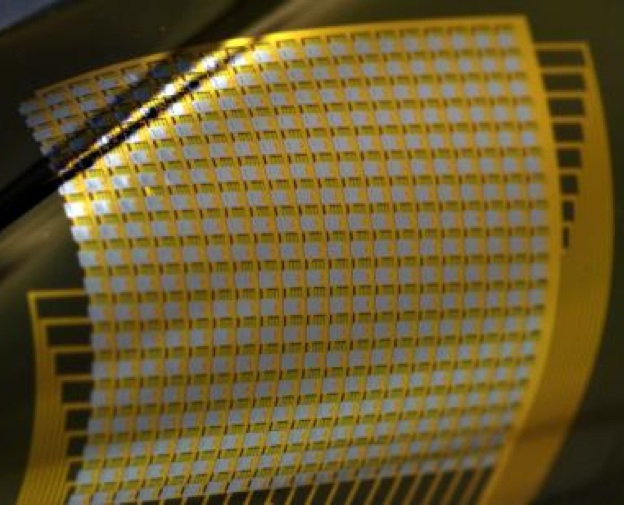
Most high-bandwidth brain implants come with a hard bargain. To read from thousands of neurons, you either open the skull with a craniotomy or push rigid electrodes down into brain tissue. Both leave marks. A team at Precision Neuroscience wanted to know how much of that damage is actually necessary, and their answer, published in Nature Biomedical Engineering, is a device that lays 1,024 electrodes across the surface of the cortex without cutting out a window of bone.
The array is a thin film. Picture a flexible sheet, thinner than a sheet of paper, dotted with a dense grid of tiny gold contacts. Instead of a full craniotomy, the surgeons slid it onto the brain through a much smaller opening. They tested this in pigs and in human cadavers first, then moved to living patients already scheduled for neurosurgery.
Reading and writing from the same contacts
What makes this array more than a passive listening device is that every electrode works in both directions. The same contacts that recorded neural activity could also deliver stimulation back into the cortex. The researchers used that stimulation to nudge small patches of brain tissue at sub-millimetre resolution, meaning they could target regions finer than the width of a grain of rice.
On the recording side, the device decoded three very different kinds of brain signals in the animal work. It picked up touch (somatosensory activity), vision, and the neural chatter tied to voluntary walking. Being able to pull all three from a surface array matters, because a lot of researchers assumed you had to penetrate the cortex to get signals that clean.
The technique here is micro-electrocorticography, or micro-ECoG. Standard ECoG grids have been used in epilepsy surgery for decades, but their electrodes are large and spaced far apart. Shrinking the contacts and packing them tightly is what pushes the channel count past a thousand while keeping everything on the surface.
The part that stands out: it comes back out
The array could be placed over multiple functional regions of the brain and then removed, more than once, without damaging the cortical surface underneath. That reversibility is unusual. Implants that burrow into tissue tend to provoke scarring and are not meant to be repositioned. A device you can slide in, move to a different region, and retract changes what a procedure can look like, and it lowers the stakes of getting placement slightly wrong.
The team then ran a pilot in five patients undergoing neurosurgery, some under anaesthesia and some awake. With the array on the cortical surface, they mapped how sensorimotor activity and speech are laid out at that scale. Awake patients are what let you study speech at all, since you need someone talking while you record.
What a five-person pilot can and cannot tell us
This is early. Five patients is a feasibility test, not evidence that the device helps anyone with paralysis or speech loss, and the recordings happened during surgery rather than over the weeks and months a real brain-computer interface would need to function. Surface electrodes also trade something away. They see the summed activity of many neurons rather than the crisp single-cell spikes that penetrating arrays capture, and whether that resolution is enough for demanding tasks like fluent speech decoding is still an open question. Long-term stability, how the tissue reacts over time, and whether the signal holds up outside an operating room all remain to be shown.
Still, the framing is worth sitting with. The dominant story in brain-computer interfaces has been about going deeper and more invasive to get better signals. This work argues the opposite direction is worth taking seriously: stay on the surface, scale up the electrode count, and avoid the craniotomy entirely. If the signal quality proves good enough for practical decoding, a lower-risk, removable implant could reach people who would never accept electrodes pushed into their brain.
Hettick, M. et al. "Minimally invasive implantation of scalable high-density cortical microelectrode arrays for multimodal neural decoding and stimulation." Nature Biomedical Engineering, 2025. doi.org/10.1038/s41551-025-01501-w
PubMed PMID: 41039113.
Photograph: Jesse Emspak, Public domain, via Wikimedia Commons.
Comments