


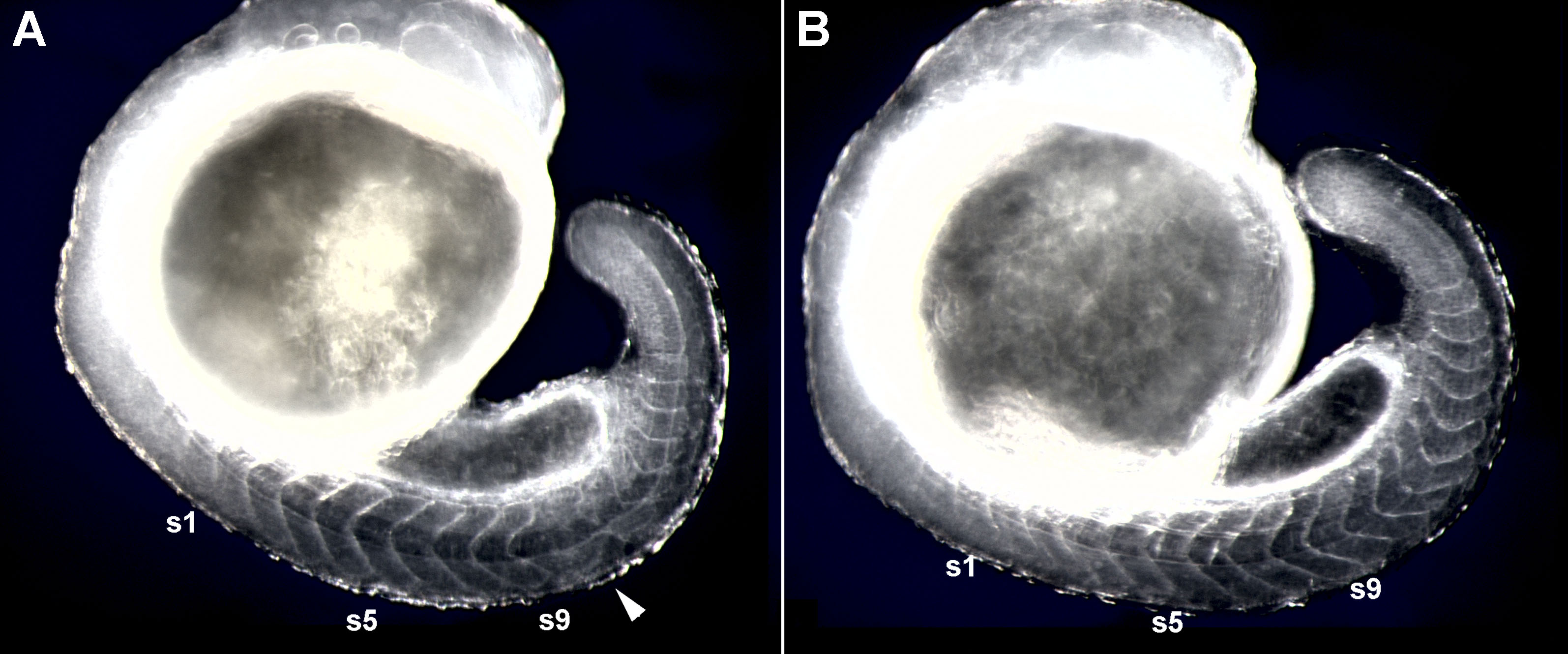
A zebrafish embryo the size of a poppy seed contains a moving target. Cells divide, slide past each other, and commit to becoming muscle or brain or gut, all within a day. Biologists have long been able to ask which genes are active in an embryo. Asking exactly where each gene is active, in every cell, across the whole animal, has been much harder.
A team led by Yinan Wan, reporting in Science, has now built a tool that does this at a scale that was out of reach before. Their platform, called weMERFISH, images gene activity throughout an entire zebrafish embryo with enough sharpness to resolve individual cells. In a single run they measured where 495 different genes were switched on, and they did it while the embryo's tissues were still taking shape.
Painting genes onto a whole embryo
The method builds on MERFISH, a technique that tags messenger RNA molecules with fluorescent probes and reads them out through repeated rounds of imaging. Each gene gets its own error-resistant barcode of colors, so the microscope can tell hundreds of them apart. What is new here is applying that readout to a whole three-dimensional embryo rather than a thin slice of tissue on a slide.
From those measurements the authors assembled an online atlas. It catalogs the expression of 25,872 genes and the accessibility of 294,954 regions of the genome across embryonic development. Accessibility matters because a gene can only be switched on if the stretches of DNA that control it are physically open. Mapping both together lets you see the wiring, not just the output.
Where the borders come from
One question the atlas helps answer is how an embryo draws sharp lines between neighboring tissues. When you look at a boundary between two future organs, the transition can be crisp, one gene abruptly giving way to another. Two explanations have competed for a long time. Either cells switch their gene programs in place, or cells with different identities physically sort themselves into separate zones like oil and water.
By combining the fixed snapshots from weMERFISH with live imaging of the same developing embryos, the team could watch how these patterns emerged over time. Sharp boundaries, they found, form mainly through changes in gene expression rather than through cell sorting. Cells stay roughly where they are and adjust what they are doing. The paper also notes that similar-looking expression patterns can arise through quite different dynamics, which is a caution against reading a static image as if it tells the whole story.
Another recurring theme: the expression of a gene often reflected a composite of tissue-specific control elements switching on, rather than a single master switch. Development, in this view, is combinatorial. The same regulatory parts get mixed in different proportions to produce distinct cell types.
What it can and cannot tell you
This is a measurement platform, and it inherits the limits of its subject. The work was done in zebrafish, a transparent, fast-developing, well-studied animal that is unusually friendly to imaging. Whether the same throughput carries over to opaque mammalian embryos is an open question the study does not settle. The atlas also captures correlations between open DNA and active genes; it does not prove that a given regulatory region is causing a given gene to fire. That would require going in and disrupting those elements one by one.
The set of 495 genes measured in a single run is large but still a curated selection, not the full genome imaged at once. And a fixed embryo, however beautifully resolved, is a still frame. The authors' pairing with live imaging is a partial fix, but reconstructing the full history of a cell from these data remains an inference.
Even with those caveats, the practical value is clear. Researchers studying a specific gene in zebrafish can now look up where and when it turns on, in the context of the whole embryo, without running the experiment themselves. Tools like this tend to matter less for any single headline finding and more for the many downstream studies they quietly make possible.
Wan, Y. et al. "Whole-embryo spatial transcriptomics at subcellular resolution from gastrulation to organogenesis." Science, 2026. doi.org/10.1126/science.adt3439
PubMed PMID: 41818362.
Photograph: Giudicelli F, Ozbudak EM, Wright GJ, Lewis J, CC BY 2.5, via Wikimedia Commons.
Comments