


Finding a molecule that latches onto one specific protein on the outside of a cell is usually slow work. Researchers run rounds of selection, sequence what sticks, then test candidates one at a time to see which ones actually bind and how well. The proteins that matter most for medicine sit on cell surfaces, where they act as biomarkers and drug targets, yet screening binders against them in their natural setting has stayed stubbornly low-throughput.
A team led by Guoyan Luo and Weihong Tan describes a way to compress much of that grind into one run. Writing in Science, they introduce SPARK-seq, a platform that screened 5,535 distinct aptamers against eight different cell-surface proteins in a single experiment. Aptamers are short strands of DNA or RNA that fold into shapes able to grip a target, a bit like antibodies but built from nucleic acid. The name stands for single-cell perturbation-driven aptamer recognition and kinetics sequencing.
Reading binding one cell at a time
The trick is to treat each cell as its own tiny assay. SPARK-seq combines three things that usually live in separate workflows. It reads which aptamers are bound to a cell, reads that cell's messenger RNA to know what it is, and uses CRISPR to switch specific surface proteins on or off. Because the readout happens cell by cell, the method can tell whether an aptamer's binding tracks with a particular protein being present. Knock out the protein, watch the aptamer signal drop, and you have evidence the two go together.
That design let the team cover a wide range in one shot. The 5,535 aptamers spanned targets whose abundance on cells varied by more than a hundredfold, and included binders from different structural families. Low-abundance proteins are often the ones that get missed in bulk screens, so pulling them into the same experiment matters.
Specificity held up under a hard test. The platform separated closely related paralogous proteins, molecules that look almost identical to each other, without detectable cross-reactivity. For a diagnostic reagent, that kind of discrimination is the whole game. A binder that also grabs the wrong protein produces false signals.
How long a grip lasts, not just how strong
Most screens tell you whether something binds. SPARK-seq also captured kinetics, meaning how fast an aptamer lets go of its target. That distinction is easy to overlook and genuinely useful. Two binders can have similar overall affinity, but the one that dissociates slowly stays put longer, which tends to make for a more reliable probe or a longer-acting therapeutic.
The authors used that information to rank candidates by their off-rates and prioritize the ones that clung longest. Then they went a step further and engineered new variants with slower dissociation, tuning the molecules rather than just picking winners from the original pool. The paper frames this as a route to rational design of aptamers and other functional nucleic acids.
What is promising and what is not settled
The appeal here is throughput paired with the kind of quantitative detail that usually costs many separate experiments to get. Aptamers are cheap to make, chemically stable, and easy to modify, which is partly why they keep drawing interest for both tests and drugs. A method that discovers them fast and characterizes their binding behavior in the same pass could shorten the path from target to reagent.
The caveats are worth stating plainly. This is a discovery and profiling platform, not a finished diagnostic or medicine. Eight surface proteins is a proof of concept, and it remains to be seen how the approach scales to harder targets or messier clinical samples. The engineered variants were characterized in the lab; whether their improved off-rates translate into better performance in a real assay or in the body is a separate question the study does not answer. And the CRISPR-based validation works cleanly for proteins you can knock out, which may not cover every case a user cares about.
Still, the core idea is straightforward and adaptable. By turning aptamer screening into a single-cell sequencing readout, SPARK-seq measures identity, binding, and kinetics together instead of chasing them one at a time.
Luo, G. et al. "SPARK-seq: A high-throughput platform for aptamer discovery and kinetic profiling." Science, 2026. doi.org/10.1126/science.adv6127
PubMed PMID: 41477891.
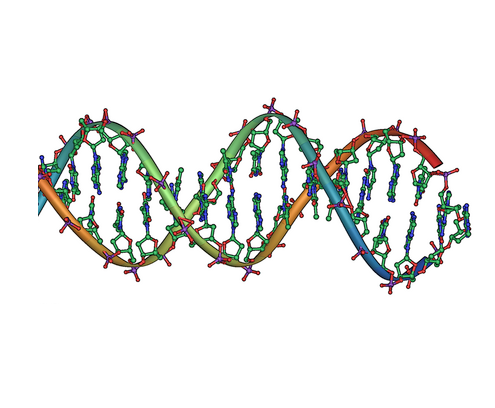
Photograph: Jerome Walker, Public domain, via Wikimedia Commons.
Comments