


Ask a movement-disorder neurologist about the hardest part of their job and many will say the same thing. Several diseases start out looking almost identical. A patient shuffles, stiffens, and slows down, and the label could be Parkinson's disease, multiple system atrophy, or progressive supranuclear palsy. Getting it wrong changes what you tell the patient about the road ahead, and it can put the wrong people into drug trials. A study published on 19 May in Nature Medicine tests a way to sort these conditions apart using a skin punch and a blood draw.
The work comes from a group led by Anthony Lang at the University of Toronto, with an independent validation cohort in Germany. Instead of betting on one protein, the team stacked three readouts that each capture a different piece of the biology. The idea is that no single marker carries enough information, but together they might.
Three signals, read together
The first two tests are seed amplification assays, which take a tiny amount of tissue and coax any misfolded protein present to replicate itself until it can be measured. One assay hunts for misfolded alpha-synuclein, the protein that clumps in Parkinson's disease and multiple system atrophy. The other looks for a specific form of tau called 4-repeat tau, the culprit in progressive supranuclear palsy. Both were run on skin taken by a small dermal biopsy rather than spinal fluid, which is a gentler thing to ask of a patient. The third signal was serum neurofilament light chain, a general marker of nerve-cell damage measured from blood.
The prospective cohort held 166 people: 40 with Parkinson's disease, 29 with multiple system atrophy, 77 with progressive supranuclear palsy, and 20 healthy controls. A separate group of 63 participants served as external validation.
Each test did roughly what the biology predicted. The alpha-synuclein assay flagged the synucleinopathies with high sensitivity. The 4-repeat tau assay picked out progressive supranuclear palsy, also called PSP, with high sensitivity and specificity. And neurofilament light chain in blood separated multiple system atrophy from Parkinson's disease and tracked with how severe the PSP had become.
Why the combination matters
Here is where the stacking pays off. The alpha-synuclein test was positive in some PSP patients too. That sounds like a flaw, but the authors read it as a real biological finding, a sign that alpha-synuclein co-pathology rides along in a subset of PSP cases. This is exactly the kind of overlap that trips up single-protein tests. When the three markers were integrated, the diagnostic discrimination improved over any marker used alone, and the panel could even split PSP into finer subgroups.
That last point is more than a technical flourish. If you can identify which PSP patients carry extra synuclein pathology, you start to see why two people with the same clinical label can follow different courses. For trial design, that separation could matter a great deal.
What it does not settle
This is a diagnostic study, not proof that outcomes change. The cohort is modest in size, and the largest single group was PSP, so the numbers behind rarer comparisons are thinner than the headline suggests. Diagnoses here rested on expert clinical assessment rather than autopsy confirmation, which remains the reference standard for these diseases. The validation cohort strengthens the case, but it is still a research setting with specialized labs running the seed amplification assays. Whether a community clinic can reproduce these results, and whether catching the distinction earlier helps patients live better, are open questions.
Still, the direction is worth noting. The field has spent years chasing a single clean biomarker for each parkinsonian syndrome. This paper argues that the messy reality, where proteins overlap and co-pathology is common, might be better handled by a panel that expects the mess. A skin biopsy and a blood tube are not nothing to ask of a patient, but they beat a needle in the spine. If the approach holds up in larger and more diverse groups, the near-term payoff is cleaner clinical trials, where knowing exactly what protein is driving a patient's disease is the difference between a drug that works and one that only seems not to.
Martinez-Valbuena, I. et al. "A multimodal biomarker strategy to enhance diagnostic precision in neurodegenerative parkinsonism." Nature Medicine, 2026. doi.org/10.1038/s41591-026-04398-3
PubMed PMID: 42157002.
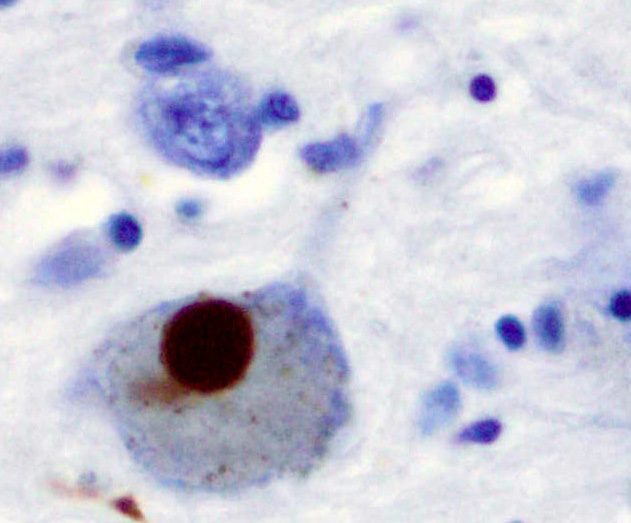
Photograph: Marvin 101, CC BY-SA 3.0, via Wikimedia Commons.
Comments