


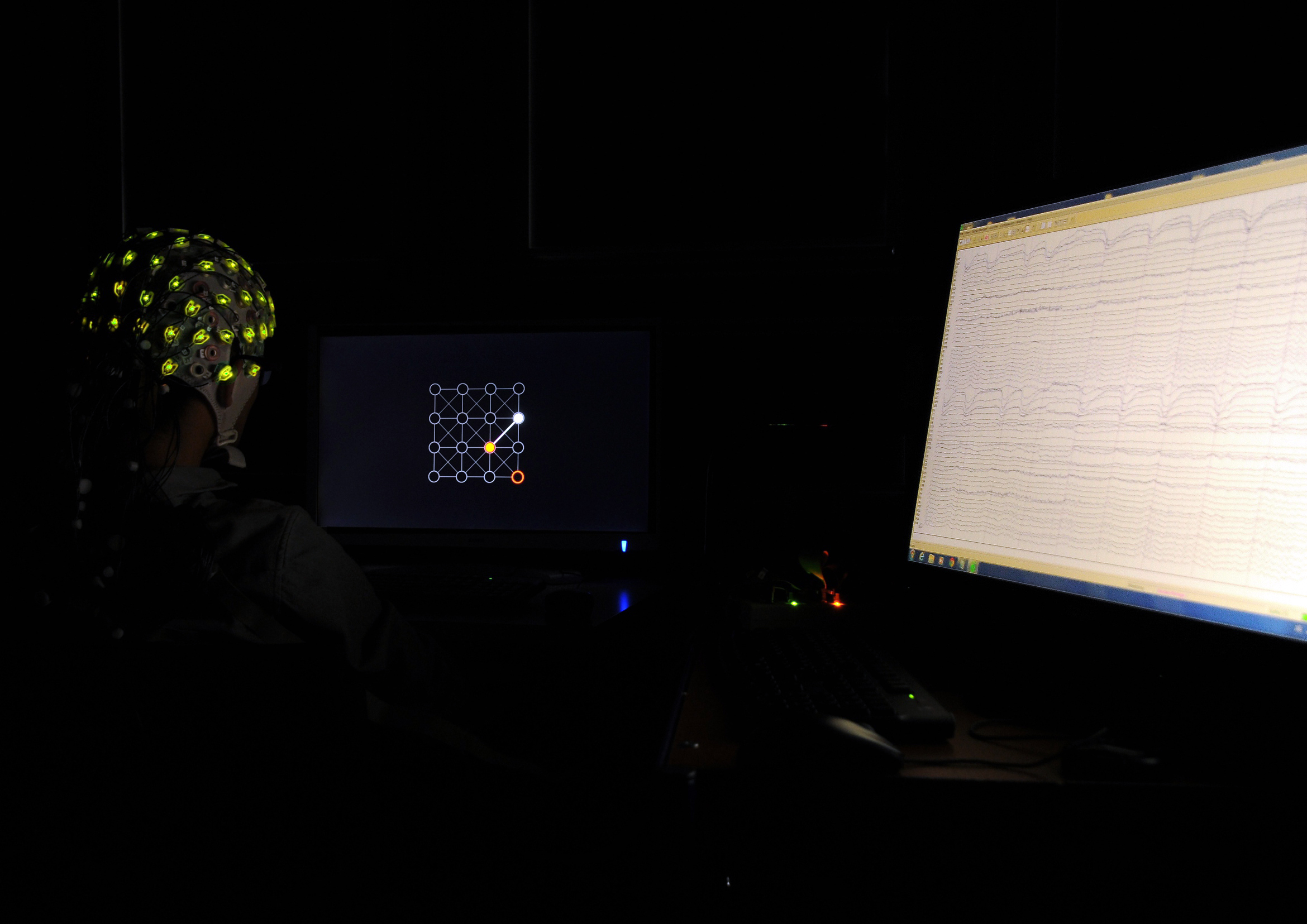
Picture trying to use a mouse that slowly rewires itself while you work. On Monday a flick of the wrist lands the cursor where you want it. By Friday the same motion drifts wide, and by the next week the thing barely obeys. That is roughly the daily reality of an intracortical brain-computer interface. Tiny electrodes read neural activity from the motor cortex, and a decoder turns that activity into cursor movement. But the signals those electrodes pick up shift from day to day, so the decoder needs to be retrained again and again. Every retraining session is time the user spends not using their device.
A team led by Guy H. Wilson at Stanford and collaborators at Brown University, the Providence VA, and Massachusetts General Hospital went after that problem. Their paper in Nature Biomedical Engineering describes a way for the interface to recalibrate itself without a supervised setup step, and without the user knowing it is happening.
Guessing the target instead of asking for it
Standard recalibration usually needs the person to run through a set of known targets so the system can relearn the mapping between brain activity and intended movement. That is the chore the researchers wanted to remove. Their trick rests on a simple observation about how people actually use a cursor: most of the time you are heading toward something specific on the screen, a button, an icon, a spot you want to click.
So the system uses a hidden Markov model to infer which target the user is probably moving toward during ordinary use. Once it has those inferred targets, it retrains the decoder against them. No calibration block, no pause in the workflow. The task itself supplies the training labels. The authors describe this as using task structure to bootstrap a noisy decoder into a reliable one, which is a neat way of saying the interface teaches itself from the work the person is already doing.
They compared this approach against a competing family of methods that try to align the distribution of new neural data to older data. In large-scale closed-loop simulations run over two months, the target-inference method came out ahead. It also held up in a closed loop with an actual human iBCI user over the course of a month, which is the harder and more meaningful test.
Why the long timescale matters
The researchers leaned on an unusually deep archive: an offline dataset spanning five years of iBCI recordings. That let them ask what happens not over a good afternoon but over the kind of stretch a real user would live with. The distribution-matching methods looked fine at first and then went wrong. Small errors fed into the next round of adaptation, which produced slightly worse data, which fed the next round. Over time those compounding errors piled up. The target-inference method avoided that trap and kept working across the long haul.
They also tested it on freeform recordings, a person using a home computer with an iBCI rather than clicking through a tidy experimental grid. It handled that messier, more realistic use offline as well.
What this does not yet settle
Some caution is warranted. The live human test involved one iBCI user over one month, so this is a demonstration of feasibility rather than proof across many people or many years. The method assumes the user is generally aiming for discrete targets, which fits pointing and clicking but says less about continuous or freehand control where there is no clear goal to infer. Simulations, however large, are still simulations, and the two-month figure comes mostly from them. The five-year archive is powerful for asking questions but it is a fixed record, not a live trial. And whether the approach transfers to other kinds of neural decoders, or to interfaces that do more than move a cursor, remains open.
Still, the core idea is worth sitting with. One of the practical barriers to putting these implants into everyday use has been the maintenance burden, the recurring downtime, the sense that the device is high-maintenance in a way that undercuts its promise. A decoder that quietly keeps itself tuned by watching what the person is trying to do chips away at exactly that barrier. It is the unglamorous engineering that tends to decide whether a technology stays in the lab or makes it to someone's kitchen table.
Wilson, G. H. et al. "Long-term unsupervised recalibration of cursor-based intracortical brain-computer interfaces using a hidden Markov model." Nature Biomedical Engineering, 2026. doi.org/10.1038/s41551-025-01536-z
PubMed PMID: 41361599.
Photograph: Laurens R. Krol, CC BY 4.0, via Wikimedia Commons.
Comments