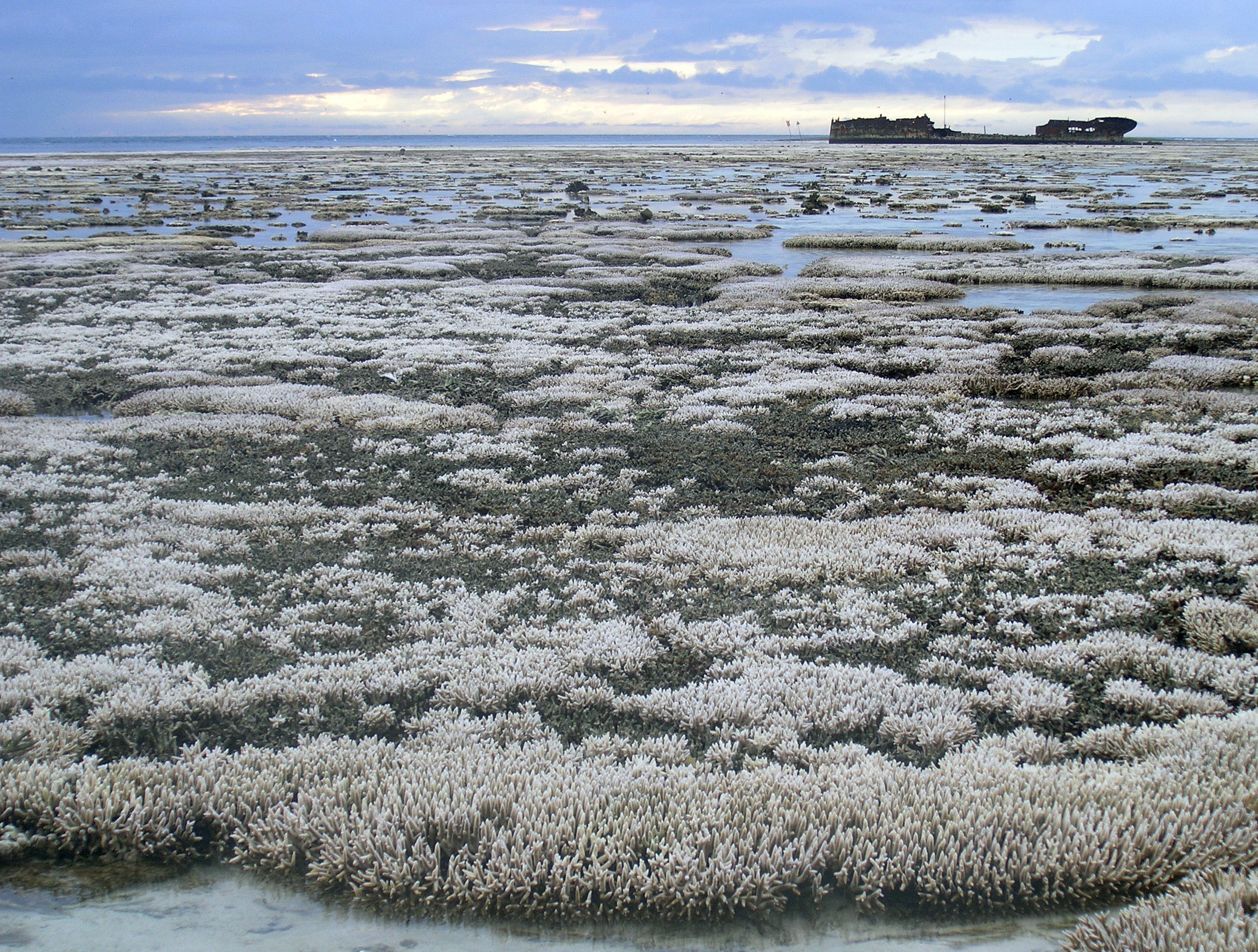
In early 2024, the water around One Tree Reef in the southern Great Barrier Reef got too warm and stayed that way. Corals that had spent decades building their skeletons turned bone white as the heat drove out the algae living inside their tissue. A team from the University of Sydney was there during the worst of it. Instead of surveying the damage once and leaving, they marked 462 individual colonies with tags and came back again and again for nine months to see which ones made it.
The colonies did not fare the same. Some regained their color and kept growing. Others sat pale for months and then died, their skeletons colonized by turf algae. What separated the survivors from the casualties had less to do with the corals themselves than with a plain fact of physics: how fast the water moved past them.
The reef's shape does the sorting
The researchers picked three sites at One Tree Reef that looked different in a way a geologist would notice. One had a wide depth range, from three to five meters, and strong water flow. Two were shallower, sitting between one and three meters. Of those two, one caught the swell rolling in from the open ocean. The other was tucked away where the water barely stirred.
Nine months out, the deep, high-flow site held the most healthy corals. Among the two shallow sites, the one exposed to swell waves came through in better shape, while the sheltered site with almost no wave energy lost a large share of its colonies to death. The pattern held up regardless of how deep a given colony sat, which points the finger at flow rather than depth alone.
The reason seems to come down to temperature at a very local scale. Moving water does not sit still long enough to bake. Flow flushes warm water off the coral surface and pulls cooler water in, shaving the peak heat that a colony actually feels even when the whole region is in a heatwave. It also carries away waste and keeps oxygen moving across the tissue, which matters more when an animal is already stressed. A coral in a calm pocket gets none of that relief.
Body shape mattered too
The team split the corals into two rough groups based on how they meet the water. Simple shapes, like mounding or plating colonies, present a smoother face to the flow. Complex shapes, like the branching staghorn corals that give reefs their tangled architecture, trap water in their thickets.
Both types did better where the flow was stronger. But the simple, smoother colonies were generally more resilient to the heat across the board. That is a bittersweet finding. The branching corals that struggle most are exactly the ones that build the three-dimensional structure fish and invertebrates depend on for shelter. A reef that loses its complex corals and keeps its simple ones is still a reef, but a flatter, emptier one.
What the study can't say yet
This is one reef watched over nine months, not a global verdict. One Tree Reef sits in a research zone that is protected and relatively remote, so the corals there were spared some of the fishing pressure and runoff that hammer reefs closer to shore. Whether the flow effect holds up on a reef already worn down by other stresses is an open question.
Nine months is also a short window for an animal that grows slowly. A colony that looked healthy at the end of the survey could still fail later, and one that looked marginal might recover. The study tracked survival and color, not the harder question of whether these corals will reproduce and reseed the reef. And because the researchers worked with the sites nature handed them, they could not cleanly separate flow from every other thing that varies across a reef, such as light or the particular mix of coral species at each spot.
Why it matters anyway
The value here is practical. Reef managers cannot turn down the ocean's temperature, and coral restoration projects have limited money and limited coral to plant. Knowing that water flow buffers heat gives them something to act on. It suggests planting recovering corals where the reef's geometry keeps water moving, and treating sheltered, stagnant pockets as high-risk ground rather than calm nurseries.
Marine heatwaves are arriving more often and hitting harder. The 2024 event that whitened One Tree Reef was part of the most widespread global bleaching on record. Corals cannot outrun that trend. But this work is a reminder that survival on a warming reef is not evenly distributed, and that the reef's own physical structure is quietly deciding who gets a second chance.
Sources: Meoded-Stern et al. "Reef geomorphology, hydrodynamic energy and coral morphology influence recovery after bleaching." Marine Environmental Research, 2025. doi.org/10.1016/j.marenvres.2025.107554. PubMed PMID: 40972210. Photograph: Oregon State University, CC BY-SA 2.0, via Wikimedia Commons.
Meoded-Stern et al. "Reef geomorphology, hydrodynamic energy and coral morphology influence recovery after bleaching." Marine Environmental Research, 2025. doi.org/10.1016/j.marenvres.2025.107554
PubMed PMID: 40972210.
Photograph: Oregon State University, CC BY-SA 2.0, via Wikimedia Commons.
Comments