


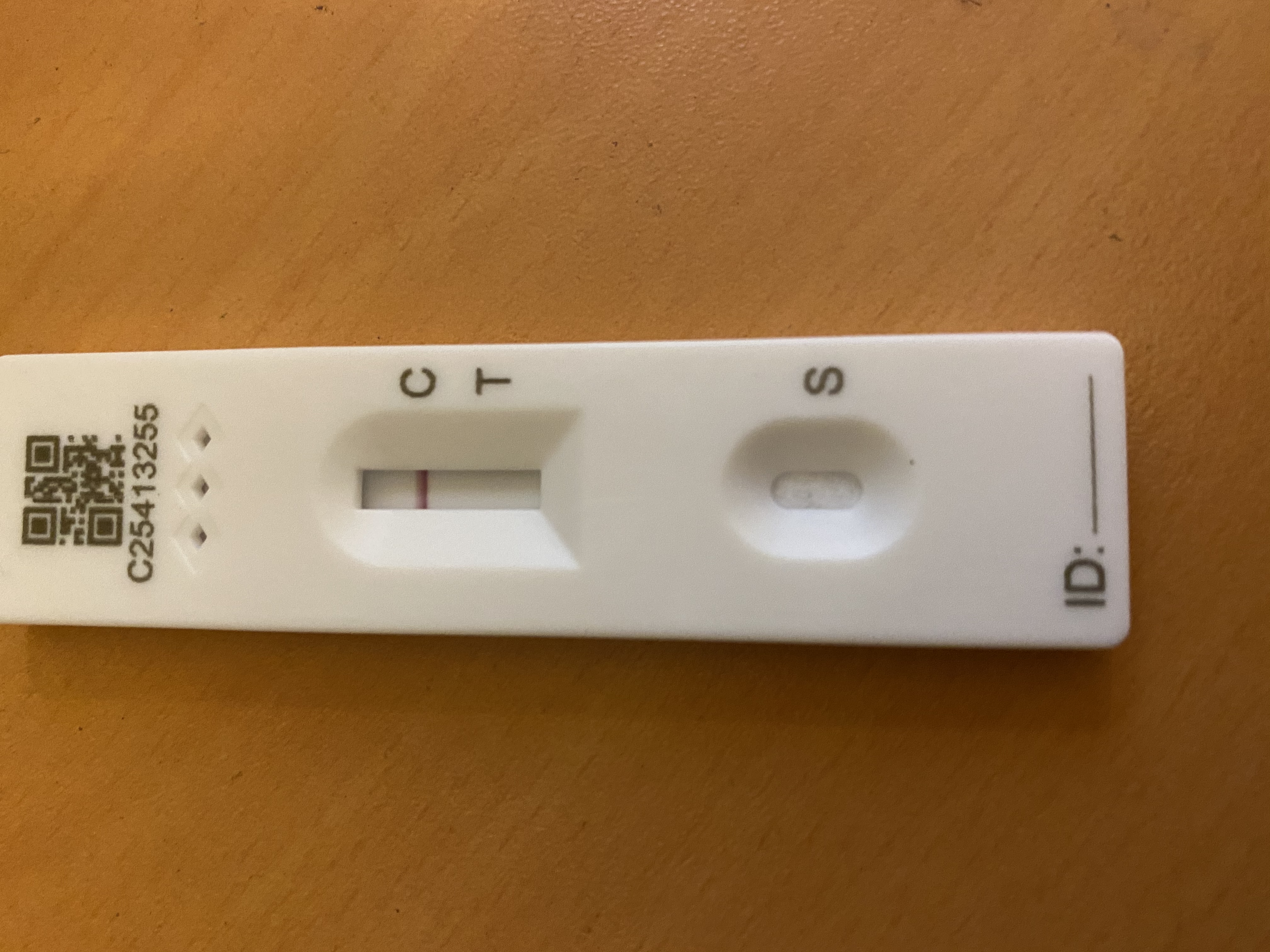
The little plastic cassette on your bathroom shelf has a known weakness. A lateral flow COVID test is fast and cheap, but it stays stubbornly blank for the first day or two of an infection, right when a person is most likely to spread the virus to someone else. That gap between being infectious and testing positive is where the technology has always lost to lab PCR.
A team at University College London tried to close it with an unusual ingredient. Instead of the gold nanoparticles that give a standard test its red line, they built the test around tiny fragments of diamond. Reporting in Nature Communications, they ran a clinical evaluation of the device on 103 upper respiratory tract swab samples and found it flagged infections a mean of two days earlier than a conventional gold-particle test.
Why put a defect in a diamond to work
The diamonds here are nanoscale, and the useful part is a flaw. A nitrogen-vacancy center is a spot where a nitrogen atom sits next to a missing carbon atom in the crystal lattice. That defect glows under light, and crucially its glow can be switched with a magnetic field. The researchers exploit this to strip away background noise. In a messy clinical sample, ordinary fluorescence competes with all the other stuff on the strip. By modulating the diamond's spin-dependent light and reading only the part that flickers in step, the readout ignores the background and picks up much fainter signals.
That sensitivity is what buys the early detection. Being able to see fewer viral antigens means the line can appear when the amount of virus in the nose is still low, which is exactly the early-infection window.
What the numbers actually showed
Benchmarked against RT-qPCR, the reference lab method, the nanodiamond test hit 95.1% sensitivity for samples with a cycle threshold of 30 or below, meaning it caught the large majority of genuine positives with a reasonable viral load. Specificity was 100%, so no false alarms in this sample set. It did not cross-react with influenza A, RSV, or rhinovirus, which matters because a test that lights up for the wrong respiratory bug is worse than useless during a busy winter.
The timing results are the headline. Modelling with patient data, the diamond test detected infections a mean of 2.0 days earlier than a conventional gold-nanoparticle test. It landed just 0.6 days behind RT-qPCR, and it caught 2.2-fold more patients on the very first day symptoms appeared. For a disease where a single early positive can change whether someone isolates, that first-day margin is the whole point.
The distance between a study and a shelf
This was a focused clinical evaluation, not a mass rollout. One hundred and three samples is enough to be encouraging and not enough to settle the question of how the test behaves across ages, variants, and the range of sample quality you get from real-world self-swabbing. The 95.1% sensitivity figure applies to samples with meaningful viral loads; performance on the faintest positives is a separate matter. And the two-day advantage comes partly from modelling patient trajectories rather than watching every case unfold in real time.
There is also the practical hurdle every quantum-enhanced device faces. Reading spin-dependent fluorescence needs a reader, and the value of this approach depends on making that reader cheap, small, and simple enough to sit next to a stack of cassettes in a clinic or pharmacy. The authors frame the work as evidence that spin-enhanced diamond labels can survive contact with the variable, protein-laden reality of clinical swabs, which earlier work had mostly dodged by using clean model systems.
Still, the direction is worth watching. Lateral flow tests are among the most successful diagnostic formats ever deployed, precisely because they are dumb and disposable. Bolting a quantum sensor onto that format, and getting lab-PCR timing out of a strip you read at home, would be a genuine shift in what a rapid test can promise. Two days sooner is not a rounding error when the clock is measured in transmission.
Thomas DeCruz, A. et al. "Quantum-enhanced nanodiamond rapid test advances early SARS-CoV-2 antigen detection in clinical diagnostics." Nature Communications, 2025. doi.org/10.1038/s41467-025-63066-1
PubMed PMID: 41038811.
Photograph: Secretlondon, CC BY-SA 4.0, via Wikimedia Commons.
Comments