

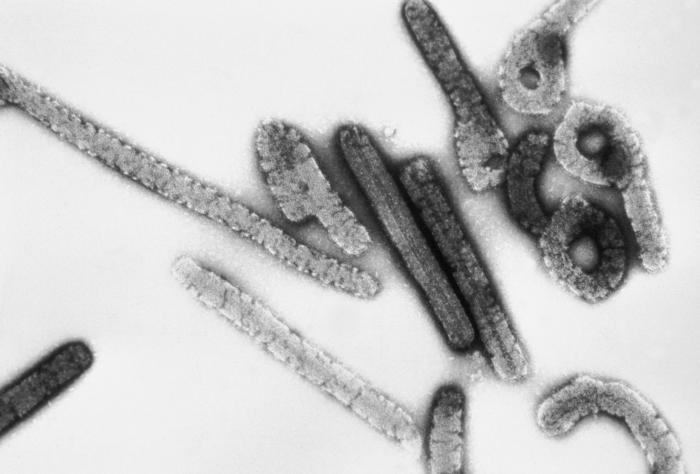
Marburg virus is the kind of pathogen that empties hospital wards. It belongs to the same family as Ebola, it triggers the same catastrophic hemorrhagic fever, and in some outbreaks it has killed close to nine of every ten people it infects. Outbreaks are getting more frequent. Rwanda saw its first in 2024, Tanzania and Equatorial Guinea in the years before that. And through all of it, doctors have had nothing licensed to give: no vaccine, no antiviral, no antibody. Care means fluids and hope.
A team led by Amin Addetia at the University of Washington, working with the antibody company Humabs Biomed, has now described a molecule that could change that math. Writing in Nature, they report a fully human antibody called MARV16 that neutralizes every known isolate of Marburg virus, plus two related filoviruses, and kept infected guinea pigs alive when given as a treatment.
Locking the machinery before it fires
Every filovirus carries a single protein on its surface that does the work of breaking into a cell. It is called the glycoprotein, or GP, and it is the only part of the virus that neutralizing antibodies and vaccines can grab onto. GP starts folded in a tense, spring-loaded shape. When the virus reaches the right spot inside a cell, that spring releases, the protein snaps into a new conformation, and the viral and cellular membranes fuse. That is the moment infection begins.
The researchers first re-engineered the GP itself, adding mutations that made it express better, hold its shape at higher temperatures, and provoke a stronger immune response. Then they went hunting for antibodies against it. MARV16 was the standout. Using cryogenic electron microscopy, the team froze the antibody clamped onto GP and mapped exactly where it binds. It grips a seam that runs across both halves of the protein, GP1 and GP2, at a spot that only exists in the pre-release shape. By holding that seam shut, MARV16 does two things at once. It blocks the virus from attaching to its receptor, and it jams the shape-shift that fusion depends on.
Broad and hard to escape
Breadth is what makes this antibody interesting. Filoviruses mutate, and outbreak strains are not identical. MARV16 neutralized all Marburg isolates the team tested, along with Ravn virus and the recently identified Dehong virus, with roughly 40 to 100 times the potency of previously described antibodies. That is a large jump.
Then there is the problem of resistance. A virus under pressure from a single antibody tends to find a mutation that shrugs it off. The team's answer was to pair MARV16 with a second antibody that hits a different part of the receptor-binding site. The two bind GP at the same time without getting in each other's way. To escape both at once, the virus needed multiple mutations, not just one. That kind of cocktail is much harder for viral evolution to defeat, which is the whole point of designing it that way.
Along the way the researchers also worked out the structure of the GP glycan cap, the sugar-coated lid that normally shields the receptor-binding site from the immune system. They found it shares architectural features with more distantly related filoviruses, a clue that could help design antibodies and vaccines aiming at several of these viruses at once.
What the guinea pigs can and cannot tell us
The therapeutic result came from guinea pigs, which were given MARV16 after being challenged with Marburg virus and survived. That is a meaningful signal, but it is worth being plain about the distance still to cover. Guinea pigs are not people, and rodent models of filovirus disease do not always predict what happens in primates or humans. The antibody has not been through the nonhuman primate studies that usually precede human trials, and it has not been tested in anyone. The glycoprotein redesign and the structural maps are laboratory findings, valuable for the next stage of design rather than proof of a working drug.
What the work does deliver is a clear target and a clear tool. A broadly neutralizing human antibody, a structural picture of exactly how it disarms the virus, and a two-antibody strategy built to stay ahead of mutation. For a disease that has had essentially no medical countermeasures, that is a real place to start.
Addetia, A. et al. "Potent neutralization of Marburg virus by a vaccine-elicited antibody." Nature, 2025. doi.org/10.1038/s41586-025-09868-1
PubMed PMID: 41225006.
Photograph: CDC/Dr. Erskine Palmer, Russell Regnery, Ph.D., Public domain, via Wikimedia Commons.
Comments