

Walk out onto a tropical mudflat at low tide and you will see mangroves doing something quietly heroic. They stand in salt water, sink their roots into soft sediment, and slow the tides that would otherwise carry that sediment away. Coastal engineers have started calling this a "nature-based" flood defense. But a study published this week in Water Research makes a point that often gets lost in the enthusiasm. Not every mangrove pulls the same weight.
A team led by Alice Twomey at the University of Queensland modelled how the physical structure of mangrove forests changes the way water moves near the seafloor, then checked those predictions against a global dataset of measured sediment build-up. The three genera they compared are the ones you find on the seaward edge of mangrove forests worldwide: Avicennia, Rhizophora, and Sonneratia. Same habitat, same job description. Very different results.
Why the mud stays put
The key number in the study is bed shear stress. That is the drag force water exerts on the sediment surface as it flows past. When shear stress is high, mud gets picked up and swept off. When roots and stems break up the flow and drop that stress, particles settle out and stay. Over years, that settling is what lets a mangrove floor rise.
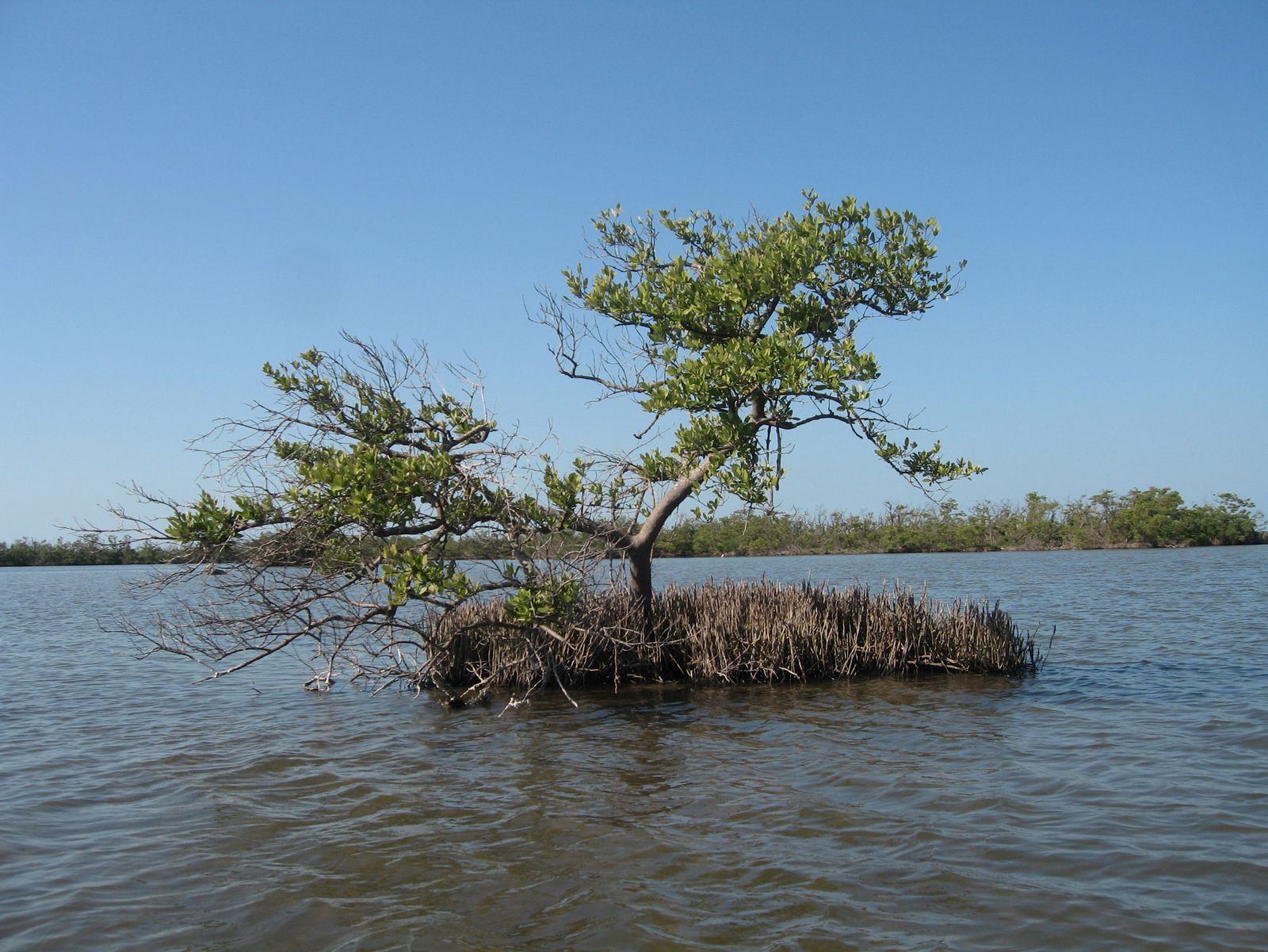
Of the three genera, Avicennia reduced bed shear stress the most, and so it promoted the highest levels of sediment accretion. Its advantage came down to a specific feature. Avicennia sends up pencil-like breathing roots, called pneumatophores, that poke straight out of the mud in dense clusters. The researchers found that the reduction in shear stress, and therefore the amount of sediment trapped, was strongly tied to the surface area of those roots while they sat underwater. More root surface in the water meant more drag on the flow and more mud left behind. The effect also grew with tree density, so a thicker Avicennia stand traps more than a sparse one.
Keeping pace with a rising sea
This is not an academic distinction. As sea level climbs, a mangrove forest survives only if its floor can build upward fast enough to stay in the tidal zone it needs. Fall behind, and the forest drowns. Sediment accretion is the mechanism that lets a mangrove keep up, which is why the authors care so much about which trees do it best.
Most previous work on mangroves and coastal protection focused on wave attenuation, how the forest knocks down incoming wave energy. That matters for storm surge. But the authors argue that sediment accretion is the piece that determines whether the forest is still there in fifty years. Their finding reframes biodiversity as something with an engineering payoff. The mix of species on a coast is not just a conservation nicety. It helps decide how resilient that coast will be.
What the model can and cannot tell us
The results come from a hydrodynamic model tested against field measurements, not from an experiment where the authors planted competing genera side by side and watched the mud accumulate. Models simplify. The link between root surface area and accretion, though strong overall, varied by climate zone, which means a rule that holds on an Australian coast may not transfer cleanly to a colder or wetter one. The study also compares genera, not the many individual species within them, and real mangrove forests are mixtures rather than tidy single-genus stands. So the practical takeaway is directional, not a planting recipe.
Still, the direction is useful. Restoration projects around the world are racing to put mangroves back as cheap coastal defenses, and planners often reach for whatever seedlings are easiest to source. This work suggests that the choice of genus is a lever worth pulling on purpose. If the goal is a shoreline that can rise with the sea, a dense stand of the right breathing-root species may buy more time than a thicker forest of the wrong one.
Twomey, A. et al. "Mangrove genera influence bed shear stress and coastal protection ecosystem services." Water Research, 2026. doi.org/10.1016/j.watres.2026.126000
PubMed PMID: 42134215.
Photograph: Andrewtappert, CC BY-SA 3.0, via Wikimedia Commons.
Comments