

The dream of using living bacteria as medicine has a stubborn problem. If you engineer a microbe to make a drug and put it inside a patient, sooner or later some of those bacteria escape into places they should not go. That risk has kept a whole class of "living therapeutics" out of the clinic. A team at Harvard now says it has a way to keep the bugs where they belong, and to make them useful while they are there.
The work, published this week in Science, describes an implantable material that seals engineered bacteria inside a tough gel. The microbes keep working from within, sensing their surroundings and pumping out a therapeutic payload, but they cannot get out. In the researchers' tests the containment held for six months.
Stiff enough to cage them, tough enough not to crack
The key is a hydrogel scaffold built with two mechanical properties that usually pull in opposite directions. It is stiff, which physically limits how much the bacteria can proliferate and pushes back against their attempts to expand and break free. It is also tough, meaning it resists fracturing when the body squeezes, bends, and loads it.
That second property matters more than it might sound. Earlier attempts at physical containment tended to fail because the material eventually cracked under everyday physiological stress, and once a crack opens, the bacteria pour through it. The Harvard gel withstood several forms of mechanical loading that the authors say would have caused catastrophic failure in a weaker material. Complete containment lasted the full six months of testing.
Encapsulation on its own is not new. What makes this design a piece of synthetic biology rather than just clever materials science is what the bacteria were engineered to do inside the cage.
Bacteria that read the room and respond
The researchers rewired the embedded microbes so the material could sense its environment and release a drug only when needed. Instead of a passive implant dribbling out medicine on a fixed schedule, this one behaves more like a sensor wired to a valve. When the surroundings change in the right way, the bacteria switch on and produce their payload.
To show it could do real work, the team turned to a hard target: prosthetic joint infection in mice. These infections form around implanted hardware, resist antibiotics, and are a genuine headache in orthopedic medicine. The living material sensed the infection and released its therapeutic on demand, treating the mice without a doctor triggering each dose. The authors describe it as autonomous treatment, and that word is doing a lot of the work here. The system acted on its own signal, from inside a sealed compartment, over an extended period.
Put together, the pieces point at a general platform. The gel is the containment. The engineered bacteria are the programmable part. Swap in microbes tuned to sense a different cue or make a different molecule, and in principle the same architecture could go after other targets.
What this does not yet prove
This is a mouse study, and a proof of concept. A prosthetic joint infection model in mice is a long way from a human implant that has to survive years, not months, of wear. Six months of containment is a strong result, but human devices are expected to last far longer, and the paper does not show what happens after that window. The work also demonstrates one disease model. Whether the same design holds up for other payloads, other sites in the body, and the messier reality of human immune responses is an open question. And an implant that must be surgically placed carries its own risks and costs that a lab test cannot capture.
Still, the escape problem has been the thing standing in the way. If a material can genuinely keep engineered bacteria confined for months while letting them do useful, responsive work, it removes one of the biggest objections to putting living cells to work as long-term medicine. The authors have shown the cage can hold and the tenant can still earn its keep. The next question is how far that idea travels.
Harimoto, T. et al. "Implantable living materials autonomously deliver therapeutics using contained engineered bacteria." Science, 2026. doi.org/10.1126/science.aec2071
PubMed PMID: 42133778.
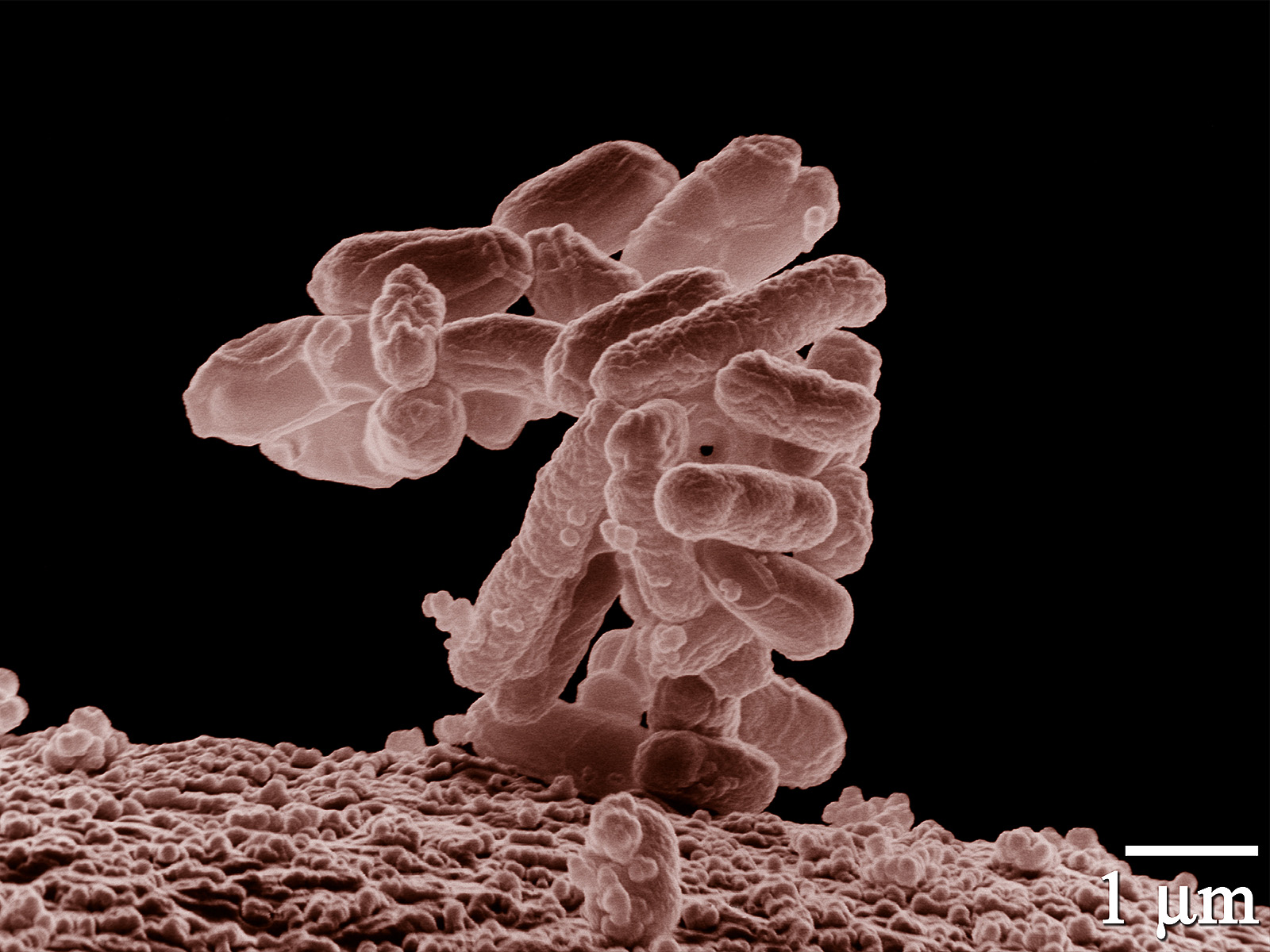
Photograph: Eric Erbe, digital colorization by Christopher Pooley, both of USDA, ARS, EMU, Public domain, via Wikimedia Commons.
Comments