


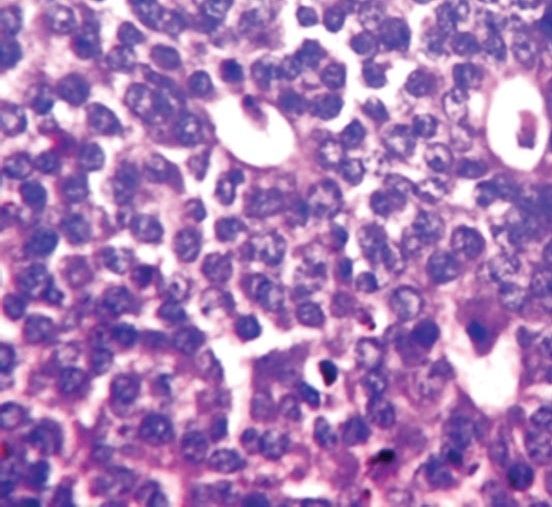
A needle biopsy grabs a sliver of tumor. Maybe a few millimeters of tissue, from one spot the radiologist could reach. Then a pathologist stains that sliver and decides whether the cancer is HER2-positive, a label that steers the whole treatment plan. The problem is that breast tumors are not uniform. One region can look HER2-positive while the tissue a centimeter away tells a different story. Sample the wrong corner and the answer is wrong.
A team led by Jiadong Zhang at ShanghaiTech University built a model that sidesteps the needle entirely. Their system, published in Nature Biomedical Engineering, reads a patient's routine pretreatment images and predicts HER2 status from the tumor as a whole rather than from a single core.
What the model actually looks at
The tool is called HER2 MAP, short for multimodal alignment and prediction. The word multimodal is doing real work here. Instead of one image type, the model pulls together several kinds of breast imaging taken before treatment and lines them up so it can read the same tumor from different angles. That is the alignment step. The prediction step then estimates whether the cancer is HER2-positive.
The logic is straightforward. A biopsy sees a pinhole. Imaging sees the entire mass, including the heterogeneity that trips up needle sampling. If the model can learn which imaging patterns track with HER2 biology, it gets a reading of the whole tumor instead of one lucky or unlucky core.
The researchers trained and tested HER2 MAP on a large dataset. It covered 14,472 images from 6,991 cases, pulled from four different medical centers. Spreading the data across four sites matters, because a model that only works on scans from one hospital's machines is close to useless everywhere else.
Beating the needle at its own job
The real test was not just matching biopsy. It was predicting what patients care about: whether the treatment works. The team built patient-response versions of the model and checked them against needle biopsies in people receiving neoadjuvant therapy, the drug treatment given before surgery to shrink a tumor.
Across the dataset, the model's HER2 predictions outperformed the needle biopsies at forecasting who would respond. The authors frame it as a decision-support tool. A physician still runs the case, but now there is a whole-tumor readout to weigh alongside the traditional pathology, and in this study that readout was the better predictor of response.
That is a meaningful shift. HER2 status is not a footnote in breast cancer. It decides whether a patient is a candidate for HER2-targeted drugs, an expensive and consequential branch of therapy. Get the classification wrong and you either withhold a drug that would have helped or give one that will not.
What to hold in reserve
A few things temper the enthusiasm. This is a retrospective study on existing images, not a prospective trial where the model guided real decisions and patients were followed forward. Beating biopsy at predicting response in a curated dataset is not the same as beating it in a live clinic, where image quality varies and edge cases pile up. Four centers is a solid spread, but all appear to be within one research network's reach, so performance on scanners and populations elsewhere is still an open question. And a model that predicts response well does not automatically explain why, which makes some clinicians reasonably cautious about trusting it over a physical sample.
Regulators will also want to know how the tool behaves when it is wrong. A confident but incorrect HER2 call could do damage precisely because it looks authoritative. None of this sinks the result. It just means the honest read is that HER2 MAP is a strong proof of concept for reading tumors without a needle, not a finished replacement for one.
Still, the direction is worth watching. The needle biopsy has been the gatekeeper for HER2 status for decades, and its blind spot has always been the same: it can only report on the tissue it happens to catch. A model that reads the whole tumor from images the patient already has does not have that blind spot. Whether it earns a place in the clinic will come down to the prospective work that has to follow.
Zhang, J. et al. "Deep-learning-based HER2 status assessment from multimodal breast cancer data predicts neoadjuvant therapy response." Nature Biomedical Engineering, 2025. doi.org/10.1038/s41551-025-01495-5
PubMed PMID: 41107520.
Photograph: Preethi Sekar et al., CC BY 3.0, via Wikimedia Commons.
Comments